

India is at a crucial point in its energy journey. With about 389.42 billion tonnes of coal resources, including 47.3 billion tonnes of lignite, the country ranks fifth in the world for coal reserves. It set a record by producing 1.047 billion tonnes in FY 2024-25. However, this wealth has a major weakness: India imports 85-89% of its crude oil. This dependence leaves the economy vulnerable to geopolitical events, results in annual foreign exchange outflows exceeding USD 100 billion, and creates problems for transport and petrochemical supply chains.
Sustainable coal use in India must move beyond the unrestrained growth of conventional combustion. It requires a deliberate shift towards processes such as beneficiation and washing, mine-mouth power generation, and industrial heating. Other key methods include entrained-flow gasification, Indirect Coal Liquefaction (ICL) with Fischer-Tropsch synthesis, and Coal-to-Chemicals (CTC) co-production of methanol, ammonia, urea, and DME. We also need to focus on Carbon Capture, Utilisation, and Storage (CCUS) clusters and on circular fuel substitution using alternatives such as RDF, biomass, industrial waste, and plastic thermolysis. This approach will help free up high-value coal for strategic conversion.
Key Findings from Techno-Economic and Global Analysis
The Ten-Point Problem Statement (synthesised from the prompt and validated against technical annexes):
- Low Coal Quality and Non-Coking Dominance: The vast majority of reserves are thermal (non-coking) grades, unsuitable for metallurgy without blending; high moisture and variable GCV (2,500–6,500 kcal/kg) reduce combustion efficiency.
- High Ash and Contaminants (25–45% Ash Typical): Renders direct combustion inefficient and polluting; increases handling, boiler maintenance, and ash disposal burdens; yet this very characteristic favours entrained-flow gasification with slagging systems, where impurities can be managed pre-combustion.
- Regional Underdevelopment in Coal Belts: Jharkhand (26.4% reserves, ~83 Bt), Odisha (~25%, ~79 Bt), and Chhattisgarh (~18%, ~57 Bt) together dominate, yet these states exhibit lower HDI, higher multidimensional poverty, a history of insurgency (e.g., Left-Wing Extremism corridors), and weaker institutional capacity—creating risks of leakage, illegal mining, and social instability.
- Freight Congestion and Long-Haul Inefficiency: The majority of coal mined in the east and central belts is transported 1,000–2,000+ km to western, northern, and southern demand centres; this ties up dedicated rail capacity, inflates logistics costs, and generates dust and spillage externalities.
- Petroleum Import Vulnerability: 85–89% dependence on crude imports creates exposure to price volatility (e.g., the 2022 spikes), supplier concentration risks, and strategic chokepoints; synthetic fuels from domestic coal offer a partial but meaningful hedge.
- Leakage-Prone Logistics and Governance Gaps: Pilferage, theft, grade manipulation, and illegal extraction are estimated to account for several per cent of production; weak digital traceability and enforcement in remote mining areas.
- Climate Pressure and Decarbonisation Commitments: Coal remains indispensable in the medium term, yet India’s Net Zero 2070 pledge, updated NDCs, and international scrutiny (G7, COP processes) demand measurable reductions in emission intensity; unabated CTL would be incompatible without CCUS.
- Governance Fragmentation: The coal value chain spans the Ministry of Coal (mining), Power (generation), Petroleum & Natural Gas (fuels/fertilisers), Steel (metallurgical), Chemicals & Fertilisers, Railways (logistics), Environment (clearances/CCUS), and Finance (fiscal instruments)—no single coordinating mechanism exists for integrated conversion pathways.
- Underused Waste-to-Energy and Circular Substitution: Industrial by-products (oil sludge, PET waste, paper rejects, rubber dust, biomass) offer 100–200 Mt of coal-equivalent displacement potential annually; the cement sector’s Thermal Substitution Rate (TSR) averages only 5–7% (top plants 25–30%), compared with EU benchmarks of >50–100% in leading facilities; CPCB guidelines (2016/2023) exist, but enforcement and scale-up lag.
- Need for Mine-Mouth Integrated Thermal and Gasification Development: The current paradigm of raw-coal evacuation to distant end-users is economically and strategically suboptimal; pithead power, gasification, ICL, ammonia-urea, methanol, and materials clusters co-located with mines can convert low-grade coal into transportable, higher-value products while generating local employment and reducing rail burden.
These ten issues are not merely technical; they are structural and institutional. Addressing them requires a paradigm shift from volume maximisation (more tonnes mined and transported) to value maximisation (the highest strategic use of each tonne: coking for steel, washed thermal for efficient power, low-grade/high-ash for gasification/CTL/CCUS, and substitutes for substitutable industrial heat). ICL is preferred over Direct Coal Liquefaction (DCL) in India because it offers greater flexibility for handling high-ash domestic feedstock. It allows easier removal of impurities, including sulphur, mercury, and particulates. Additionally, it integrates well with pre-combustion CCUS and enables the co-production of high-value chemicals and fertilisers. Energy efficiency ranges from 45 to 55 per cent, with a liquid yield of 1.1 to 1.3 barrels of synfuel per tonne of coal.
Regarding economies of scale, the optimal plant size ranges from 50,000 to 100,000 barrels per day (bpd). The estimated capital expenditure is between USD 6 and 9 billion, including CCUS. The breakeven oil price is between USD 70 and 100 per barrel and depends on co-product credits and carbon pricing. With CCUS, lifecycle emissions decrease from around 900 kg CO₂ per barrel to between 250 and 350 kg CO₂ per barrel, representing a reduction of 60 to 90 per cent. Water is a significant constraint. The process uses 8 to 12 barrels of water for each barrel of synfuel, necessitating zero-liquid discharge (ZLD), mine-water utilisation, and closed-loop recycling as essential practices. There is considerable potential for import substitution. Large-scale deployment of ICL/CTC in the eastern and central coal belts could replace 10 to 15 per cent of oil imports by 2035, equivalent to about 35 to 50 million tonnes of crude equivalent annually. This shift can also help create strategic synthetic fuel reserves for defence, aviation, and crisis resilience.
The 2026 Fertiliser Crisis: A Frozen Price and an Exploding Bill
In April–May 2026, as the Strait of Hormuz effectively closed amid geopolitical tensions, Indian Potash Limited secured the largest urea tender in the country’s history, at nearly double the price of two months earlier. Diammonium phosphate (DAP) tenders followed at record landed costs. Yet in a Vidarbha fertiliser shop, the 45-kg bag of urea continued to sell for ₹242 — the same price it has been at since 1 April 2018.
India pays roughly ₹ 3,600 to land that bag at the port. The farmer pays ₹ 242. The ₹ 3,358 gap, scaled across ~35 million tonnes of annual urea consumption, is the central operating principle of Indian fertiliser policy. The result: a projected FY27 subsidy bill exceeding ₹ 2 lakh crore — the highest peacetime outgo in the instrument’s history — even before the full impact of disrupted imports and domestic gas curtailments (a 25% drop in March 2026) is felt.
This is not merely a fiscal problem. It is a structural vulnerability: heavy dependence on imported urea, ammonia, and natural gas feedstock, exposed to every chokepoint from Hormuz to Red Sea disruptions. The policy of absorbing every global price spike on the exchequer to protect the farmer has worked — but at mounting and ultimately unsustainable cost.
The Coal Opportunity: From Volume to Value
India holds 389 billion tonnes of coal resources, including vast high-ash thermal grades (25–45% ash) that are suboptimal for long-haul power generation but ideally suited for modern entrained-flow gasification. The May 2026 policy research paper, Sustainable Coal Application for Energy Security and Petroleum Import Substitution (Basu, Bhandarkar & Sahu), provides a rigorous techno-economic and governance framework to convert this endowment into a strategic asset — specifically for the fertiliser sector.
The core mechanism is straightforward and already proven at pilot scale in India: Coal (high-ash, mine-mouth) → Gasification (oxygen/steam → syngas: CO + HJ) → Ammonia synthesis → Urea production. This is not speculative. The Talcher Fertiliser Ltd project in Odisha (coal/petcoke gasification to urea, methanol, and SNG) is under construction and represents India’s flagship demonstration. Scaling this model across mine-mouth clusters in Talcher-Ib Valley, Korba-Raigarh, and Jharia-Bokaro directly attacks the import dependence and price volatility that define the current crisis.
How Gasification Directly Solves the Four Core Problems of the 2026 Crisis
- Import Dependence & Forex Outflow. India’s fertiliser vulnerability is largely an ammonia and urea import problem, compounded by natural gas feedstock risk. Coal gasification produces syngas domestically, enabling on-site or nearby ammonia-urea production. The coal paper quantifies that scaled ICL/CTC deployment (with co-production of ammonia/urea) can deliver meaningful substitution — reducing the need for imported merchant ammonia and finished urea. Every tonne of coal converted to urea at the mine-mouth displaces a tonne of imported urea or ammonia, directly easing the current account and insulating against Hormuz-style shocks.
- Domestic Production Resilience. The March 2026 gas curtailment, which cut domestic urea output by 25%, would have been far less damaging if a meaningful share of ammonia synthesis had shifted to coal-derived syngas. Mine-mouth plants are not hostage to pipeline gas allocation priorities. They create a parallel, coal-based production backbone that complements gas-based plants and, over time, reduces pressure on them.
- Long-Term Subsidy Trajectory. The current system is a ratchet: global prices rise → subsidy bill explodes → MRP stays frozen. Coal-based urea has a different cost structure. While initial capex for gasification and ammonia-urea complexes is high (USD 6–9+ billion for large integrated plants), marginal costs are tied to domestic coal (stable, allocated under policy) rather than to volatile imported spot urea or LNG. Over time, as more supply shifts to this controlled-cost base, the average subsidy per bag declines — even if the printed MRP remains politically frozen. The coal paper’s emphasis on co-production (urea + methanol + power + chemicals) further improves project economics and reduces the net fiscal burden per unit of fertiliser output.
- Regional Development & Political Sustainability. The fertiliser subsidy is politically untouchable because it protects 14 crore landholdings. But the coal paper adds a powerful pro-coal constituency: the coal-bearing districts of eastern and central India (Jharkhand, Odisha, Chhattisgarh). Mine-mouth clusters create formal, skilled jobs in gasification, ammonia synthesis, CCUS operations, and ancillary industries — precisely in regions with histories of underdevelopment and insurgency. A credible just-transition framework (community equity, skilling, local content) turns potential opposition into stakeholder support, making the overall policy coalition more durable than one based solely on subsidy absorption.
Policy Architecture Proposed
- Establish a National Sustainable Coal and Carbon Conversion Mission under the Cabinet Secretariat/PMO, coordinating the Ministries of Coal, Petroleum & Natural Gas, Power, Steel, Chemicals & Fertilisers, Railways, Environment, Forest & Climate Change, and Finance.
- Create a Technical Standards Council (BHEL, CIL, GAIL, NTPC, SAIL, IOC, CIMFR, academic labs) to standardise gasifier/CTL modules, adapt to high-ash coal, and develop CCUS protocols.
- Designate integrated coal-conversion industrial regions (Talcher-Ib Valley, Korba-Raigarh, Jharia-Bokaro corridors) with fast-track clearances tied to strict environmental performance bonds.
- Deploy policy instruments: Viability Gap Funding (VGF) and concessional sovereign debt for first-of-a-kind ICL+CCUS plants; revenue-share rebates and feedstock allocation priority for gasification/CTL coal; carbon contracts for difference (CCfD) or equivalent for CCUS outperformers; mandatory ZLD, methane monitoring, and digital traceability; and freight pricing reform reflecting the full system costs of long-haul raw coal.
Phased Roadmap
Phase I (2026–2030). Establish 3 to 5 major mining clusters at the mines. These clusters will ensure that the minerals are properly processed and digitally tracked. Also, use waste materials and biomass in cement and heat production, aiming for 15 to 20% of energy to come from these sources. A technical council and a special mission will also be launched.
Phase II (2030 to 2040). Focus on establishing carbon capture and utilisation projects across regions. This involves transporting and storing CO₂, using it for coal-bed methane recovery, storing it in saline aquifers, and converting it into minerals. Also, build networks to transport methanol, syngas and synthetic fuels. The use of these products in key sectors such as defence, railways and fertilisers could be supported by the government.
Phase III (2040 to 2050). Set carbon limits for the entire production lifecycle (less than 200 kg of CO₂ per barrel equivalent) and ensure that biomass is co-fed and that renewable hydrogen is used in production. Integrate the above with the National Hydrogen Mission and review progress going forward.
Projected Outcomes by 2035 (under supportive policy)
10–15% oil import substitution; 50–80 Mt coal redirected to high-value gasification/CTL; 200,000+ skilled jobs in coal districts; 60–90% emission intensity reduction in conversion pathways; strengthened energy sovereignty and balance-of-payments resilience.
This paper provides the evidence base, international comparative analysis, and actionable ministry-level implementation framework to transform India’s coal endowment from a source of vulnerability into a strategic asset for energy security, industrial competitiveness, and an orderly transition to Net Zero 2070.
Global Benchmarks and Lessons from Leading CTL and Clean Coal Nations
India is not operating in isolation. Global experience provides both proof of concept and cautionary lessons for CTL/CCUS deployment at scale.
China
The Shenhua Ningxia CTL Complex, the world’s largest integrated facility, is located at the Ningdong Energy and Chemical Industry Base in Yinchuan, Ningxia Hui Autonomous Region (arid northwest; water-stressed context analogous to parts of India’s coal belts). The scale and investment are as follows:
- Total complex: ~235,000 bpd liquid fuels (Phase I DCL ~24,000 bpd; Phases II/III ICL ~210,000 bpd).
- Coal input: >20 Mt/year. – Investment: ~USD 7.9 billion (state-backed). – Products: 2.7 Mt diesel, 0.98 Mt naphtha, 0.34 Mt LPG + by-products (sulfur, ammonium sulfate, mixed alcohols). – Efficiency: ~42% coal-to-liquids conversion.
Technology & Environmental Controls:
- Hybrid: Initial DCL (Shenhua proprietary, iron-based catalyst, 460°C/190 bar) + massive ICL (Siemens/MAN syngas coolers + Chinese HTFT).
- Zero Liquid Discharge (ZLD): Aquatech system recycles >55 million litres/day; critical for arid locations.
- CCUS Demonstration: Captures portion of concentrated process CO₂ for EOR in nearby fields; full-scale pilots advancing. Lifecycle CO₂ ~7.95 t/t product (base) → ~4.5 t/t (with CCS).
- Emission controls: Advanced particulate, SOx, NOx; vitrified slag utilised in construction.
- Economics: Breakeven USD 60–80/bbl (lower than generic estimates due to vertical integration—owns mines—economies of scale, and by-product revenue). State strategic priority overrides pure merchant economics.
Lessons for India: Scale matters: 100k+ bpd plants achieve competitive unit costs. – ICL route dominates expansion (feedstock flexibility for high-ash Chinese coals mirrors India). ZLD and CCUS are non-negotiable for social license and policy support in water-stressed, climate-conscious jurisdictions. The national energy security imperative (China imports ~70%+ of its crude) justifies sovereign financing and fast-track approvals. India’s Talcher and similar projects can replicate Ningxia’s integrated model (gasification + urea/methanol + future ICL liquids + CCUS).
South Africa
Sasol Secunda is the longest-operating commercial CTL. Details are as follows:
- Capacity: ~160,000 bpd primary (gasoline, light olefins) + chemicals; multiple trains since 1977/1983.
- Technology: ICL with HTFT (high-temperature Fischer-Tropsch); iron catalysts.
- Resilience: Operated through sanctions, oil shocks, and post-apartheid transition; demonstrates 40+ year asset life with continuous optimisation.
- Lessons: Co-production of chemicals/fertilisers improves economics and strategic value; catalyst and reactor R&D critical for local coal adaptation; long-term offtake agreements (synthetic fuels into transport) anchor viability.
United States and Australia: Demonstration and Niche Deployment
- US: Multiple DOE-funded pilots (H-Coal, SRC, Exxon Donor Solvent, etc.) in the 1970s–80s; recent interest in CBTL (coal-biomass-to-liquids) and CCUS integration (e.g., FutureGen, Illinois Clean Fuels). No commercial-scale CTL due to abundant domestic shale oil/gas and environmental opposition.
- Australia: Arckaringa and other proposals are being considered. These proposals focus on export-oriented projects or on mining-related projects in specific areas. There are regulations in place for water and biodiversity. Here, export-oriented projects are being prioritised, mining projects in specific areas are being considered, and stringent regulations are in place to protect water. Biodiversity is also being protected with regulations.
- Lesson: In liberalized markets with cheap alternatives, CTL requires strong policy push (energy security premiums, carbon pricing exemptions, or defence mandates). India’s context (high import dependence, coal abundance, developmental-state capacity) is more analogous to China/South Africa’s than to the US/Australia.
International Comparative Matrix: Clean Coal Technology Adoption (2025)
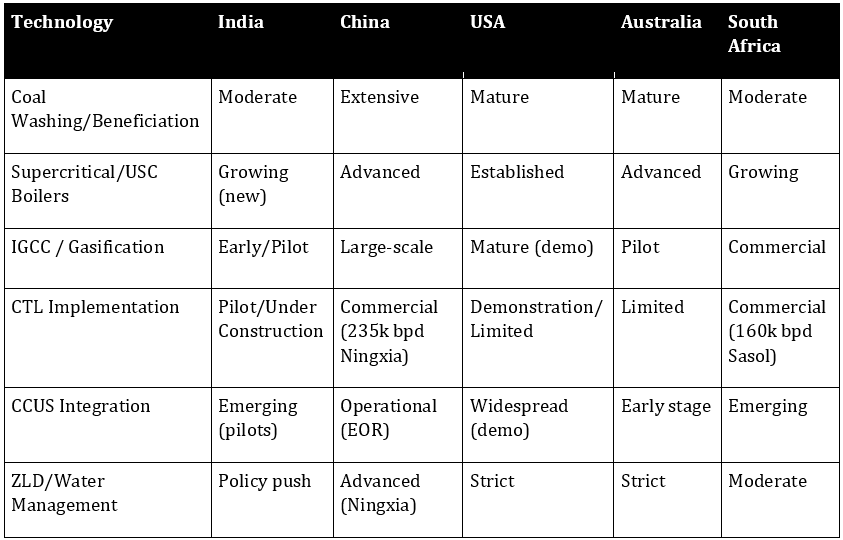
India lags in scaling commercial CTL/CCUS but has policy momentum (National Coal Gasification Mission targeting 100 Mt of gasification by 2030; ₹8,500 crore in incentives; Atmanirbhar Coal Mission; coal block auctions) and a technical foundation (BHEL gasifier development, CIMFR/CSIR catalyst R&D, Talcher Fertiliser project) to accelerate rapidly if governance and financing align.
Key International Takeaway: Successful large-scale CTL requires (a) sovereign or quasi-sovereign financing for first-of-a-kind plants, (b) integration with chemical/fertiliser co-production for revenue diversification, (c) mandatory CCUS/ZLD from design stage, and (d) alignment with national energy security and industrial policy—not pure market signals.
Risks, Realism, and the Path Forward
This is not a silver bullet. Large-scale coal gasification + ammonia complexes entail high upfront capital costs, high water intensity (mitigated by ZLD and mine-water use), and require rigorous CCUS to be compatible with Net Zero 2070. The coal policy should be explicit: no project receives sovereign support without carbon capture readiness, ZLD, >95% slag valorisation, and just-transition commitments. It treats coal conversion as a transitional bridge (2026–2045/50), not a permanent lock-in, with periodic reviews and sunset provisions for non-performing assets.
Yet the alternative — indefinite absorption of every global spike while domestic production remains gas-dependent and import-exposed — is the higher-risk path. The 2026 crisis has shown the limits of that approach. Coal gasification, executed intelligently at mine-mouth scale with CCUS, offers a credible route to gradually broaden the domestic production base, dampen the transmission of price volatility, create jobs where they are most needed, and reduce the long-term fiscal load-bearing wall of the ₹242 bag.
Synthesising the Ten Strategic Issues into Actionable Policy Challenges
The ten issues interact across five structural domains. Policy must address them holistically rather than in silos.
- Resource Quality and Conversion Constraint. High-ash coal, with 25 to 45 per cent ash content, does not burn well. It contains many impurities, such as sulphur, mercury, and arsenic, which make combustion inefficient. A key point to consider is that coal should be classified and allocated based on its value. The best coals, such as Steel Grade I and II and Washery I to IV coals, which are suitable for making coke, should be reserved for steelmaking. Coals such as G1 to G6, which have been washed and are suitable for electricity generation, should be used in high-efficiency power plants. Other coals, such as G7 to G17 and those with ash content, should be used to make gas or for other special processes, such as Integrated Gasification Combined Cycle (IGCC), Circulating Fluidized Bed Technology (CFBC), and Coal to Chemical (CTC), and for power generation right at the mine, with advanced systems to control emissions. Beneficiation (washing) mandates apply to all coal above G8 or allocated to distant power plants. This hierarchy is already implicit in grading systems but requires statutory enforcement and allocation linkage.
- Geography, Poverty, Governance Deficit, and Regional Development. The coal areas in Jharkhand, Odisha, Chhattisgarh, and parts of West Bengal and Madhya Pradesh face many problems. These coal districts experience multiple forms of poverty; the systems in place are weak, and there has been significant conflict in the past. When coal is extracted and shipped away, conditions worsen. This is what people call the “resource curse”. It means that the people in these coal districts do not receive the money they should from the coal. Instead, the money goes elsewhere. The coal districts do not get to use the coal to make things and create jobs for the people. Mine-mouth clusters (pithead power + gasification + ICL/CTC + slag valorization + shared utilities) convert extraction sites into industrial growth poles, formalising employment, improving HDI, and reducing incentives for insurgency through economic inclusion. Just-transition funds and community equity stakes (5–10% of project SPV) should be mandatory for new clusters.
- Transport, Supply-Chain Inefficiency, and Leakage. We should generate power and heat at the coal-extraction site and use them for industry, sending any surplus power to other locations via the grid. Coal should be converted into products that can be transported through pipes, such as gas, methanol, ammonia, synthetic crude and DME, at the mine site. A group like the Coal Logistics Rationalisation Board could be established to regulate prices, so that it costs more to send coal more than 500 kilometres unless it has been upgraded and can be tracked. We should use tags and a special kind of computer system called blockchain to track the coal from the mine to where it is used, and have special paths for trains that can carry containers and tankers rather than just open cars.
- Import Vulnerability and Strategic Exposure. 85–89% dependence on oil imports is very risky, as crises such as supply disruptions, price spikes and currency depreciation can occur. For India, dependence on oil imports will continue to be a challenge. CTL/CTC can deliver 10–15% substitution by 2035 under an aggressive but feasible rollout (3–5 large clusters + supporting gasification). This is partial but strategically significant—equivalent to 35–50 Mt crude/year, reducing current account pressure and building sovereign synthetic fuel reserves (defence, aviation, strategic petroleum reserves integration). Producing fertilisers such as ammonia and urea, along with petrochemical feedstocks such as methanol and naphtha, helps reduce the need to import them. This is beneficial for agriculture and for making plastics. By producing these things ourselves, we are less dependent on other countries for fertilisers such as ammonia and urea and for petrochemical feedstocks such as methanol and naphtha.
- Climate Pressure, Policy Fragmentation, and the Sustainability Test. The government has a problem with fragmentation. This means that no single ministry is in charge of the project from start to finish. This causes delays in projects that need to be done. That is why we need a National Mission for the following:
- The ability to use carbon capture and storage, which is also called CCUS readiness.
- The ability to use biomass as a fuel, also called biomass-feeding pathways.
- Regular project reviews every five years.
- Future plans for hydrogen and renewable energy beyond 2040 and 2050.
- Have stringent rules to ensure pollution control, responsible water use, land restoration after the project is over, and support for the community around the project.
Conclusion
The 2026 fertiliser crisis is a symptom of a deeper design flaw: a system that treats fertiliser security as a pure consumption subsidy rather than a production and conversion challenge. The sustainable coal policy framework reframes the problem. By prioritising high-ash domestic coal for gasification and for the co-production of ammonia and urea in integrated mine-mouth clusters, India can simultaneously address energy security, petroleum import substitution, regional development, and — over time — the fiscal sustainability of the fertiliser promise itself.
India’s coal debate is not about mining tonnage or power megawatts alone. It is about national resilience, industrial geography, strategic imports, environmental stewardship, state capability, and social justice. The ten-point analysis in the prompt paper, validated and expanded by the attached technical resources and international benchmarks, shows that India has both the resource scale (389.42 Bt) and the technological pathways (ICL + CCUS + co-production) to convert a portion of this endowment into synthetic fuels, chemicals, and energy-security assets—but only if policy shifts decisively from maximising raw-coal volume to sustainable value-chain transformation.
We have the opportunity to act now and make a difference. The evidence is clear. The policy architecture is ready. What remains is decisive implementation at the ministry level.
Authors Brief Bio:
Dr Saptarshi Basu is a Policy Research & Maritime Engineering Specialist.
Dr Bhaskar Bhandarkar is the former Chairman of the MRDB Institution of India and the Vice President of the Institute of Marine Engineers India.
Shri Manish Sahu is the COO of Kreeti Technologies Pvt. Ltd. He is an expert in Alternative Fuels & Circular Economy.
Shri Gopal Singh is the former Chairman-cum-Managing Director (CMD) of Coal India Limited (CIL).