

Sapt Dhara and National Security: A Blueprint for India’s Defence-Industrial Transformation

Introduction

In his 80th Independence Day address on 15 August 2026, the Prime Minister set out Sapt Dhara, seven streams of national strength.[1] As the nation advances towards Viksit Bharat@2047, this articulated concept will provide a powerful framework for India’s growth and national strength. Of particular significance is “Raksha Shakti”, the fifth stream of Sapt Dhara, with its emphasis on defence self-reliance, becoming a global supplier, drones and counter-drone systems, leadership in hypersonic defence technologies and cyber security as a field for Indian youth.[2] The armed forces play a vital role in realising this vision through technological advancement, indigenous capability development and operational excellence. The number also recalls Kautilya’s Arthashastra, which held that “the king, the minister, the country, the fort, the treasury, the army and the friend are the elements of sovereignty.”[3] The two lists differ in content and purpose, but they share a premise: national strength arises from the relationship among its elements rather than from any one of them.

Applying that premise to the defence industry, this article proposes organising strategy around five operational domains and three enabling layers. It also proposes shifting the unit of planning from the platform to the integrated combat ecosystem and broadening the measure of success from indigenous manufacture to indigenous design, integration and operational effectiveness. Overall, the article analyses a shift from prioritising where equipment is manufactured to prioritising who owns its design, intellectual property and source code – summarised as a move from “Made in India” to “Owned by India”.

The Changing Logic of Military Power

For much of the twentieth century, military power was largely measured by inventory: the number of army divisions, aircraft, warships and tanks a country could field and sustain. But the outcomes of recent conflicts have turned less on the quantity of platforms than on how quickly and coherently forces can integrate sensors, weapons, communications, intelligence and command decisions into a single operational system. Unmanned aerial and maritime systems, space-based surveillance and navigation, cyber operations, electronic warfare and artificial intelligence now operate alongside conventional military platforms such as tanks, aircraft and warships. Military effectiveness is increasingly a property of networks rather than of individual machines.

Traditionally in India, indigenisation has been tracked using straightforward metrics: production volumes, the share of indigenous content, and the number of platforms delivered from domestic lines.[4] These indicators show genuine progress, but they reveal little about whether Indian industry can supply the software, sensors, secure data links, components and integration expertise on which modern capability depends. Therefore, the challenge is not merely to ramp up production but also to ensure that industrial output meets the armed forces’ requirements. Defence-industrial reform is thus bound up with national security and technological innovation. It is also central to the ambition of Viksit Bharat@2047, which assumes a country capable of designing, not merely assembling, advanced systems.

A Platform-Centric Defence-Industrial Base

India’s defence-industrial base comprises public sector undertakings (PSUs), which produced about 76 per cent of output in 2025–26; the Defence Research and Development Organisation (DRDO) and other government PSUs; the private sector, whose share reached 24 per cent; and a growing layer of start-ups and Micro, Small and Medium Enterprises (MSMEs).[5] Production reached a record ₹1.78 lakh crore and exports ₹38,424 crore that year, yet India remained the world’s second-largest importer of major arms during 2021–25.[6]

The defence-industrial architecture remains largely organised around platforms. Individual services generally set requirements, and official reports emphasise outputs and indigenised items. The weak point, in the author’s assessment, is the connecting layer: data links, mission software, sensor fusion, resilient networks and decision-support tools. Control of this layer depends on the platform’s origin. Imported systems usually arrive with this layer closed and vendor-controlled. Indian-built systems often rely on foreign components, selected programme by programme. The Air Force’s Integrated Air Command and Control System (IACCS) and the Army’s Akashteer network show that India can design this layer. Still, they emerged from service programmes rather than from industrial strategy. The performance of these networked air defence architectures during Operation Sindoor showed what these foundations can deliver when systems are designed to work together.[7]

The draft Defence Acquisition Procedure 2026 would increase indigenous content for the Buy (Indian-IDDM) category from 50 to 60 per cent and introduce a test of indigenous design based on ownership of design documents, source code and core architecture. The next challenge is to connect and deepen existing capabilities by linking programmes, technologies and military users.

Five Domains, Three Enabling Layers

This article proposes organising defence-industrial strategy around five operational domains, namely air, land, maritime, space, and cyber, supported by three enabling layers: artificial intelligence; networks and secure communications; and unmanned and autonomous systems. Here, a domain is a medium in which a force can be denied or defeated. Electronic warfare is placed in the networks layer instead, because it operates across all five by contesting the spectrum their communications use.

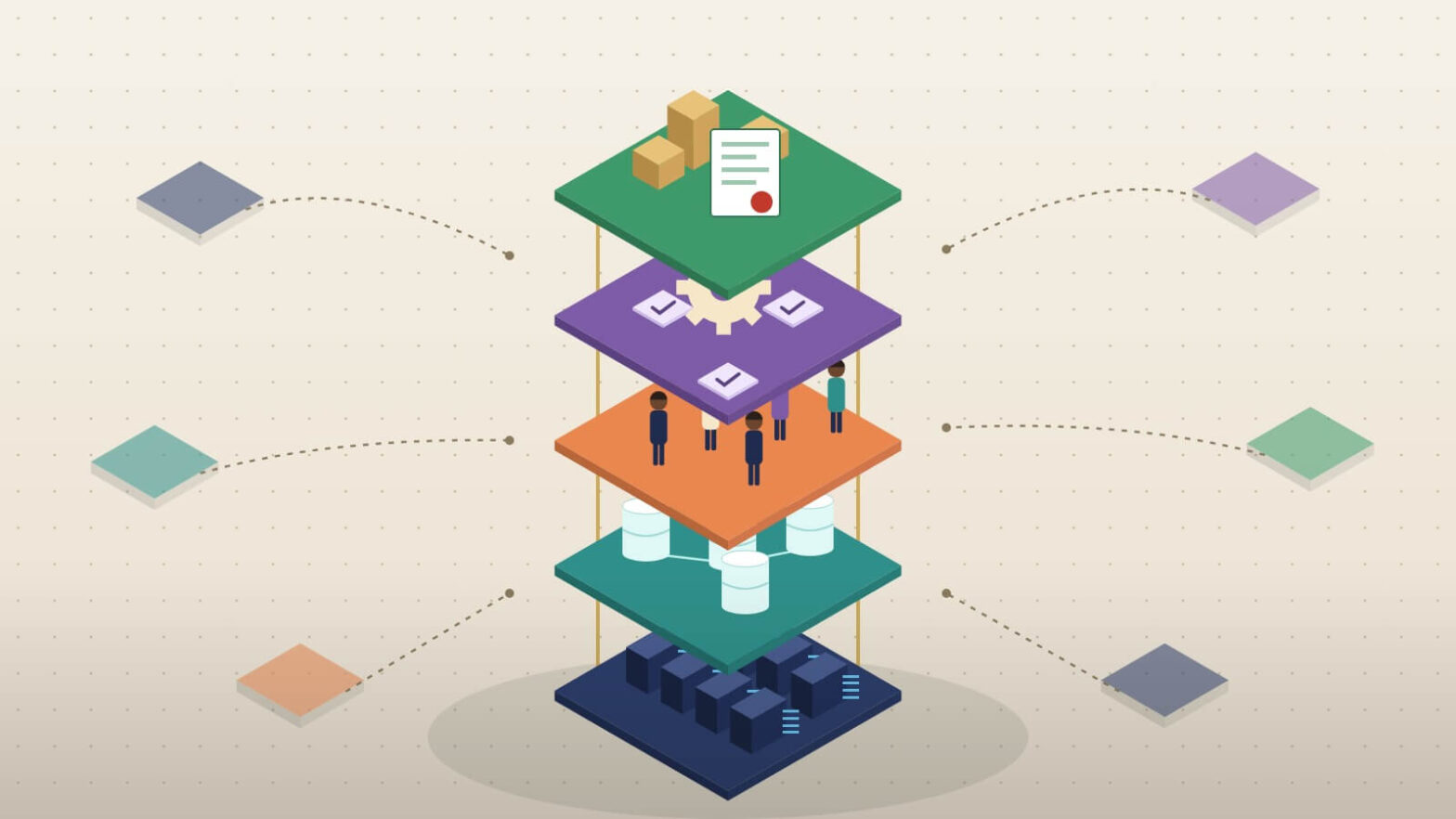
Figure 1: Five Domain Missions Resting on Three Shared National Capability Layers
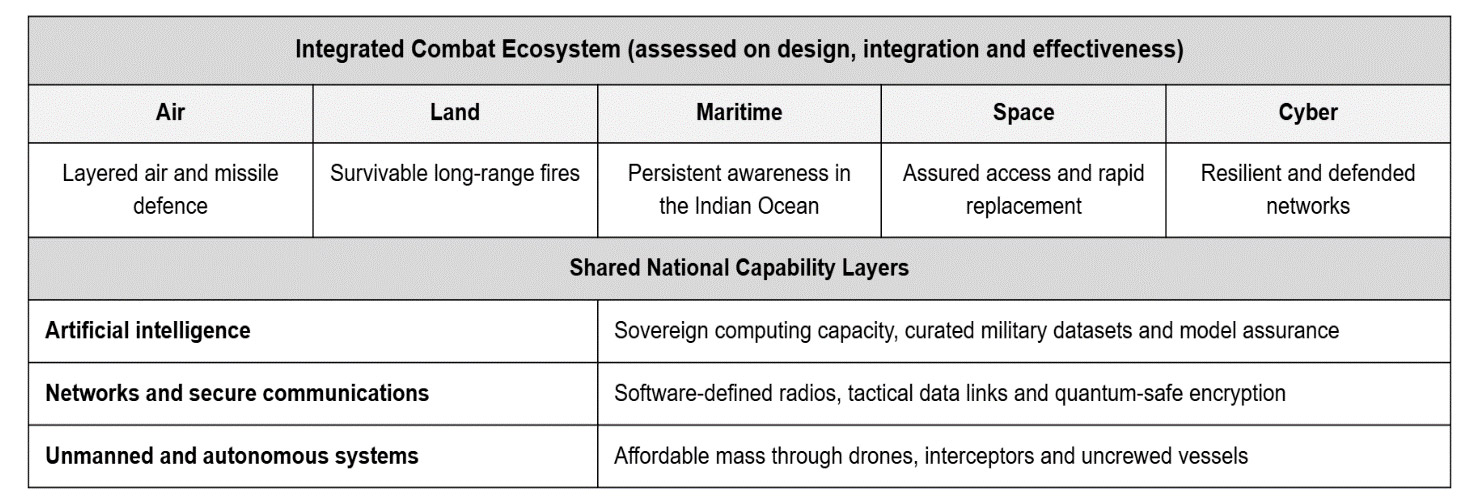
The diagram sets out the author’s proposal; it does not describe current practice.

Each domain could host a joint capability mission defined by an operational outcome, such as layered air and missile defence or persistent maritime awareness across the Indian Ocean. Platforms would remain essential but would be specified as nodes within a mission architecture. The three enabling layers would be treated differently from platforms. They would be developed as shared national assets, with common standards for data formats, interfaces, encryption and autonomy safety that would apply to every platform, whether Indian or imported.

Consider the defence of a forward airbase against a combined drone and missile attack. In platform-level planning, the question is which aircraft, radars and missiles to buy. Planned as a mission, the question becomes what sensors, networks, software, munitions, repair capacity and personnel are needed to keep the base defended over a period of time, and how well they connect. That is the first shift this article proposes: making the integrated combat ecosystem, rather than the platform, the unit of planning. The second shift follows. If the mission is the unit, then where a component is manufactured matters less than whether India designed it, can integrate it and has shown that it works. Domestic manufacture retains value for employment, skills and wartime production, but a licence-built platform remains exposed to its supplier’s decisions.

Two further tests would complete what the draft DAP has begun with its ownership-based definition of design.[8] The first, integration authority, asks whether the Indian side holds the interface documents, and, if necessary, the source code, to connect a system to national networks without seeking the vendor’s permission. The second, demonstrated effectiveness, asks whether the system has passed a mission-level trial, run by the services’ trial and testing teams at shared facilities, against a pass mark set by the capability board for that mission (proposed below).

Space: Dual-Use Foundations without Militarisation

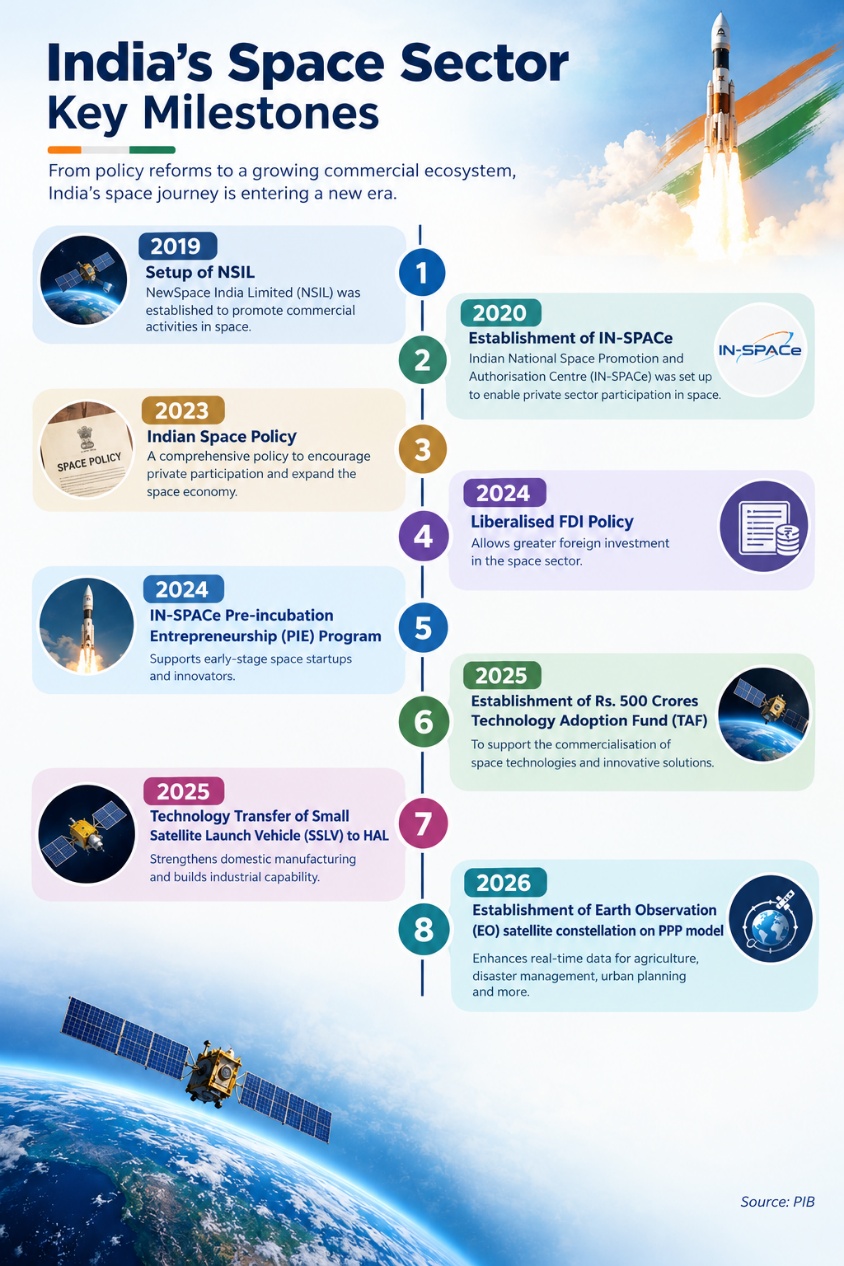
India’s space programme was conceived to serve national development.[9] The Indian Space Policy 2023 frames its vision around augmenting space capabilities and fostering a commercial space sector in support of socio-economic development and security, and it opens end-to-end space activities to non-government entities through IN-SPACe. Earth observation, navigation, satellite communications, launch capability, systems engineering and supplier depth all have clear dual-use potential. The line this article draws is between programmes, not technologies. The civilian programme retains its developmental purpose, the industrial base is shared, and military space capability is built separately and answers to the defence establishment.

In October 2024, the Cabinet Committee on Security approved a constellation of at least 52 surveillance satellites, 31 of which are to be built by private firms.[10] Capabilities developed to safeguard civilian satellites are directly relevant to protecting national assets in orbit. This should also include enhancing space situational awareness, resilient navigation and secure satellite communications. Gaganyaan shows why these matters. A crewed mission demands reliability engineering, precision manufacturing and careful systems integration, the same skills that dependable defence systems require. The engineers who master them become a strategic asset in their own right.

But there are gaps to be addressed. India still has no national space law. The Space Activities Bill remains pre-legislative.[11] Other gaps include an unclear IP regime for ISRO-private collaborations, weak demand aggregation, and limited insurance and launch-pad capacity beyond Sriharikota. The IP gap is directly linked to DAP 2026: the ownership questions the draft procurement procedure seeks to answer for defence remain unresolved for space as well.

Alignment and the Path to Production

Beyond space, India has a deep talent base in software and electronics, established public scientific institutions, and a growing defence start-up ecosystem. Closer alignment among the armed forces, DRDO, space institutions, private industry, start-ups, and academia could be pursued through standing joint capability boards for each domain mission, led by the relevant operational commander. The boards would define mission-level requirements, set interface standards, fund technology gaps, and maintain the dependency map, with the armed forces remaining the customer and the final judge of effectiveness. Four measures would give the boards practical means to act:

  1. Procurement. A capability board can shape the industry only if successful prototypes lead to orders. The draft DAP’s Minimum Pilot Order Quantity for successful iDEX and TDF prototypes is a start;[12] framework contracts with defined production quantities would turn it into a path to scale.
  2. Testing. Shared national test facilities for drones, electronic warfare, AI assurance and space hardware, if made available to private firms at a predictable cost, would serve both acquisition trials and developers’ own testing.
  3. Intellectual property. Developers would own the IP they create by default, with government use rights. For foreign systems that connect to Indian networks, contracts would secure access to interface documentation and source code.
  4. Innovation finance. iDEX and the Technology Development Fund would provide follow-on funding and production tooling; DPSUs would act as anchor customers and integrators. This would bridge the gap between a funded prototype and a production line.
From Atmanirbharta to Strategic Interdependence: The Global Dimension

Atmanirbharta is better understood as control over critical dependencies than as domestic production of everything. Complete technological independence is neither achievable in the near term nor necessarily desirable. Even the largest military powers do not produce every component or technology used by their armed forces. India needs credible domestic alternatives in critical areas so that it can retain freedom of decision and keep its forces effective even when external supplies, technologies or partnerships are constrained.

The positive indigenisation lists are one instrument for this: they set timelines after which listed items must be purchased from Indian manufacturers.[13] International partnerships can accelerate progress in other areas and provide specialised expertise, research networks and access to global supply chains. However, their value depends on the terms. Assembly rights alone may not provide access to intellectual property, independent maintenance, future upgrades, or the freedom to modify a system without external approval. Arrangements that strengthen domestic design, engineering, testing, integration and production should be prioritised. Joint development, co-production and sustained technical collaboration can serve this purpose when they include meaningful technology access and genuine domestic learning.

Exports can help domestic manufacturers achieve economies of scale, sustain production lines between domestic orders, and finance further research. To realise these benefits, export promotion must be grounded in product reliability, long-term support, competitive pricing, and consistent delivery. The BrahMos sale to the Philippines illustrates the point: a system developed through an Indo-Russian joint venture and proven in Indian service secured its first foreign customer.[14] India should aim to develop selected systems that meet both domestic operational requirements and international market needs.

Strategic autonomy does not require isolation. It requires the capacity to select partners, manage dependencies and retain control over critical national security decisions.

A Roadmap for Viksit Bharat@2047

Viksit Bharat@2047 is a development goal, but it is also a national-security goal. A country that aims to be advanced and self-directed by 2047 cannot rely on others for the systems and materials its forces will need in a crisis. Defence capability takes decades to build, and many of the programmes that will equip the armed forces in the 2040s are being decided now. The Ministry of Defence’s Technology Perspective and Capability Roadmap 2025 already looks fifteen years ahead.[15] The transition from platforms to ecosystems proposed in this article can therefore be organised into three phases, each building the connective capacity that multi-domain operations demand. The dates below are proposed planning horizons derived from this analysis.

Phase I: Consolidation and Integration (2027–2032)

The first priority is to connect existing capabilities and remove barriers to collaboration. This should begin with a systematic assessment of critical technology and supply-chain dependencies. China’s April 2025 licensing requirements for certain medium and heavy rare earths put at risk supplies of materials used in combat aircraft, submarines, missiles and radars. Before 2023, China handled about 99 per cent of heavy rare earth processing, showing how a seemingly minor dependence can quickly become a strategic vulnerability.[16] India has begun responding through the National Critical Mineral Mission and a magnet-manufacturing scheme approved in November 2025.[17]

Procurement needs further streamlining, as start-ups have often struggled to secure follow-on orders after successful trials. The Ministry has acknowledged this difficulty, and the proposed Defence Acquisition Procedure 2026 seeks to address it through faster routes and assured orders.[18] This phase should also set out common interoperability and upgradeability requirements, so that systems built for one service can share data across air, land, maritime, space and cyber operations. Priority development programmes should begin with the shared layers on which every domain depends: artificial intelligence, secure networks and unmanned systems.

Phase II: Scale and Technological Depth (2032–2040)

The second phase should convert successful domestic technologies into dependable, scalable industrial capabilities. Production should expand first where Phase I’s dependency assessment shows India to be most exposed. Indian firms should take a larger role in systems integration and lifecycle support, including cross-domain integration, not only within individual platforms, since much of a programme’s long-term value and operational knowledge resides there. Testing is likely to become a bottleneck as more firms reach the prototype stage. The Defence Testing Infrastructure Scheme, approved in 2020 with ₹400 crore for six to eight new facilities, was a sensible start,[19] but its scale reflects the industry of 2020, not the larger and more varied base that Phase II envisages.

Phase III: Ecosystem Maturity (2040–2047)

The measure of the defence-industrial base would have changed by the final phase. Capability would be judged by how well systems work together across domains, not by how many platforms leave the production line. Major systems would be designed from the outset for continuous upgrades, and Indian industry would be able to integrate new technologies into them. Some external dependencies would remain, but only those the dependency map deems acceptable. The ₹1 lakh crore Research, Development and Innovation scheme, which finances private research in strategic and sunrise sectors, is the kind of instrument through which civilian advances in enabling technologies could be drawn into this effort.[20]

Limitations and Counterarguments

The ecosystem approach has costs that need to be made clear. The first concern is coordination. Planning at the mission level rather than for individual platforms requires many organisations, including the three services, research laboratories, public sector undertakings and private firms, to agree on shared goals and to continue working together over many years. The joint capability boards proposed in this article carry an obvious risk: they could become yet another layer of review in a system that is already slow. To avoid this, each board should take over an existing approval step rather than add a new one. It would also be prudent to start small. Air and missile defence and counter-drone systems are natural candidates, since both depend on linking sensors, weapons and command systems across services and quickly expose integration gaps. Success there could then justify extending the approach to other missions.

The second concerns competition. Central architecture and open competition pull in opposite directions. The more precisely the government specifies a system, the easier it becomes to integrate, and the harder it is for a firm with an unconventional approach, often a smaller one, to offer something better. The way through is to standardise interfaces rather than designs: fix how systems connect and exchange data, and leave the rest to industry.

The third concerns urgency. The armed forces must be ready for the threats they face now, and some gaps will open before any Indian programme can fill them. In those cases, a proven foreign system may be the responsible choice. Insisting on indigenous design regardless of timing would raise costs, delay inductions and leave units short of equipment. Self-reliance should shape long-term choices without overriding operational necessity. Vendors may refuse to provide, or charge heavily for, interface documents and source code for systems that connect to Indian networks. For urgent purchases, interface documents alone may be the realistic minimum: enough to connect the system, though not to modify it.

The fourth concerns perception abroad. India’s reputation as a peaceful space power is an asset, and a closer civil-military relationship in space could put that reputation at risk if other states interpret shared industrial capacity as a sign of militarisation. The separation of programmes proposed in the space section is the main safeguard: civilian institutions retain their developmental mandate while military capability is developed and governed separately.

The fifth lies outside industry altogether. As noted earlier, requirements are still generally written by individual services. Mission-level planning needs a joint view of how the forces will fight, and that depends on progress towards theatreisation and joint doctrine.

Conclusion

For Viksit Bharat@2047, this article argues for a shift from “Made in India” to “Owned by India”. Higher production and fewer imports remain worthwhile, but the broader goal is for India to design, integrate and export the technologies and architectures that shape multi-domain warfare, rather than remaining chiefly a market and a manufacturing base.

The aim should be to develop a defence-industrial ecosystem that can translate Indian research into operational capability, connect indigenous technologies across domains, sustain military systems throughout their service lives, and preserve strategic freedom of action during a crisis. The central proposition is simple: India’s next defence-industrial leap must be measured not merely by what the country manufactures, but by what its industrial ecosystem enables the armed forces to achieve.

Kautilya distinguished three kinds of strength: “the power of deliberation is intellectual strength,” “the possession of a prosperous treasury and a strong army is the strength of sovereignty,” and “martial power is physical strength.”[21] India has invested heavily in the second and third. An ecosystem-based strategy is, in part, an investment in the first: the capacity to see, decide and act coherently.

Author Brief Bio: Squadron Leader Saurabh Sharma is an Indian Air Force Officer and a Fighter Pilot with over a decade of Operational Experience. He has served in diverse operational appointments, gaining first hand exposure to contemporary air operations, military technology and evolving requirements of the warfighting capabilities. He has also served as ADC to the Honourable President of India from 2020-24 where he got first-hand experience of India’s Constitutional Framework, national security environment, strategic engagements and functioning of the Highest levels of the State.

References :

[1] Prime Minister’s Office, “PM Gives Clarion Calls for India’s Next Leap towards Viksit Bharat in 80th Independence Day Address,” PMIndia, 15 August 2026, https://www.pmindia.gov.in/en/news_updates/pm-gives-clarion-calls-for-indias-next-leap-towards-viksit-bharat-in-80th-independence-day-address/.

[2] Prime Minister’s Office, “PM’s Address from the Ramparts of Red Fort on the Occasion of 80th Independence Day,” PMIndia, 15 August 2026, https://www.pmindia.gov.in/en/news_updates/pms-address-from-the-ramparts-of-red-fort-on-the-occasion-of-80th-independence-day/; Prime Minister’s Office, “PM Gives Clarion Calls.”

[3] Kautilya, Arthashastra, trans. R. Shamasastry (Bangalore: Government Press, 1915), bk. 6, chap. 1.

[4] Ministry of Defence, “Make in India Powers Defence Growth,” backgrounder, Press Information Bureau, 3 April 2025, https://static.pib.gov.in/WriteReadData/specificdocs/documents/2025/apr/doc202543531401.pdf.

[5] Ministry of Defence, “Defence Production Soars to a Record Rs 1.78 Lakh Crore in Financial Year 2025-26,” press release, Press Information Bureau, 17 June 2026, https://www.pib.gov.in/PressReleasePage.aspx?PRID=2273824.

[6] Ministry of Defence, “Defence Exports Skyrocket to Record Rs 38,424 Crore in Financial Year 2025-26, a Massive 62.66% Increase over Previous Fiscal,” press release, Press Information Bureau, 2 April 2026, https://www.pib.gov.in/PressReleasePage.aspx?PRID=2248124; Mathew George et al., Trends in International Arms Transfers, 2025, SIPRI Fact Sheet (Stockholm International Peace Research Institute, March 2026), 10, https://www.sipri.org/sites/default/files/2026-03/fs_2603_at_2025.pdf.

[7] Santosh Kumar, Ritu Kataria, and Kritika Rane, “Akashteer: The Unseen Force behind India’s New War Capability,” Press Information Bureau, May 2025, https://static.pib.gov.in/WriteReadData/specificdocs/documents/2025/may/doc2025516556201.pdf; Ashish Vohra, “Operation Sindoor: India’s Atmanirbharta Success Story,” Defence and Diplomacy Journal 14, no. 3 (April–June 2025): 11–20, https://capssindia.org/wp-content/uploads/2025/10/2-Ashish-Vohra.pdf.

[8] Harsh V. Pant and Ankit K, “The Many Firsts in India’s New Defence Acquisition Policy,” commentary, Observer Research Foundation, 28 February 2026 (originally published by NDTV), https://www.orfonline.org/research/the-many-firsts-in-india-s-new-defence-acquisition-policy.

[9] Department of Space, “Vision, Mission and Objectives of the Department of Space,” Indian Space Research Organisation, accessed 23 October 2026, https://www.isro.gov.in/Vision-Mission-Objectives.html.

[10] Vijay Mohan, “Space-Based Assets Crucial for Defence, Lot of Technology Being Developed: ISRO Chief,” Tribune (Chandigarh), 8 December 2025, https://www.tribuneindia.com/news/defence/space-based-assets-crucial-for-defence-lot-of-technology-being-developed-isro-chief.

[11] Paridhi Adani et al., “Space Law 2026: India,” Chambers and Partners Global Practice Guides, last modified 14 July 2026, https://practiceguides.chambers.com/practice-guides/space-law-2026/india.

[12] Pant and Ankit K, “Many Firsts.”

[13] Ministry of Defence, “‘Aatmanirbharta’ in Defence: MoD Approves 4th Positive Indigenisation List of 928 Strategically-Important Line Replacement Units/Sub-Systems/Spares & Components,” press release, Press Information Bureau, 14 May 2023, https://mod.gov.in/sites/default/files/pre3_26623.pdf.

[14] “India Gets First-Ever Export Order for BrahMos Missiles; Philippines Signs USD 374 Million Contract,” Tribune (Chandigarh), 28 January 2022, https://www.tribuneindia.com/news/nation/india-gets-first-ever-export-order-for-brahmos-missiles-philippines-signs-usd-374-million-contract-364962.

[15] Ministry of Defence, Technology Perspective and Capability Roadmap 2025 (New Delhi: Ministry of Defence, 2025), https://www.mod.gov.in/dod/sites/default/files/FINAL-TPCR-2025.pdf.

[16] Gracelin Baskaran and Meredith Schwartz, “The Consequences of China’s New Rare Earths Export Restrictions,” Critical Questions, Center for Strategic and International Studies, 14 April 2025, https://www.csis.org/analysis/consequences-chinas-new-rare-earths-export-restrictions; “China’s Rare Earth Export Curbs to Hit Defence, Auto and Consumer Electronics Sectors,” Tribune (Chandigarh), 23 October 2025, https://www.tribuneindia.com/news/business/chinas-rare-earth-export-curbs-to-hit-defence-auto-and-consumer-electronics-sectors.

[17] Prime Minister’s Office, “Cabinet Approves ‘National Critical Mineral Mission’ to Build a Resilient Value Chain for Critical Mineral Resources Vital to Green Technologies, with an Outlay of Rs.34,300 Crore over Seven Years,” news release, PMIndia, 29 January 2025, https://www.pmindia.gov.in/en/news_updates/cabinet-approves-national-critical-mineral-mission-to-build-a-resilient-value-chain-for-critical-mineral-resources-vital-to-green-technologies-with-an-outlay-of-rs-34300-crore-over-seven-years; Prime Minister’s Office, “Cabinet Approves Rs.7,280 Crore Scheme to Promote Manufacturing of Sintered Rare Earth Permanent Magnets (REPM),” news release, PMIndia, 26 November 2025, https://www.pmindia.gov.in/en/news_updates/cabinet-approves-rs-7280-crore-scheme-to-promote-manufacturing-of-sintered-rare-earth-permanent-magnets-repm.

[18] Shruti Tripathi, “Govt to Launch Dedicated Procurement Window for Defence Tech Start-Ups beyond iDEX in 3–4 Months: MoD Secy,” Outlook Business, 14 August 2025, https://www.outlookbusiness.com/start-up/news/govt-to-launch-dedicated-procurement-window-for-defence-tech-start-ups-beyond-idex-in-34-months-mod-secy; “DAP 2026 Has Been Designed to Bolster Self-Reliance, Accelerate Acquisition Timelines & Empower Indian Defence Industrial Ecosystem: Ministry of Defence,” All India Radio News, 13 February 2026, https://www.newsonair.gov.in/dap-2026-has-been-designed-to-bolster-self-reliance-accelerate-acquisition-timelines-empower-indian-defence-industrial-ecosystem-ministry-of-defence.

[19] “Defence Minister Approves Rs 400 Crore Defence Testing Infrastructure Scheme,” Raksha Anirveda, 15 May 2020, https://raksha-anirveda.com/defence-minister-approves-rs-400-crore-defence-testing-infrastructure-scheme.

[20] Prime Minister’s Office, “Cabinet Approves Research Development and Innovation (RDI) Scheme to Scale Up Research, Development and Innovation in Strategic and Sunrise Domains,” news release, PMIndia, 1 July 2025, https://www.pmindia.gov.in/en/news_updates/cabinet-approves-research-development-and-innovation-rdi-scheme-to-scale-up-research-development-and-innovation-in-strategic-and-sunrise-domains.

[21] Kautilya, Arthashastra, bk. 6, chap. 2.

 

Cultural Enterprise Ecosystems: Defining Soft Power Value and Shaping Brand India for Viksit Bharat 2047

The inclusion of soft power as a pillar of Sapt Dhara for Viksit Bharat 2047, as articulated by Prime Minister Narendra Modi in his Independence Day address on August 15, 2026, marks an important shift in India’s development vision. It signals that India’s civilisational endowments are more than sources of international goodwill. They can be developed as strategic assets to showcase creative capabilities, generate economic opportunities, and advance international influence. Fulfilling this vision requires a strategic approach and sustained investment in India’s cultural and creative economy, with particular emphasis on building globally competitive cultural enterprises. This article examines where India’s cultural economy stands today and sets out a roadmap for ecosystem development to transform cultural enterprises into instruments of soft power.

Harvard political scientist Joseph Nye Jr. coined the term soft power to introduce non-coercive means of power into diplomatic discourse. Soft power, wrote Nye in his seminal 1990 essay, ‘tends to be associated with intangible power resources such as culture, ideology and institutions.’[1]  In a more recent article published in 2021, Nye argued that ‘soft power depends on the minds of the target audiences’.[2]

Cultural and creative industries (CCIs) are among the most direct ways to reach those minds. CCIs commonly include traditional creative sectors such as crafts, fashion, design, visual arts, cinema, performing arts, publishing, festivals, and tourism, as well as digitally forward industries, including software, gaming, advertising, and content creation. While no single definition applies universally, CCIs sit at the intersection of creative expression, innovation, intellectual property (IP), and commercialisation and distribution, generating economic and cultural value.[3] The United Nations Conference on Trade and Development (UNCTAD) identifies creative industries as among the most dynamic growth sectors in the global economy, particularly for developing countries.[4]

When exported, CCIs can shape how foreign audiences perceive, experience, and adapt to a country’s culture. Such exports often accompany the sharing of ideas, national values and ethos, and knowledge traditions, which in turn influence people-to-people engagement, consumer demand, and favourability towards that nation. Countries worldwide are focusing on their CCIs by aligning policy priorities, improving access to capital, and investing in infrastructure. By demonstrating domestic capabilities and meeting international consumer demand through cultural and creative products, services, and experiences, an exporting nation can bolster its soft power.

Some of the most successful soft powers today leverage one or more of the resources Nye identified, namely culture, ideology, and institutions, to cultivate influence, attract investment, and build familiarity through their brands. South Korea’s growing cultural clout, the hallyu wave, stems from its pop culture (music, cinema, and television), which spills over into cuisine, beauty, and fashion. The United States has long stood for innovation, free markets, and technological advancement, fostered by its top universities, enterprises, and scientific and government institutions. It is the birthplace of Disney, Netflix, and YouTube, which are among the world’s leading creative economy brands today in terms of revenue, market share, and popularity.[5] Artisanal luxury brands such as Hermès, cultural festivals like Cannes, and museums and institutions such as the Louvre and Alliance Française all help make France the most visited country in the world. As these examples show, cultural and creative brands can generate brand equity, i.e., the value of a brand built through narrative, consumer education, positioning, and strong recall.[6] Enterprises with strong and stable brand equity reinforce the ‘country of origin’ association and subsequently that country’s soft power.

India’s Cultural and Creative Economy

Backed by its rich cultural heritage, growing entrepreneurial talent, and an emerging consumer class with purchasing power and a propensity for cultural consumption, India is well placed to become a leader in the global cultural and creative economy. India’s cultural and creative economy was reported to be worth US$80 billion in 2026, representing 4.3% of total economic output.[7] What remains missing are globally recognised, consumer-facing cultural brands. This is an untapped opportunity for India to establish itself firmly in key markets, both established and emerging, through lifestyle, experiential services, creator and knowledge services, and hospitality.

India’s abundant cultural resources have long enjoyed global appreciation. Textile crafts such as muslin, pashmina, and Kalamkari (chintz) have shaped the fashion vocabularies of the world. India’s knowledge traditions, mathematical discoveries, and the wisdom behind Ayurveda and yoga have led to groundbreaking innovations. Its rich literary heritage, including the Ramayana and Mahabharata, continues to flourish through the performing and visual arts in Southeast Asia. Additionally, India is the world’s largest film producer by volume, has the second-highest number of internet users, has 44 UNESCO World Heritage Sites, and is among the youngest and fastest-growing major economies.[8] This tailwind points to the advantage ahead: transforming cultural resources into national assets, creating employment, and generating national wealth. Otherwise, India risks losing authorship of its own heritage in international markets.

The case of yoga offers one of the clearest illustrations of a missed opportunity for India and the need to reverse it through enterprise creation. Practised in virtually every city in the world, yoga is one of India’s strongest soft-power resources in theory and public diplomacy. While establishing the International Day of Yoga was a cultural-diplomacy success, it fell short of capturing yoga’s economic value in the absence of institutional market frameworks. By contrast, the US has invested in research, enterprise support, and brand creation, including meditation apps such as Headspace, athleisure brands such as Alo, and nationwide studios such as CorePower.[9] While India exported the idea and ethos of yoga, it still has market share to capture.

Crafts: Defining Global Luxury

Another sector where India leads in export value is the manufactured and handmade craft and design goods, such as textiles, handicrafts, rugs, and jewellery. For many international luxury houses, India has been a muse and a source of materials. While some brands, such as Louis Vuitton and Christian Louboutin, have openly showcased their inspirations and partnerships with Indian artisans, others have done so more discreetly, sparking conversations about appropriation, transparency, and misrepresentation.

Some of these brands are from France, where the fashion and luxury goods sector alone was estimated to be worth $181 billion in 2022. The French government has emphasised maintaining this competitive edge through dedicated funding for artisanal businesses, talent retention, and the strengthening of French brands’ presence in emerging markets. In addition, city-level cultural economies are preserved and promoted through strict GI norms that protect the names, products, and traditional production methods of regions, such as Dijon and Cognac for food and Grasse for perfumery.[10]

While India’s cultural diversity and crafts remain unparalleled for artisanal skills and material knowledge, they do not enjoy the same level of protection. Official data show that the craft sector employs 6.4 million artisans across 455 categories, 318 of which are GI-tagged.[11] Despite this scale, the sector remains hampered by weak IP protection, limited market incentives, and insufficient funding. Policies that enforce licence use, protect GI-tagged crafts, and establish legal frameworks can turn crafts into one of India’s strongest intellectual property assets.

Alongside this, brand creation can drive compounding value over the long run. Labels such as Sabyasachi, Anita Dongre and Jaipur Rugs are expanding their global footprint and drawing attention to Indian craftsmanship through advertising, storytelling, merchandise creation and cross-platform adaptations. By positioning crafts at a premium, in line with their international counterparts, these enterprises build strong brand value, long-term profitability and consumer appeal. In India, marketplaces such as Swadesh and The Kunj, and brands such as Good Earth, can transform the craft-shopping experience for international travellers. Through curation, product display and storytelling at every touchpoint, these brands showcase artisanal excellence, educate customers and, most importantly, offer high-end products in design and quality, elevating the craft tourism experience.

Creative Artists, Cuisine and Diaspora

The story repeats across cinema, the performing arts, and theatre, where scale at home has not translated into international accolades. While India produces the most films, it does not carry the same global clout as Hollywood. Theatrical performances, concerts by Indian artists, and international film releases remain largely confined to diaspora groups. Sizeable in number and economically affluent, diaspora communities serve as a bridge between India and the world. However, they should not be seen as the sole target consumers for India’s cultural exports. Nations with lasting soft power are those whose appeal is universal. In music, the global fanfare for a Taylor Swift or BTS concert far outpaces that for their Indian contemporaries, whose primary overseas audience remains Indian expats.[12] The former’s success relies on universally recognisable storytelling, merchandise creation, and global partnerships, among other factors built over a sustained period.

A compelling early proof of concept for changing perceptions and increasing demand comes from the culinary space. Two decades ago, Indian food was seen as cheap, greasy, monolithic, low-cost dining for expatriates. Today, Indian chefs and entrepreneurs abroad have successfully built Michelin-starred restaurants such as Tresind in Dubai and have received James Beard recognition for presenting culinary heritage, as with New York-based Semma. Through innovative, world-class dining experiences, they are rewriting India’s gastronomic story.[13] A key driver of this change is collaboration between chefs and entrepreneurs, which makes businesses more resilient to risk and better managed through centralised operations. While privately run restaurant enterprises create bespoke experiences, supportive policies can enable Indian food brands to scale in volume.

Thailand, one of the first nations to launch a dedicated state-led gastrodiplomacy campaign, offers a playbook for India. As part of its ‘Global Thai’ programme, local chefs were trained to open Thai restaurants abroad that catered to global tastes, not just the Thai diaspora. Inter-ministerial coordination ensured financial support for enterprises, visa exemptions for chefs, easier import of local ingredients, and heavy investment in marketing. Integrating tourism, culture, and cuisine into a single brand successfully popularised Thai food, fuelled demand for more outlets, attracted inbound tourism, and boosted Thailand’s soft power.[14] Indian cuisine can also shed its diaspora dependency and become a global phenomenon when supported by conducive policies and backing from private individuals and enterprises.

Virasat, Vikas and Vyapar: A Roadmap for Viksit Bharat 2047

India has no shortage of talent or know-how. The core challenge is the lack of an ecosystem that can elevate cultural and creative professions into a value-driven industry. A deeply interconnected landscape would support businesses through skills training, idea validation, and funding channels. It would set quality standards, establish IP protection frameworks, and implement necessary licensing regulations. Policy and diplomacy would help expand established economic corridors and create new ones. Lastly, resources and talent would come together to shape a narrative across international forums and digital platforms.

A comprehensive framework, in which virasat (heritage) provides creative grounding, vyapar (commerce) creates economic momentum, and vikas (development) drives policy design, will shape the trajectory of Viksit Bharat. A multi-stakeholder approach is needed to cultivate this ecosystem, in which a favourable policy environment, incubatory and entrepreneurial support, and market linkages align to build enterprising capabilities at home and capture global markets through brands, talent and narrative.

Vikas:  Building Policy Foundations

Strong policy and institutional support from the government are the first and foremost step for India’s cultural and creative industries to succeed. Given that no single definition applies universally, India must define its own cultural and creative industries. A clear articulation would determine the scope and nature of support CCIs receive. This definition can evolve and should be revisited at regular intervals to assess its relevance, progress, and applicability. A national vision setting out opportunities and targets for India’s CCIs could serve as the guiding framework, along with a comprehensive roadmap for phased implementation. However, the real test of success lies in translating policy into action.

The Indian government is gradually incorporating the cultural and creative economy into its policy agenda, but existing programmes and schemes continue to operate in silos. Furthermore, institutional support, such as the Indian Institute of Creative Technologies for developing the audio-visual, gaming and comics (AVGC) sectors, the National Creators Award and the World Audio Visual and Entertainment Summit (WAVES), as well as the emphasis on STEM-based innovation, has tilted the balance towards content creation and digital-first activities. India’s rich tangible and intangible cultural heritage, with immense economic value, still lacks the same infrastructure and policy support.[15]

To address this gap, a nodal agency should be established within the Prime Minister’s Office (PMO) to give cultural industries – crafts, cuisine, performing arts, puppetry, yoga, Ayurveda, toy-making, etc. – policy priority, a technocratic character, and a unique organisational structure that ensures involvement from both the government and the private sector. India’s cultural industries involve many stakeholders: ministries such as external affairs, culture, textiles, tourism, agriculture, AYUSH, MSME, and urban development; industry bodies; and autonomous think-tanks. Academic institutions such as the Indian Institute of Crafts and Design (IICD) and the Institute of Hotel Management (IHM), along with network organisations, festival curators, and museum professionals, also need to participate in decision-making. Most importantly, cultural enterprises, whether supplying other businesses or being consumer-facing, need representation.

A nodal agency would not replace existing cultural preservation efforts but would coordinate them to achieve better, more streamlined outcomes. Placing it within the PMO would give it authority to bring multiple ministries onto a single planning platform. Primarily, the nodal agency would outline the national vision, develop an action plan, and monitor the implementation and performance of schemes related to the CCIs. It would facilitate coordination among the centre, state, and local-level governing bodies, aligning them to meet national goals within a set timeline. The nodal agency would also determine the investments needed for infrastructure development, knowledge creation and documentation, research, and storytelling at the national scale. A key focus should be developing and enforcing strict IP regulations and strengthening existing legal measures, such as trademarks, copyrights, certifications, and GI traceability. To advance soft power through CCIs, the nodal agency, with representation from the Ministry of External Affairs (MEA), the Indian Council for Cultural Relations (ICCR), and other relevant institutions, could offer visa relaxations for entrepreneurs seeking to go global.

Tourism offers a clear illustration of what can be achieved when travel, cultural experiences, heritage immersion and hospitality are integrated into a single offering. The 2025-26 Economic Survey noted that while cities worldwide integrate art, music, food and other elements into urban policy, ‘Indian cities remain institutionally hostile to creativity.’[16] Making cities engaging and lively tourism destinations requires investment in transport, hospitality, and basic physical infrastructure, such as visitor facilities, information centres, and signage. Replicating the Kunj model in other states, for instance, and integrating craft brands into India’s official tourism information platforms can create meaningful partnerships that benefit state-wide local craft enterprises and the tourism sector.

Equally important are documentation and archival efforts, data collection, and the creation of world-class experiences through the services offered, whether craft tours in Jaipur and Srinagar, culinary walks in Lucknow, or music festivals in Varanasi and Gwalior. These cities already enjoy UNESCO Creative City recognition, but a development plan involving all stakeholders will ensure better tourism products, culturally relevant marketing, and investment in heritage protection and promotion. While a strong policy foundation benefits the cultural and creative industries as a whole, brand development requires a market-facing approach and sharp business acumen. This is where the private sector and individuals, including corporates, incubators, academia, and industry specialists, can come together to focus on business development and market readiness.

Virasat: Incubating India’s Cultural Brands

Business incubators and accelerators offer mentorship, skills training, access to capital, and networks that increase startups’ chances of success. India’s artisanal sector faces a perception problem: craft enterprises are largely seen as non-profit initiatives rather than scalable, profit-making businesses. The perception is reflected in funding patterns, with only 1 in 10 craft-led MSMEs having easy access to finance.[17]  Similarly, despite an uptick in investment value in Ayurveda beauty and personal care (BPC), studies reveal that only 3.4% of companies received funding.[18]

Hybrid incubators that support entrepreneurs with best practices for business growth while offering financial capital that recognises the risks involved and accepts patient returns need to be developed. Cultural entrepreneurs could benefit from low-interest loans, convertible notes, and debt funding. For investors, preferential tax treatment and simpler legal frameworks could encourage more investment in fledgling cultural businesses. The funding apparatus should also encourage philanthropic support, family office investments, and public-private investment funds. DPIIT’s partnership with the Estée Lauder Companies Inc. (ELC) and Nykaa to support a burgeoning BPC startup space should be expanded to include a category dedicated to Ayurveda brands.[19]

Through mentorship, incubators can connect businesses with industry experts, service providers, and freelancers, and support distribution, supply-chain, and manufacturing partnerships. This would reduce capital and operational costs for small businesses. Universities can offer this incubatory support early on, channelling endowments, donations, and academic partnerships into entrepreneurial development. Introducing entrepreneurial development programmes into curricula could offer many benefits. First, they would equip students with pitching skills and an understanding of market realities, preparing them to design real-world solutions. Second, they would support product development by combining faculty’s deep cultural knowledge with industry knowledge gained through practical experience. IICD’s Crafts Business Accelerator Programme is one such example, in which students receive entrepreneurial support to start their own brands or return to family craft, equipped with new techniques, technologies, and better market access. Universities also offer infrastructure such as research labs, co-working spaces, and alumni connections that can support product development and market research.

Beyond capital and mentoring, brands also need marketing, packaging and storytelling support. India has long been a land of storytellers, and the cultural industries have kept this tradition alive. From offline packaging and store curation to online newsletters, social media posts, and partnerships with retailers, vendors and buyers, every detail shapes how brands are perceived and consumed. In today’s cultural economy, filmmakers, campaign builders, brand strategists, curators and creative producers carry that inheritance forward. They help brands translate heritage into modern formats without stripping it of meaning. For storytelling to achieve reach and impact on a global scale, enterprises must take these stories to global markets and harness their potential to connect with consumers.

Vyapar: Tapping into Global Markets

Support at home must be matched by market access abroad, which begins with understanding those markets. This involves learning about cultural norms, local tastes, spending patterns, and regulatory, compliance, and certification requirements. At the same time, understanding market rhythms, such as seasonal demand, buying cycles, and trade calendars, can enable better commercial decision-making. For instance, Jaipur Rugs, one of the world’s largest hand-knotted carpet brands, times its collection launches to align with key cultural events in different international markets, such as design weeks and festivals, an approach that has given it greater visibility, recognition, and partnerships with eminent design houses.

For smaller businesses, conducting independent research into these nuances may be an overhead cost. Establishing research centres within government agencies and autonomous think tanks, and partnering with market research agencies, could provide much-needed strategic consulting across three domains. First, entrepreneurs would learn export requirements and could set pricing, plan market entry, and prepare their supply chains accordingly. Building critical infrastructure for transporting products, extending the shelf life of perishables, reducing transport costs, and preparing for geopolitical and economic uncertainties are important inputs for brands’ supply chain strategy. Second, brand identity, developed through packaging, quality standardisation, communication strategies, and brand positioning, could be tailored to different markets. Finally, research into digital frontiers and the impact of AI on creative production, jobs, and distribution has become equally important for brands’ operations and for entry into new markets. By providing these insights and more, research centres can become trusted sources of information for startups and investors and support policymaking with market-facing data.

With these resources, enterprises will be well placed to target key markets and establish a retail or online presence. Markets with high potential for brand success could include those with large diaspora populations and strong economic ties with India, as well as those that show greater openness and spending potential for new categories. Expos, trade fairs, and bilateral business conventions facilitate buyer-seller meetings and partnerships between Indian entities and large global conglomerates. Initiatives such as Bharat Tex and the One District One Product (ODOP) programme have provided market access and revenue streams for cultural enterprises. Participation in international expos and trade events outside India should also be supported through financial and visa-related assistance. Although slow, the process will build organic discoverability and business traction for promising Indian brands.

Lastly, performance incentive structures must accompany market linkages to ensure enterprises remain accountable for the support they receive and the growth targets they set. Joe Studwell’s concept of export discipline offers a model in which domestic incentives and export targets go hand in hand. In practice, incentives could include export-linked grants for brand development, business tenders, IP registration and trade fair costs, and tax benefits proportional to export earnings. Each could be disbursed in stages against agreed targets, so that continued support depends on performance. While the model is theoretically robust, India needs to develop its own metrics to measure performance and define export success.

Conclusion

Fostering cultural brands through an ecosystem approach and integrating them into the Viksit Bharat 2047 vision requires time-bound strategies and astute execution across the depth and breadth of the cultural industries. A comprehensive policy design that encourages innovation, offers protection, and sets an ambitious development target; a robust ecosystem that augments India’s cultural footprint; and a market-led approach that makes CCIs a high-value sector with lasting brand equity will ensure the vision of developing India’s CCIs is fulfilled. Cultural and creative heritage, represented through brands and institutions, would mark the evolution of “Make in India” into Brand India. This would tell the story of India’s rise as a soft power, shaping how the aspirations of Viksit Bharat 2047 are nurtured at home and communicated to the world.

Author Brief Bio: Arunima Gupta is an author, scholar of soft power, and a creative economy professional with extensive experience across think tanks and entrepreneurship development organizations in the US and India. She is a Viksit Bharat Fellow at BlueKraft Digital Foundation. Her writing has been published on leading national and international platforms. Arunima holds a master’s in international relations from Leiden University, the Netherlands, and a bachelor’s in history from Lady Shri Ram College, Delhi University.

Notes

[1] Joseph S. Nye Jr., “Soft Power,” Foreign Policy, no. 80 (Autumn 1990): 153–71, https://doi.org/10.2307/1148580.

[2] Joseph S. Nye Jr., “Soft Power: The Evolution of a Concept,” Journal of Political Power 14, no. 1 (2021): 196–208, https://doi.org/10.1080/2158379X.2021.1879572.

[3] UNESCO, Re|Shaping Cultural Policies: A Decade Promoting the Diversity of Cultural Expressions for Development (Paris: UNESCO, 2015), https://unesdoc.unesco.org/ark:/48223/pf0000235710.

[4] UNCTAD, “Trade and the Creative Economy,” accessed 13 October 2026, https://unctad.org/topic/trade-analysis/creative-economy.

[5] Makoto Tsujiguchi, “More than Entertainment: Japan’s Creative Industries and the U.S.-Japan Partnership,” Center for Strategic and International Studies, 13 August 2026, https://www.csis.org/analysis/more-entertainment-japans-creative-industries-and-us-japan-partnership.

[6] Sallie Allen, “Brand Equity Explained: How to Build and Measure Success,” Harvard Business School Online (blog), 5 November 2024, https://online.hbs.edu/blog/post/brand-equity.

[7] Primus Partners, Shaping Education to Nurture the $80 Billion Creative Economy (Primus Partners, 2025), https://primuspartners.in/docs/documents/Shaping%20%20Education%20to%20nurture%20the%20$80%20Billion%20Creative%20Economy_updated.pdf.

[8] World Bank, “India,” World Bank Data360, accessed 13 October 2026, https://data360.worldbank.org/en/economy/IND; UNESCO World Heritage Centre, “India,” accessed 13 October 2026, https://whc.unesco.org/en/statesparties/in.

[9] ET Bureau, “Why It Matters Who Owns Yoga,” ETBrandEquity, 24 June 2015, https://brandequity.economictimes.indiatimes.com/news/marketing/why-it-matters-who-owns-yoga/47798186.

[10] Atout France, “France: The Undisputed Benchmark for Fashion, Luxury Goods, Perfume and Cosmetics,” 23 January 2025, https://www.atout-france.fr/en/mice/us/fashion.

[11] India Brand Equity Foundation, “Indian Handicrafts Market: Growth, Exports & Government Initiatives,” accessed 13 October 2026, https://www.ibef.org/exports/handicrafts-industry-india.

[12] “Live Nation Reports 2023 Biggest Year Ever for Concert Turnout and Ticket Sales,” Guardian, 22 February 2024, https://www.theguardian.com/music/2024/feb/22/live-nation-concert-attendance.

[13] James Beard Foundation, “The James Beard Awards,” accessed 13 October 2026, https://www.jamesbeard.org/awards.

[14] Government Public Relations Department, Thailand, “Government Boosts Global Thai Cuisine Appeal,” 10 January 2024, https://thailand.prd.go.th/en/content/category/detail/id/52/iid/248768.

[15] Arunima Gupta and Sanjay Anandaram, “Catalysing Cultural Entrepreneurship in India,” ORF Issue Brief no. 544 (New Delhi: Observer Research Foundation, May 2022), https://www.orfonline.org/research/catalysing-cultural-entrepreneurship-in-india.

[16] Ministry of Finance, Government of India, Economic Survey 2025–26 (New Delhi: Government of India, 2026), https://www.indiabudget.gov.in/economicsurvey/doc/echapter.pdf.

[17] 200 Million Artisans, Financing a Handmade Revolution (200 Million Artisans, July 2023), https://www.businessofhandmade2.com/.

[18] Tracxn, “Ayurvedic Medicines Sector,” n.d., https://tracxn.com/d/trending-businessmodels/startupsinayurvedicmedicines/__y7prdd9ZGGHUYlpuQnvjQW4vjZFmXmL81g1O9FJLHRg#about.

[19] Press Information Bureau, Government of India, “DPIIT and The Estée Lauder Companies Partner to Advance Beauty Innovation and Entrepreneurship in India,” 12 March 2025, https://www.pib.gov.in/PressReleaseIframePage.aspx?PRID=2110937&reg=48&lang=2.


Beyond Isolated Missions: Building India’s Integrated Technology Capability Stack for Strategic Autonomy

Introduction

A technology mission leaves more than its stated outputs behind. It helps researchers identify new equipment, gives companies practice in vetting suppliers, and helps public agencies gain hands-on experience in specifying and procuring technical services. Some of this capability can support the next mission. Whether it does so depend on decisions that receive less attention than project approvals: who may use a facility, who pays for its maintenance, and whether another agency can obtain the rights and assistance needed to adapt its work.

India’s investments in artificial intelligence (AI) and semiconductors make these questions consequential. In June 2026, the Government reported that shared IndiaAI capacity exceeded 45,000 graphics processing units (GPUs), alongside 12 approved semiconductor manufacturing projects with an investment pipeline of approximately ₹1.64 lakh crore.[1] These figures indicate the scale of programme activity. They leave open how much capability a later programme could draw on, on what terms, and with what continuing dependence on external suppliers.

India already has institutions with relevant coordination mandates: the Empowered Technology Group (ETG), the Prime Minister’s Science, Technology and Innovation Advisory Council (PM-STIAC), and NITI Aayog’s Frontier Tech Hub.[2] A proposal for another council must therefore explain what these arrangements cannot achieve. The more immediate task is to examine how mission assets can be made available across departmental boundaries, including the costs imposed on the organisation expected to share them.

Reusability exists when a subsequent mission can draw on an earlier mission’s infrastructure, knowledge, rights, skills or operating arrangements without recreating them at full cost. This is the paper’s central criterion. It directs attention to the second user’s experience: access should be technically feasible, legally permitted and affordable. An asset can be on a national inventory without meeting any of these conditions. We argue that this practical test is essential to technological sovereignty, and we outline how Indian institutions can organise and finance the effort.

Conceptual framework

Edler and colleagues distinguish technological sovereignty from comprehensive self-sufficiency, focusing on access to critical technologies without structural dependence on a single source.[3] The OECD places sovereignty-related policy within combinations of protection, promotion and international projection.[4] Both approaches allow for cooperation. A country can strengthen its position through domestic production, as well as through alternative suppliers, technical partnerships and the ability to negotiate usable rights.

Mission-oriented innovation research helps explain why the benefits of public investment may extend across sectors and organisations.[5] Procurement research examines how public purchasers can support innovation by specifying needs and creating demand.[6] These arguments matter here because a mission’s legacy depends, in part, on what public contracts fund and permit. If adaptation rights, documentation and maintenance are omitted, later users may have to commission work that has already been publicly financed. The possibility of wider benefit does not ensure that contracts will provide for it.

Sovereign-AI literature likewise considers infrastructure, models and partnerships together.[7] Possessing a national model is only one part of the problem. Strategic autonomy, as used here, is the practical ability to pursue an important public objective despite disruption to a technology relationship. Strategic resilience concerns maintaining or restoring the service through which that objective is pursued. These definitions require attention to specific dependencies. A locally assembled system can remain vulnerable to the withdrawal of a software service; an imported component may be replaceable if alternatives have already been qualified.

The relevant policy choice is therefore selective. Public expenditure should address dependencies whose disruption would materially impair the mission, taking into account substitution costs and recovery time. This approach does not prescribe domestic ownership for every input. It does require an explanation of why the chosen arrangement can withstand the disruption it is intended to protect against.

Analytical approach and scope

The analysis asks what India’s existing institutions can do to make one mission’s capabilities available to another. AI and semiconductors provide the two cases. Their link through computing infrastructure makes them useful for examining this question, although the paper does not assess quantum or space mission outcomes.

To collect our data, we reviewed Cabinet decisions, ministry updates, and parliamentary replies on the PIB and PRS portals, as well as official reports and scholarly research. Legal texts informed the procurement discussion. We concluded our research on 31 August 2026.[8] Figures are presented with their original dates, not adjusted to a single day. If an official website didn’t list a publication date, we verified the information against dated documents.

Documents are reviewed to determine the decisions an institution is authorised to make and the arrangements by which another programme could access its work. Programme announcements require particular care. Getting approval simply means a project was green-lit; it doesn’t mean the work was actually done.

The analysis retains the more precise administrative description when two accounts use different terms for the same figure. These distinctions are detailed in Appendix 1. We use policy documents from China, the U.S., and the EU as a backdrop to the Indian cases. They highlight different approaches to funding research, purchasing technology, and supporting manufacturing. However, this isn’t a strict comparison intended to rank countries or to attribute economic results to specific agency actions.

Connecting Sovereignty to Capability

A mission’s exposure becomes clearer when the analysis focuses on a specific service. For example, a disruption to the chip supply poses a different problem from a restriction on the use of the data required to run an AI application. If we frame both as a general loss of control, we lose sight of the real decision at hand.

These challenges come down to six key areas, and strength in one doesn’t make up for weakness in another. These are:

  • Supply Chain: Can you obtain the parts and manufacturing services you need?
  • Data: Who controls the data and decides how it may be used?
  • Compute: Do you have sufficient processing power available?
  • Intellectual Property: Do you own the rights to build, adapt, and sell the technology?
  • Operations: Can you keep services running smoothly and recover quickly when issues arise?
  • Standards: Do you have a seat at the table when setting the rules for how systems interact?

The five capability pillars identify where policy can act: compute infrastructure, data ecosystems, talent, standards-setting and procurement-led demand. They form a ‘stack’ because their effectiveness depends on how they work together. This is a framework for the capabilities examined here, rather than a complete account of production. Project appraisal must also address power, water, materials, equipment and finance.

Three strategic postures guide the choice of response. Control requires the authority, rights and expertise to operate a critical function. Assured access relies on enforceable supply arrangements, supported by tested alternatives. Influence entails sustained participation in technical standards, research priorities or market practices. These postures draw on the sovereignty literature and may be combined.[9] An agency could retain control over sensitive data while purchasing compute from several providers and contributing to international standards.

The choice hinges on the consequences of losing access. Domestic production may be justified where a critical input has no viable substitute. Elsewhere, qualifying another supplier may be preferable to building an entire production chain. Table 1 links these choices to the institutions and indicators that could support them.[10]

Table 1. Crosswalk of sovereignty dimensions, capability pillars, strategic postures, institutions and indicators
Sovereignty dimension and problemStrategic responseCapability to build and share, with supporting pillarsProposed institutional responsibilityEvidence of benefit to a subsequent mission
Supply chain: A critical input becomes unavailable or difficult to replace.Secure alternative supply; develop domestic control where substitution is impractical.Qualified suppliers, shared testing facilities and transferable qualification records. Pillars: compute, procurement, talent.ISM/MeitY would support relevant semiconductor capabilities; purchasing ministries would define requirements; ETG would address dependencies shared across missions.A later mission qualifies an alternative input with less testing, lower cost or a shorter replacement lead time.
Data: Useful data exist, but another programme cannot establish whether or how it may use them.Retain authority over lawful use while providing clearly governed access.Datasets accompanied by permissions, provenance, quality records and usable access procedures. Pillars: data, standards, talent.Sector custodians would determine permitted access; MeitY and IndiaAI would support relevant shared arrangements.A later mission obtains suitable, documented data with less preparation and fewer repeated permission negotiations.
Compute: A programme cannot obtain suitable computing capacity when it needs it.Arrange reliable access; retain operational control where interruption would threaten a critical service.Accessible compute services, workload support and tested migration arrangements. Pillars: compute, procurement, talent.IndiaAI/MeitY would support compute provision; ETG would address requirements spanning missions; users would specify workload needs.A later mission runs a comparable workload with shorter waiting time, lower total cost or less dependence on one provider.
Intellectual property: Earlier publicly supported work cannot be adapted without further permission or redevelopment.Obtain essential modification and licensing rights; negotiate access where ownership is unnecessary.Designs or models with verification records, documentation and rights that permit further development. Pillars: talent, procurement, data.Funders and purchasing agencies would negotiate reuse rights with universities and firms; ISM/MeitY would support relevant programme arrangements.A later mission adapts an existing design or model with less redevelopment and fewer licensing obstacles.
Operational: A service depends on a supplier or team whose withdrawal would interrupt delivery.Retain the ability to operate and restore the service; test alternatives before disruption occurs.Operating knowledge, trained staff, recovery procedures and tested alternatives that other programmes can adapt.

Pillars: talent, compute, standards, procurement.

System-owning ministries and operators would maintain continuity arrangements, with relevant security authorities involved where required.A later mission adopts and tests these arrangements with less preparation; recovery time and switching cost are recorded.
Standards: Incompatible systems or limited technical participation restrict adoption and supplier choice.Shape standards through sustained technical work and support their implementation.Reusable specifications, conformance tests and expertise in applying standards. Pillars: standards, talent, procurement.The Bureau of Indian Standards, Department of Telecommunications and relevant industry and research bodies would support technical participation and implementation.A later mission uses established specifications and tests with less integration work and a wider choice of compatible suppliers.

Source: Author’s synthesis.[11]

Institutional connections are proposed working relationships, not new statutory assignments.

Indicators are proposed measures, not verified national baselines. PM-STIAC would inform scientific priorities across the rows, while the Frontier Tech Hub would support foresight, state engagement and diffusion. MeitY denotes the Ministry of Electronics and Information Technology.

A hypothetical hospital application illustrates the limits of any single intervention. A locally developed AI model would still require clinical evaluation and permission to use patient data. A shared testing facility could support evaluation, but the hospital would remain responsible for governing access to its records. If the proposed service could not operate during a compute outage, it would also need a fallback. The appraisal should address these dependencies separately and identify the agency able to address each one. Bringing the arrangements together would be a coordination task; transferring them all to one institution would not necessarily solve the problem.

India’s Institutional and Programme Baseline

Coordination already has institutional homes

The Cabinet approved ETG in February 2020, chaired by the Principal Scientific Adviser. Its remit encompasses technology advice, mapping, procurement strategy, indigenisation and research-and-development choices.[12] The Office of the Principal Scientific Adviser also describes a role in coordinating technology policy and advising on the sharing of capabilities developed or procured by India.[13] ETG’s remit therefore provides a basis for examining cross-mission sharing. PM-STIAC, constituted in 2018, advises on science and technology, helps formulate and coordinate missions, and oversees the implementation of relevant interventions.[14] For the proposed capability plan, its role would centre on scientific opportunities and the coherence of mission design. Control over departmental appropriations or procurement cannot be inferred from that remit; it would require a separate basis in the relevant instruments.

NITI Aayog announced the Frontier Tech Hub in March 2025. Its published approach combines technology foresight, sector strategies and partnerships.[15] Its work with states on AI-ready data centre investment exemplifies convening around a shared infrastructure issue.[16] It offers a route to connecting national technology priorities with adoption and state-level implementation. The documents examined do not establish that the Hub can bind ministries to pooled expenditure. The residual policy question is whether a recurring mechanism records cross-mission dependencies, assigns responsibility, finances shared assets and verifies reuse. A mandate demonstrates authorised purpose; meeting activity demonstrates institutional use; neither alone establishes an outcome. Decision records and reusable outputs are needed to assess performance. Their absence from this documentary sample does not prove coordination failure.

IndiaAI and the distinction between capacity and use

Approved in March 2024, IndiaAI encompasses compute, models, data, applications, skills, start-up finance and safe and trusted AI.[17] It is already broader than a hardware acquisition programme. A June 2026 government statement reported more than 45,000 GPUs in the shared compute facility.[18] This aggregate does not indicate a single government-owned cluster or uniform performance across devices. The parliamentary reply published on 6 August 2026 records 15 empanelled compute providers, 237 projects approved for subsidised support and 93.18 lakh GPU-hours sanctioned.[19] A 13 August backgrounder describes the same figures as “accessed computing”.[20] Because the parliamentary response specifies approval and sanction, while the backgrounder uses the broader term “accessed”, the narrower interpretation governs. Sanctioned hours are not treated as consumed hours, nor are approved projects treated as simultaneously active.

For a research team, the practical issue is whether its workload can be run affordably when required. Hardware class, networking and waiting time affect that answer, as do allocation conditions and reliability. Mission reporting should link sanctioned allocations to delivered services and completed work, using comparable reporting periods and hardware categories.

Semiconductors and the distinction between approval and production

ISM serves as the nodal organisation for implementing semiconductor and display programmes within Digital India Corporation.[21] On 27 June 2026, MeitY reported 12 approved manufacturing projects: one silicon fabrication unit, two compound-semiconductor fabrication units, and nine packaging units, with an investment pipeline of approximately ₹1.64 lakh crore.[22] The approvals did not indicate a uniform stage of execution; the preceding Cabinet account described projects at different stages of implementation.[23] The August parliamentary account reports three approved projects in commercial production; a dated PIB factsheet identifies them as Micron, Kaynes and CG Semi.[24] The 4 July release independently documents CG Semi’s commercial start.[25] Assembly, testing, marking and packaging, including outsourced semiconductor assembly and test (OSAT), do not constitute domestic wafer fabrication for those products.

Semicon 2.0 was approved on 15 July 2026, with an outlay of ₹1,27,500 crore and a broader emphasis on design, equipment, materials and advanced packaging.[26] Assessment must still distinguish programme outlays from project investment commitments, disbursements and realised productive capacity. Neither the investment pipeline nor the number of operating packaging facilities establishes domestic availability of frontier AI accelerators.

Lessons from International Experience

China’s Made in China 2025 set out an industrial upgrading agenda spanning innovation, manufacturing capabilities and implementation instruments.[27] Its relevance to India lies in the relationship between a technological priority and the production capabilities required to support it. The document prompts a practical question for mission design: have suppliers, skills and prospective users been considered together? It does not establish that central coordination caused subsequent industrial outcomes, nor that India should adopt the same administrative structure.

The US experience shows why public support needs to be assessed on a case-by-case basis. DARPA supported ARPANET.[28] GPS was developed through government programmes.[29] In integrated circuits, both private invention and public-sector demand mattered.[30] These histories cannot be explained by procurement alone. Research funding, technical collaboration and later commercial activity played distinct roles. The 2022 CHIPS implementation strategy also combined support for manufacturing with investment in research and development.[31] For India, the point is to identify what is holding a technology back. A public order can create demand. It cannot, on its own, provide the research base or train the specialists needed to make every component.

The European Union’s 2023 Chips Act combined research and innovation capacity, security of supply, and monitoring and crisis response.[32] This combination raises a further consideration: arrangements to manage disruption should be developed alongside longer-term investment. A mission can expand capacity while remaining poorly prepared for the loss of a supplier.

These cases raise practical questions for Indian missions. Are the necessary skills and suppliers being developed? Is there a likely user for the technology? What happens if a major supplier withdraws? Institutional choices must align with the responsibilities of Indian ministries, states and firms. An arrangement that works elsewhere may require staff or powers that the proposed Indian body lacks. Strengthening existing mechanisms before adding institutions.

A common capability plan. ETG provides a starting point for a common capability plan. PM-STIAC could advise on scientific priorities. The Frontier Tech Hub could contribute its foresight work and links with states. Each participating mission would set out what it needs from other programmes and what it can offer. The plan would name the responsible agency, record access terms and set a delivery date. Problems awaiting a decision should remain visible in the record. The agency that owns a programme should remain responsible for delivery. Take a shared evaluation facility as an example. Someone must approve access, provide staff and handle competing requests. Users need a named contact and a way to raise delays. Sensitive details can be kept in restricted annexes, while the broad progress of the arrangement is reported publicly. There is a cost to the agency doing the sharing. External users may need help preparing a test, interpreting results or adapting software. A manager with a delivery deadline may have little spare staff time for this work. The plan should budget for it. Simply instructing an agency to share a facility could add duties without the resources to carry them out. This is a design risk, not a finding of refusal to cooperate.

Secretariat support and pooled finance.

The first question is whether existing staff can maintain the plan and follow up decisions. If they cannot, a small supporting unit could serve ETG and the relevant PM-STIAC processes. It would track unresolved matters, seek responses and check whether agreements have been acted upon. Matters involving several ministries could be referred for Cabinet Secretariat support. The unit should not repeat technical appraisals already completed by a ministry. Some shared work will have no obvious budget owner. A testing service might benefit several missions, although none can justify paying its full cost. Migration tools and specialist training may face the same problem. A pooled funding arrangement could cover such cases. It would require formal approval and an authority accountable for spending the money. The applicable expenditure rules would still apply. An advisory body cannot move money between departmental budgets on the strength of its advisory remit. Applications for support should name the expected users. They should explain why an existing facility or commercial service cannot meet the need. Costs must include staffing and maintenance after installation.

Reviewers would also need to know what rights later users will have. Continued funding should normally depend on evidence of use. An emergency facility is a possible exception, but its readiness would need testing. The claim that an asset is strategic should not settle the funding decision by itself. Access charges deserve attention too. A facility may be technically open to smaller institutions yet too costly for them to use. Where their participation serves a public purpose, the funding decision should address that barrier explicitly.

A conditional case for a new council.

A new National Technology Capability Council should be considered only after the strengthened arrangements have been tried. The review should identify decisions that remain unresolved and explain why. A staff shortage calls for a different remedy than a lack of authority. If nobody follows up on an agreement, another council may simply inherit the delay. If ministries repeatedly dispute who can allocate a shared resource, a change in decision rights may be needed.

The case for a council must specify the function it would perform. It should also explain why that function cannot be assigned to an existing body. Any founding instrument would need clear spending responsibilities and a defined relationship with ETG, PM-STIAC and other institutions. Its performance should be reviewed. Creating a body is itself a commitment of public resources, so the expected gain must justify the added administrative work

Procurement and Capability Development

Matching procurement to the public purpose. A public purchaser can give an emerging technology its first practical application. Whether the purchase also supports innovation depends on how clearly the need is specified and on the purchaser’s ability to assess the response.[33] A security-critical service may justify demanding continuity arrangements. An experimental technology may require a development contract before a reliable specification can be written. For routine civilian purchases, compatibility with existing systems and the cost of maintaining them may carry greater weight.

A start-up pilot should answer a defined question within a limited budget and period. Its assessment criteria and route to competitive scale-up should be stated in advance. Research contracts need scope for learning, together with a decision point at which support can end. Failure to produce a deployable prototype does not necessarily make the expenditure wasteful: a properly designed experiment may resolve an uncertainty that would otherwise attract further spending. That judgement requires a record of what was learned.

Future use should also be addressed in the contract. If another public agency is likely to adapt a component, the purchaser should negotiate the necessary permissions and documentation before commissioning it. Full ownership of the supplier’s intellectual property may be unnecessary. A licence could meet the public need while allowing the supplier to serve other customers. The terms would depend on the intended use and the supplier’s legitimate commercial interests. India’s Manual for Procurement of Goods provides the administrative context; procuring entities must follow the applicable rules and approvals.[34]

Procurement and Trade Rules

India’s observer status under the World Trade Organisation (WTO) Agreement on Government Procurement (GPA) should not be confused with membership. India is not a party to the GPA, so its market-access obligations do not generally apply to Indian procurement.[35] This does not determine the treatment of a particular purchase under other trade rules. Article III:8(a) of the General Agreement on Tariffs and Trade (GATT) excludes qualifying government procurement from Article III’s national-treatment requirements.[36] For services, Article XIII:1 of the 10

The General Agreement on Trade in Services (GATS) disapplies specified obligations to procurement within its scope.[37] Both provisions are subject to conditions. Neither removes all WTO obligations from a transaction labelled public procurement. Subsidy disciplines require separate examination, as do other applicable commitments.[38] The legal assessment must therefore examine who is buying, what is being bought, and its intended use. A preference for domestic production is also distinct from a requirement for domestic ownership or domestic intellectual property. Each requires a stated policy purpose and a basis in the applicable domestic rules and trade commitments.

Making the Pillars Work Together
  • Consider a team allocated compute hours for an AI project. It may still be unable to start if it lacks permission to access the dataset or cannot adapt its software to the provider’s environment. The allocation would then overstate the support available in practice. A capability plan should identify the work needed to make the allocation usable and provide for that work where public funding is justified.
  • Training and participation in standards require a similar connection to be useful. Training can be assessed by the technical tasks participants can perform. Work in a standards body can be examined through submitted contributions and implementations that satisfy the relevant requirements. Attendance records offer little evidence of either achievement.
  • For a design intended to serve later programmes, handover should include verification records, licensing terms and an identified source of maintenance support. Arranging this while the original team is available is preferable to asking a later user to reconstruct the original work. Procurement can fund the documentation and assistance, alongside the technical output itself.
Measurement and Implementation

The first test should cover a few capabilities with identifiable users. For each, the responsible agency would record what it offers, the terms of access, and the costs the second programme is expected to avoid. Quarterly updates could highlight delays while there is still time to act. An annual independent technical review could then assess whether the second programme actually used the capability. Numerical targets would be more defensible once this initial evidence is available.

The records need to show how support moves from approval to use. In the compute case, an allocation can be sanctioned without all the hours being delivered. Delivered hours can, in turn, be used without improving the later programme’s performance. Expenditure, service delivery and benefits should therefore remain separate observations. Combining them into a single sovereignty score would make it harder to identify the source of progress or delay.

Compute reporting should retain requested, sanctioned, delivered and billed hours, separated by hardware class and user category. Semiconductor records need to include the corresponding stages from approval and financial closure through to construction, qualification and commercial production. Capacity measures must identify the product to which they apply. For an operating service, a migration or recovery test can demonstrate what happens when the current supplier becomes unavailable. Appendix 2 sets out the proposed measures and their safeguards.

The comparison also needs to include the second user’s costs. Suppose a mission gains access to an existing testing facility but must adapt its equipment and wait several months for a slot. The avoided construction cost is only part of the outcome. Adaptation, maintenance and migration expenses, as well as the delay, belong in the comparison. The alternative must provide an equivalent function; comparing a shared specialist facility with a cheaper but unsuitable test would tell little about the value of reuse. Where faster delivery could reflect an easier task or a general improvement in technology, evaluators should report that uncertainty rather than attribute the entire gain to sharing.

Shared provision can also be a constraint. Congestion may render a shared facility impractical for a time-sensitive mission, while a common technical standard may restrict a design that needs to change. A mission should be able to propose an alternative and explain its additional cost. Review would then assess whether continued sharing offers value and whether the system retains sufficient alternatives to withstand disruption. Participation in a common platform would not, by itself, constitute success.

Conclusion

India’s technology institutions offer a starting point for making mission investment useful beyond the programme that financed it. The public record establishes coordination mandates and substantial programme activity. It leaves the practical terms of reuse and their effects on later missions to be demonstrated more systematically. The proposed approach begins with those terms: identify the dependency, assign responsibility for resolving it, and fund the work needed to make the capability available. Existing ETG, PM-STIAC and Frontier Tech arrangements should be tested and strengthened before another council is created. The six sovereignty dimensions and five pillars provide a framework for organising this work, while the indicators keep attention on what a subsequent user actually gains.

Mission success should be measured by reusable capabilities that reduce the cost, dependence, or coordination burden of subsequent missions.

Notes
  1. The cut-off is a boundary for substantive evidence, not a claim that every administrative series was measured on 31 August 2026. Each numerical observation retains its source date. One lakh equals 100,000; one crore equals 10 million.
  2. Proposed institutional arrangements and indicators are the author’s policy recommendations. They do not describe additional powers already held by ETG, PM-STIAC or the Frontier Tech Hub.
  3. “Control”, “assured access” and “influence” are used as a practical classification informed by the sovereignty literature, not as a newly discovered or mutually exclusive theory. Assured access requires tested arrangements and cannot be guaranteed by a commercial contract alone.
Appendix 1. Evidence definitions and reconciliation
Table 2. Numerical baseline admitted at the data cut-off
ItemAdmitted observationInterpretation and source
Shared AI computeMore than 45,000 GPUs, reported June 2026Aggregate shared capacity; not metered utilisation or proof of government ownership.[39]
Subsidised compute projects237 approved projects, reported 6

August 2026

Approval for support; not a count of simultaneously active or completed projects.[40]
Subsidised compute hours93.18 lakh GPU-hours sanctioned, reported 6 August 20269.318 million sanctioned hours; consumption is not established by this figure.[41]
 

Semiconductor manufacturing

12 approved projects; approximately ₹1.64 lakh crore investment pipeline, reported 27

June 2026


Commitments associated with approved projects; not verified expenditure.[42]


Manufacturing categories

One silicon fab; two compound-semiconductor fabs; nine packaging units, reported 27 June 2026 

The same dated source establishes both the total and its classification.[43]

Commercial productionThree approved projects in commercial production, reported August 2026Micron, Kaynes and CG Semi; packaging-related production must be distinguished from silicon wafer fabrication.[44]
 

Semicon 2.0


₹1,27,500 crore programme outlay approved 15 July 2026

Public programme provision, distinct from the

₹1.64 lakh crore project investment pipeline.[45]

Source: Documents cited in each row; reporting dates are retained. The parliamentary response’s approval and sanction categories govern over the backgrounder’s broader “accessed” wording: sanctioned GPU-hours are not consumed hours. No utilisation, realised-investment or production-yield estimate is inferred.

Semiconductor commercial starts are recorded within the approved-programme scope. Forecasts of further starts later in 2026 are excluded. Commercial production does not establish operation at rated capacity.

Appendix 2. Definitions for evaluating reusable capability
Table 3. Proposed measures and safeguards
MeasureOperational definitionSafeguard
 

Cross- mission reuse

An asset, dataset, design, skill programme or contractual arrangement demonstrably used by a second mission 

Record  the  user  and  service  delivered; designation as “shared” is insufficient


Cost change

Difference in comparable lifecycle cost with reuse relative to a documented alternativeInclude integration, licences, maintenance and migration; state attribution limits
Lead-time changeDifference in time to an equivalent operational milestoneMatch technical scope and record external delays
 

Dependency reduction

Improvement in qualified substitution, recovery time or continuity for a specified critical function 

Test alternatives; do not equate local incorporation with independence

Coordination burdenStaff time and elapsed time required to agree access, rights and responsibilitiesInclude the secretariat’s costs and repeat negotiations

Source: Author’s proposed evaluation definitions.[46] These are not reported national statistics or official targets.

Author Brief Bio: Utpal Kant Singh is a PGP candidate at the Indian School of Business (ISB), Hyderabad, working on technology and innovation policy. He has more than seven years of consulting experience across government and corporate settings related to technology policy, strategic affairs, and India’s development trajectory. His research interests focus on the intersection of frontier technology, economic development, AI governance, and Global Capability Centres.

References:

[1] Ministry of Electronics and Information Technology, Government of India, “Digital India Nears 11 Years, Driving India’s Next Phase of Technology-Led Growth through Artificial Intelligence, Semiconductor Manufacturing, Digital Public Infrastructure and Affordable Digital Connectivity,” press release 2278453, Press Information Bureau, 27 June 2026, https://www.pib.gov.in/PressReleasePage.aspx?PRID=2278453.

[2] Union Cabinet, Government of India, “Cabinet Approves the Constitution of an Empowered ‘Technology Group,’” press release, Press Information Bureau, 19 February 2020, https://www.pib.gov.in/newsite/PrintRelease.aspx?relid=199438; Office of the Principal Scientific Adviser, Government of India, “Prime Minister’s Science, Technology and Innovation Advisory Council (PM-STIAC),” accessed 4 October 2026, https://psa.gov.in/pm-stiac (establishment and mandate corroborated in Office of the Principal Scientific Adviser, Vigyan Dhara, June 2025, https://www.psa.gov.in/CMS/web/sites/default/files/psa_custom_files/Vigyan%20Dhara_June%202025.pdf); NITI Aayog, “NITI Aayog Announces Frontier Tech Hub and Releases a Paper on ‘Quantum Computing: National Security Implications & Strategic Preparedness,’” press release 2108403, Press Information Bureau, 5 March 2025, https://www.pib.gov.in/PressReleasePage.aspx?PRID=2108403.

[3] Jakob Edler et al., Technology Sovereignty: From Demand to Concept (Karlsruhe: Fraunhofer ISI, 2020), https://www.isi.fraunhofer.de/content/dam/isi/dokumente/publikationen/technology_sovereignty.pdf.

[4] OECD, “Science, Technology and Innovation Policy in Times of Strategic Competition,” in OECD Science, Technology and Innovation Outlook 2023 (Paris: OECD Publishing, 2023), https://www.oecd.org/en/publications/oecd-science-technology-and-innovation-outlook-2023_0b55736e-en/full-report/component-6.html.

[5] Mariana Mazzucato, “Mission-Oriented Innovation Policies: Challenges and Opportunities,” Industrial and Corporate Change 27, no. 5 (2018): 803–15, https://doi.org/10.1093/icc/dty034; open-access manuscript at https://discovery.ucl.ac.uk/10063782/1/Mazzucato_dty034.pdf.

[6] Jakob Edler and Luke Georghiou, “Public Procurement and Innovation: Resurrecting the Demand Side,” Research Policy 36, no. 7 (2007): 949–63, https://doi.org/10.1016/j.respol.2007.03.003.

[7] Tony Blair Institute for Global Change, “Sovereignty in the Age of AI: Strategic Choices, Structural Dependencies and the Long Game Ahead,” 19 January 2026, https://institute.global/insights/tech-and-digitalisation/sovereignty-in-the-age-of-ai-strategic-choices-structural-dependencies.

[8] The cut-off is a boundary for substantive evidence, not a claim that every administrative series was measured on 31 August 2026. Each numerical observation retains its source date. One lakh equals 100,000; one crore equals 10 million.

[9] “Control,” “assured access” and “influence” are used as a practical classification informed by the sovereignty literature, not as a newly discovered or mutually exclusive theory. Assured access requires tested arrangements and cannot be guaranteed by a commercial contract alone. On the sovereignty literature, see Edler et al., Technology Sovereignty; and OECD, “Science, Technology and Innovation Policy in Times of Strategic Competition.”

[10] Proposed institutional arrangements and indicators are the author’s policy recommendations. They do not describe additional powers already held by ETG, PM-STIAC or the Frontier Tech Hub.

[11] Informed by Union Cabinet, “Empowered ‘Technology Group’”; Office of the Principal Scientific Adviser, “PM-STIAC”; NITI Aayog, “NITI Aayog Announces Frontier Tech Hub”; Edler et al., Technology Sovereignty; OECD, “Science, Technology and Innovation Policy in Times of Strategic Competition”; Mazzucato, “Mission-Oriented Innovation Policies”; Edler and Georghiou, “Public Procurement and Innovation.”

[12] Union Cabinet, “Empowered ‘Technology Group.’”

[13] Office of the Principal Scientific Adviser, Government of India, “Empowered Technology Group,” accessed 4 October 2026, https://psa.gov.in/etg; see also the dated institutional account in Office of the Principal Scientific Adviser, Vigyan Dhara, June 2025.

[14] Office of the Principal Scientific Adviser, “PM-STIAC.”

[15] NITI Aayog, “NITI Aayog Announces Frontier Tech Hub”; NITI Aayog, NITI Frontier Tech Hub: Our Approach (New Delhi: NITI Aayog, 2025), https://www.niti.gov.in/sites/default/files/2025-03/NITI_Frontier_Tech-Hub_The_only_way_to_predict_the_future_is_to_create_it.pdf.

[16] NITI Aayog, “NITI Frontier Tech Hub Organizes a Workshop for States on Accelerating AI Datacentre Investments,” press release 2127731, Press Information Bureau, 8 May 2025, https://www.pib.gov.in/PressReleasePage.aspx?PRID=2127731.

[17] Ministry of Electronics and Information Technology, Government of India, “Cabinet Approves over Rs 10,300 Crore for IndiaAI Mission, Will Empower AI Startups and Expand Compute Infrastructure Access,” press release 2012375, Press Information Bureau, 7 March 2024, https://www.pib.gov.in/PressReleasePage.aspx?PRID=2012375.

[18] Ministry of Electronics and Information Technology, “Digital India Nears 11 Years.”

[19] Ministry of Electronics and Information Technology, Government of India, “Government Expands Sovereign AI Infrastructure through IndiaAI Mission and Semiconductor Initiatives,” press release 2295477, Press Information Bureau, 6 August 2026, reporting information submitted to the Lok Sabha on 5 August 2026, https://www.pib.gov.in/PressReleasePage.aspx?PRID=2295477.

[20] Press Information Bureau, Government of India, “Semiconductor and AI Revolution: Powering the Future,” release 2298788, 13 August 2026, https://www.pib.gov.in/PressReleasePage.aspx?PRID=2298788.

[21] Ministry of Electronics and Information Technology, Government of India, “India Semiconductor Mission,” press release 1885367, Press Information Bureau, 21 December 2022, https://www.pib.gov.in/PressReleasePage.aspx?PRID=1885367.

[22] Ministry of Electronics and Information Technology, “Digital India Nears 11 Years.”

[23] Union Cabinet, Government of India, “Cabinet Approves Two More Semiconductor Manufacturing Units with Cumulative Investment of More than Rs. 3,900 Crore,” press release 2258116, Press Information Bureau, 5 May 2026, https://www.pib.gov.in/PressReleasePage.aspx?PRID=2258116.

[24] Ministry of Electronics and Information Technology, “Government Expands Sovereign AI Infrastructure”; Press Information Bureau, Government of India, “Manufacturing Momentum: Building a Self-Reliant India,” factsheet 150923, 14 August 2026, https://www.pib.gov.in/FactsheetDetails.aspx?ModuleId=16&NoteId=150923&id=150923&lang=1&reg=6.

[25] Ministry of Electronics and Information Technology, Government of India, “‘India Has Entered a New Era in Semiconductors’ Says Union Minister Ashwini Vaishnaw as CG SEMI’s OSAT Facility Begins Commercial Production in Sanand,” press release 2281174, Press Information Bureau, 4 July 2026, https://www.pib.gov.in/PressReleasePage.aspx?PRID=2281174.

[26] Union Cabinet, Government of India, “Cabinet Approves Semicon 2.0: Government Delivers on Its Commitment for a Long-Term Policy Support to Semiconductors in India,” press release 2284784, Press Information Bureau, 15 July 2026, https://www.pib.gov.in/PressReleasePage.aspx?PRID=2284784.

[27] State Council of the People’s Republic of China, “Notice of the State Council on the Publication of ‘Made in China 2025,’” 8 May 2015, trans. Center for Security and Emerging Technology, Georgetown University, https://cset.georgetown.edu/publication/notice-of-the-state-council-on-the-publication-of-made-in-china-2025/.

[28] Defense Advanced Research Projects Agency, “ARPANET,” accessed 4 October 2026, https://www.darpa.mil/news/features/arpanet.

[29] National Aeronautics and Space Administration, “Global Positioning System History,” 27 October 2012, https://www.nasa.gov/general/global-positioning-system-history/.

[30] Jack S. Kilby, “Turning Potential into Realities: The Invention of the Integrated Circuit” (Nobel lecture, 8 December 2000), https://www.nobelprize.org/uploads/2018/06/kilby-lecture.pdf.

[31] National Institute of Standards and Technology, “Biden Administration Releases Implementation Strategy for $50 Billion CHIPS for America Program,” 7 September 2022, https://www.nist.gov/news-events/news/2022/09/biden-administration-releases-implementation-strategy-50-billion-chips.

[32] Regulation (EU) 2023/1781 of the European Parliament and of the Council establishing a framework of measures for strengthening Europe’s semiconductor ecosystem (Chips Act), 2023, https://eur-lex.europa.eu/eli/reg/2023/1781/oj.

[33] Edler and Georghiou, “Public Procurement and Innovation.”

[34] Department of Expenditure, Ministry of Finance, Government of India, Manual for Procurement of Goods, 2nd ed. (New Delhi: Department of Expenditure, 2024), https://doe.gov.in/files/circulars_document/Manual_Goods_2024.pdf.

[35] World Trade Organization, “Parties, Observers and Accessions,” Agreement on Government Procurement, accessed 4 October 2026, https://www.wto.org/english/tratop_e/gproc_e/memobs_e.htm.

[36] General Agreement on Tariffs and Trade (1947), art. III:8(a), https://www.wto.org/english/docs_e/legal_e/gatt47_e.htm.

[37] General Agreement on Trade in Services (1994), art. XIII, https://www.wto.org/english/docs_e/legal_e/26-gats_01_e.htm.

[38] Agreement on Subsidies and Countervailing Measures (1994), esp. arts. 1–3 and 5, https://www.wto.org/english/docs_e/legal_e/24-scm_01_e.htm.

[39] Ministry of Electronics and Information Technology, “Digital India Nears 11 Years”; Press Information Bureau, “Semiconductor and AI Revolution.”

[40] Ministry of Electronics and Information Technology, “Government Expands Sovereign AI Infrastructure.”

[41] Ministry of Electronics and Information Technology, “Government Expands Sovereign AI Infrastructure.”

[42] Ministry of Electronics and Information Technology, “Digital India Nears 11 Years.”

[43] Ministry of Electronics and Information Technology, “Digital India Nears 11 Years.”

[44] Press Information Bureau, “Manufacturing Momentum”; Ministry of Electronics and Information Technology, “‘India Has Entered a New Era in Semiconductors.’”

[45] Union Cabinet, “Cabinet Approves Semicon 2.0.”

[46] Informed by Edler et al., Technology Sovereignty; OECD, “Science, Technology and Innovation Policy in Times of Strategic Competition”; Mazzucato, “Mission-Oriented Innovation Policies”; Edler and Georghiou, “Public Procurement and Innovation.”


Sapt Dhara: India’s Oceanic Pathway to Viksit Bharat

Introduction

India’s geographical location has historically provided it with significant maritime advantages. This has enabled India to emerge as an important centre of trade, cultural exchange and regional interaction since ancient times. Access to coastal resources, knowledge of monsoon winds and the development of seafaring technologies have facilitated India’s maritime commerce. India occupies a strategic position between West Asia, East Africa and Southeast Asia, connecting the Arabian Sea in the west with the Bay of Bengal in the east. Proximity to major maritime trading networks has facilitated the movement of goods, people and ideas across distant regions. From ancient maritime trade networks to contemporary global connectivity, cultural interactions and political power clearly demonstrate the maritime domain’s relevance to the nation. Over time, the maritime domain evolved from a space primarily associated with trade, navigation and cultural exchange into an arena of colonial expansion, naval competition and strategic control. Industrialisation, technological advancements, the expansion of global supply chains and growing economic interdependence have further transformed the oceans into critical spaces for international trade. These oceans have also become central to energy security, infrastructure development and geopolitical competition.

In a world where countries seek to build economic resilience and secure supply chains, they diversify their trade routes and extend their regional influence. As a result, marine connectivity has become increasingly important. Kautilya, in the Arthashastra, also emphasised the role of marine operations in military and economic planning, providing detailed accounts of trade routes and naval strategies.[1]

But the changing global economic environment, geopolitical competition and technical breakthroughs have heightened the importance of marine connectivity in India’s modern foreign policy. In this evolving geopolitical and economic landscape, India’s maritime strategy can be understood through four interconnected perspectives: geoeconomics, connectivity, the Blue Economy, and maritime diplomacy. Together, these approaches help explain how India seeks to translate its geographical advantage into economic growth, sustainable development and regional influence.

Why does the Indian Ocean Matter?

India’s position in the northern Indian Ocean provides access to major international shipping routes, linking it to energy-producing regions, global markets and the wider Indo-Pacific. Growing requirements for energy security, international trade, manufacturing, export expansion and supply-chain resilience have further underscored the importance of the maritime domain. At the geopolitical level, China’s expanding presence in the Indian Ocean, its Belt and Road Initiative (BRI) and the China-Pakistan Economic Corridor (CPEC) create economic opportunities for China but also raise strategic concerns in India.

These developments have encouraged India to strengthen its maritime capabilities, infrastructure and regional partnerships. Morgenthau assumes that states seek to protect their national interests and security in an international system without a central authority to guarantee their survival. From this perspective, India has incentives to strengthen its naval capabilities, develop ports, diversify connectivity and deepen partnerships with other maritime powers.

Meanwhile, political tensions with Pakistan and unresolved boundary issues with China constrain aspects of India’s overland connectivity, highlighting the need to diversify transport routes and reduce strategic dependencies. These developments can be examined through Kautilya’s emphasis on geographical position, relative power, strategic calculation and alliances.

India’s growing maritime emphasis does not replace land-based connectivity but complements continental security by providing maritime access, economic resilience and regional cooperation. In this context, initiatives such as PM Gati Shakti, the Sagarmala Programme and SAGAR can be analysed as complementary policy frameworks through which India seeks to translate its geographical advantages into economic growth, sustainable development and greater regional influence, thereby contributing to its long-term vision of Viksit Bharat@2047. A substantial share of India’s merchandise trade by volume travels by sea. Consequently, the efficiency of its ports, shipping networks and coastal infrastructure directly affects its economic competitiveness and strategic autonomy.

However, geographical advantage alone does not automatically translate into maritime power. India must connect its ports to inland production centres, reduce logistics costs, develop modern port infrastructure, promote coastal economic activities, secure sea lanes, and build cooperative relationships with neighbouring countries. These requirements demonstrate that maritime development cannot be achieved solely as an infrastructure or transport issue.

China’s dependence on existing maritime routes depends on the development, cost and capacity of the associated transport networks. China’s economic growth depends significantly on international trade, including maritime imports of crude oil and other energy resources. Its manufacturing industries also rely on access to international markets and global supply chains. China’s investments in overseas infrastructure, port access, shipping networks and maritime capabilities can be understood, in part, as efforts to protect its economic interests and maintain access to international trade. China’s growing maritime presence is a strategic consideration for India. India has incentives to strengthen its naval capabilities, improve port infrastructure, expand maritime surveillance and deepen partnerships with Indian Ocean countries.

Consequently, the security of maritime routes has economic and strategic implications for both China and India. Their maritime policies reflect the interplay of economic dependence, geographical advantages and security concerns. Hans J. Morgenthau also offers a useful lens for understanding the pursuit of national interests and the power dynamics driving engagement between the two countries.[2] However, India is not simply reacting to China. Its maritime development also supports manufacturing, international trade, energy security, employment and the broader ambition of Viksit Bharat@2047.

India has made significant strides to shake off the old vestiges of sea blindness and has once again regained its civilisational confidence. This resurgence is evident in Prime Minister Narendra Modi’s Sagarmala and Neel Kranti initiatives, as well as in India’s vision document for the region, SAGAR. Alfred Thayer Mahan also emphasised the importance of indigenous mercantile marines to nations in his seminal work, The Influence of Sea Power upon History. He famously wrote that the profound influence of sea commerce on the wealth and strength of countries is clearly seen before the true principles which govern their growth and prosperity are detected.[3]

PM Gati Shakti 2021 represents India’s policy commitment to integrated infrastructure planning and multimodal connectivity. It seeks to coordinate infrastructure development across ministries and sectors, improving links among roads, railways, ports, airports and logistics networks.[4] Edward N. Luttwak’s geoeconomic perspective explains that this initiative demonstrates how infrastructure can strengthen national economic competitiveness.[5] Better coordination can reduce logistical bottlenecks, improve the movement of goods, support industrial development and enhance export efficiency.

In this context, PM Gati Shakti supports coordinated multimodal infrastructure planning, while the Sagarmala Programme strengthens port connectivity and port-led development. SAGAR complements this domestic economic dimension by providing a framework for India’s maritime engagement with Indian Ocean countries, centred on security, growth and cooperation. PM Gati Shakti provides policy-level evidence of India’s efforts to translate infrastructure investment into economic capacity, productivity and long-term development.

The Sagarmala Programme, launched in 2015, aims to promote port modernisation, port connectivity, port-led industrialisation and coastal community development.[6] Its geoeconomic significance lies in strengthening links among maritime infrastructure, domestic production and international trade. Modern ports and efficient hinterland connections can reduce transport costs, improve cargo handling and facilitate access to global markets. These improvements enhance the competitiveness of Indian industries and create opportunities for investment and employment. Luttwak helps explain how economic infrastructure such as Sagarmala can serve as an instrument of national development and competitiveness while supporting India’s broader maritime economic objectives.[7]

Figure 1 : Major Ports of India

Source: Ministry of Ports, Shipping and Waterways, Government of India, “Sagarmala: Transforming India’s Maritime Landscape,” press release, Press Information Bureau, 11 April 2026.

Security and Growth for All in the Region (SAGAR), articulated in 2015, provides a policy framework for India’s engagement with countries in the Indian Ocean. It emphasises maritime security, regional cooperation, capacity-building and shared economic development. From a geoeconomic perspective, SAGAR shows how maritime partnerships can complement domestic infrastructure by strengthening regional connectivity, trade and economic relationships. Its significance extends beyond naval security to cooperation in areas such as maritime safety, humanitarian assistance and sustainable development. Although distinct from PM Gati Shakti and Sagarmala, SAGAR complements India’s maritime policy by linking regional engagement to broader objectives of economic growth, strategic autonomy and international cooperation.

Vision behind Sapt Dhara

The idea of Shakti ki Saptadhara offers an interesting way to understand the evolving direction of India’s development strategy. Rather than treating infrastructure, economic growth, sustainability, technology and national security as separate areas, the framework brings them together as interconnected dimensions of national development. For India’s maritime sector, two of these dimensions are particularly significant: Gati Shakti, which focuses on connectivity and infrastructure, and the Green and Blue Economy, which recognises the economic and ecological importance of India’s maritime resources.[8] When these are considered alongside Sagarmala and the SAGAR framework, a broader picture emerges in which maritime infrastructure is increasingly integrated with economic development, regional connectivity and strategic engagement.[9]

The question behind this convergence is straightforward: India has invested heavily in ports, roads, railways and waterways, but has this investment begun to change how cargo moves? How does trade connect with the hinterland?[10] And how do coastal communities participate in the maritime economy? The three major initiatives can be understood as serving distinct yet overlapping functions. Gati Shakti provides the planning architecture, Sagarmala connects maritime infrastructure with economic activity, and SAGAR extends the maritime framework into regional cooperation. The Blue Economy raises the question of whether this growth can be sustained through responsible use of marine resources and continued support for coastal livelihoods.

Geography is the natural starting point. India’s coastline has been reassessed from the long-quoted 7,516.6 kilometres to 11,098.81 kilometres, following the use of updated GIS and high-resolution data by the National Hydrographic Office and the Survey of India, with the coastal States and Union Territories concurring.[11] India also has an Exclusive Economic Zone of about 2.4 million square kilometres and more than 14,500 kilometres of potentially navigable inland waterways.[12]

India’s Sapt Dhara vision can be examined through the interplay of geography, economic development and maritime strategy. According to the Ministry of Ports, Shipping and Waterways, nearly 95 per cent of India’s trade by volume and around 70 per cent by value is handled through ports.[13] In 2025–26, India’s major and non-major ports handled 1,668 million tonnes of cargo.[14] These figures underscore the importance of linking ports to roads, railways, inland waterways, logistics centres and industrial clusters. Effective maritime connectivity depends not only on ports but also on the efficient movement of goods between production centres and international markets.[15] These initiatives can be understood through Edward N. Luttwak’s concept of geoeconomics, which explains how economic instruments and infrastructure can strengthen national competitiveness and international influence.

Three policy frameworks support this objective. PM Gati Shakti, launched in October 2021, promotes integrated infrastructure planning through a shared digital platform, helping coordinate transport networks and reduce logistical bottlenecks. As shown in Figure 2, by August 2026, the Network Planning Group had evaluated 396 infrastructure projects worth approximately ₹18.66 lakh crore.[16] The National Master Plan integrates 58 ministries and departments and uses about 1,800 data layers. Sagarmala complements this approach through port modernisation, port connectivity and port-led development, linking maritime infrastructure with trade, industrial growth and coastal livelihoods.

Figure 2. PM Gati Shakti: Network Planning Group project status

Source: Ministry of Commerce and Industry, “PM GatiShakti National Master Plan Enables Integrated and Coordinated Infrastructure Planning,” Press Information Bureau, 11 August 2026; February 2026 comparison from Ministry of Commerce and Industry, “PM GatiShakti Network Planning Group Evaluates 352 Infrastructure Projects worth ₹16.10 Lakh Crore,” Press Information Bureau, 10 February 2026.

SAGAR extends India’s maritime engagement through regional cooperation, maritime security and capacity-building across the Indian Ocean.[17] Inland waterways create another link between the hinterland and the maritime economy and can offer an alternative to road and rail where navigable routes exist. The Ministry estimates inland water transport at ₹1.06 per tonne-kilometre, compared with ₹1.36 for railways and ₹2.50 for highways, at 2014 price levels.[18] Here, the concept of complex interdependence, associated with Robert Keohane and Joseph Nye, helps explain the importance of connectivity and regional cooperation. The Blue Economy adds a sustainability dimension by linking maritime growth with environmental protection and coastal livelihoods.[19] Together, these frameworks illustrate how India can translate its geographical advantages into economic growth, regional engagement and sustainable development.

Sagarmala: Port-led development

If Gati Shakti provides the connectivity architecture, Sagarmala gives that connectivity an economic purpose. Launched in 2015, the programme promotes port-led development across five broad areas: port modernisation, port connectivity, port-led industrialisation, coastal community development, and coastal shipping and inland waterways. It is the largest of the three layers and the one with the best data, and its size has grown over time.

Figure 3. Cargo movement on National Waterways, 2013–14 to 2025–26

Source: Ministry of Ports, Shipping and Waterways, “National Logistics Policy, Inland Waterways Development and Multimodal Connectivity,” Press Information Bureau, 21 July 2026 (2013–14 and 2025–26); Ministry of Ports, Shipping and Waterways, “Sagarmala: Transforming India’s Maritime Landscape,” Press Information Bureau, 11 April 2026 (2024–25).

By March 2026, it covered 845 projects worth ₹6.06 lakh crore. Of these, 315 projects worth ₹1.57 lakh crore had been completed, 210 were under implementation, and 320 remained at the planning stage.[20] Meanwhile, cargo movement on National Waterways rose from 18 million tonnes in 2013–14 to 218.24 million tonnes in 2025–26, as shown in figure 3.

Figure 4. Sagarmala Programme: project status as of 24 March 2026

Source: Ministry of Ports, Shipping and Waterways, “Sagarmala: Transforming India’s Maritime Landscape,” Press Information Bureau, 11 April 2026.

As depicted in Figure 4, 210 projects were under implementation, and 320 were at the planning stage.[21] In a single year, 43 more projects were finished.

Table 1. Where Sagarmala stands (as of 24 March 2026)

Source: Ministry of Ports, Shipping and Waterways, “Sagarmala: Transforming India’s Maritime Landscape,” Press Information Bureau, 11 April 2026 (status as of 24 March 2026); Ministry of Ports, Shipping and Waterways, “Sagarmala Programme: Powering India’s Maritime Revolution,” Press Information Bureau, 27 March 2025 (March 2025 comparison).

Operational National Waterways rose from three to 32.[22] However, only about 37 per cent of Sagarmala projects had been completed, indicating substantial work remains. Together, Gati Shakti and Sagarmala demonstrate how integrated connectivity and port-led development can reduce logistics costs, improve market access and support industrial growth and coastal livelihoods.

Under the Maritime India Vision 2030, India’s total port capacity rose from 1,400 million tonnes per annum in 2013–14 to 2,818 million tonnes in 2025–26, while cargo throughput increased from 972 million to 1,668 million metric tonnes. The 2030 targets are 3,500 million tonnes of capacity and 2,200 million tonnes of throughput.[23]

Figure 5. Port capacity and cargo throughput, 2013–14, 2025–26 and 2030 targets

Source: Ministry of Ports, Shipping and Waterways, “Maritime India Vision 2030,” Press Information Bureau, 21 July 2026.

 In FY 2025–26, major ports handled 915.17 million tonnes, exceeding their target of 904 million tonnes and recording 7.06 per cent annual growth.[24] Deendayal, Paradip and Jawaharlal Nehru Port Authority were the leading ports. These figures distinguish major-port cargo from the 1,668 million tonnes handled by major and non-major ports combined.

Figure 6. Top three major ports by cargo handled, FY 2025–26

Source: Ministry of Ports, Shipping and Waterways data, as reported in “Major Ports Handle Record 915 Million Tonnes Cargo in FY26, Surpass Target,” DD News (Prasar Bharati), 5 April 2026.

Sagarmala has completed 120 port-modernisation projects, adding over 400 million tonnes per annum of capacity, alongside 106 road and rail connectivity projects.[25] Its emphasis on coastal shipping and inland waterways is reflected in cargo growth from 87 to 195 million tonnes and from 18.10 million tonnes in 2013–14 to 145.50 million tonnes in 2024–25, respectively. These alternatives can improve logistics efficiency and reduce pressure on land transport.

Sagarmala also supports coastal communities through fisheries, tourism, fish processing and port-related employment. Its estimated potential of one crore jobs, 40 lakh direct and 60 lakh indirect, is a projection, not actual employment created.[26] Thus, its contribution to the Blue Economy depends on combining efficient maritime infrastructure with sustainable development and inclusive coastal livelihoods.

SAGAR (Security and Growth for All in the Region)

Introduced by Prime Minister Narendra Modi in Mauritius in 2015, SAGAR provides the regional and diplomatic dimension of India’s maritime strategy. It envisages a free, open, inclusive, peaceful and prosperous Indo-Pacific, grounded in a rules-based order, freedom of navigation, respect for sovereignty and the peaceful settlement of disputes.[27] With nearly 95 per cent of India’s trade by volume moving by sea,[28] maritime security and reliable regional connectivity are essential to India’s economic interests. SAGAR links security with growth by promoting maritime cooperation, disaster response and regional capacity-building.

India–Bangladesh connectivity exemplifies this approach. The Protocol on Inland Waterways Trade and Transit, operational since 1972, facilitates trade and transit through shared river systems. In 2023, the two countries operationalised arrangements allowing India to use the Chittagong and Mongla ports for transit cargo between mainland India and the Northeast.[29] These routes can reduce transport time and costs for a region connected to the rest of India by a narrow land corridor. Similarly, the Kaladan Multimodal Transit Transport Project connects India’s eastern coast with Mizoram through Myanmar. Its planned route combines 539 kilometres of maritime transport between Kolkata and Sittwe, 158 kilometres of inland-waterway transport between Sittwe and Paletwa, and onward road connectivity towards the India-Myanmar border. Sittwe Port became operational in May 2023, when the first Indian cargo vessel arrived from Kolkata.[30]

India’s western connectivity via Chabahar Port highlights the political challenges facing regional infrastructure. In May 2024, India and Iran signed a long-term contract to develop and operate the Shahid Beheshti Terminal, thereby strengthening access to Afghanistan and Central Asia.[31] However, the expiry of the US sanctions waiver on 26 April 2026 introduced uncertainty about India’s continued role.[32] Through geoeconomics and complex interdependence, SAGAR demonstrates how infrastructure agreements can create alternative trade routes and strengthen regional cooperation. However, their success depends on political stability, commercial viability and sustained cooperation among participating countries.

The Blue Economy and Economic Growth

The Blue Economy is a key pillar of India’s Sapt Dhara vision, linking marine resources to economic growth, coastal livelihoods and environmental sustainability. India is the world’s second-largest fish producer, accounting for approximately 8 per cent of global output. Fisheries production rose from 95.79 lakh tonnes in 2013–14 to 197.75 lakh tonnes in 2024–25.[33] The sector supports over 30 million livelihoods, while coastal states account for 72 per cent of India’s fish production and 76 per cent of seafood exports.[34] Fisheries exports reached ₹73,890 crore (approximately US$8.46 billion) in 2025–26, reflecting the sector’s growing contribution to foreign exchange earnings.[35] However, frozen shrimp accounted for ₹49,037.93 crore, or approximately 66.5 per cent of export earnings in US-dollar terms, highlighting the need for product and market diversification.[36]

Figure 7. India’s fish production: five-year trend and long-run comparison

Source: Press Information Bureau, “Advancing India’s Fisheries Sector: Institutions, Investment, and Inclusion,” 6 April 2026; Department of Fisheries, Ministry of Fisheries, Animal Husbandry and Dairying, annual fish production data.

Government initiatives such as the Pradhan Mantri Matsya Sampada Yojana, approved with an investment of ₹20,050 crore, aim to strengthen fisheries, infrastructure and fisher welfare.[37] The Blue Economy extends beyond fisheries to include port services, shipbuilding, marine tourism, offshore renewable energy and sustainable ocean resource management. Its economic potential depends on connecting production with processing, cold-chain infrastructure, transport and export markets. These initiatives support fisheries development and fisher welfare.[38]

From a geoeconomic perspective, these activities can strengthen India’s trade competitiveness, create employment, and expand its participation in the global maritime economy. However, economic expansion must not undermine the ecological systems on which coastal livelihoods depend. Marine pollution, declining fish stocks, and illegal, unreported, and unregulated fishing require stronger monitoring, conservation, and international cooperation.[39] The Blue Economy therefore advances Sapt Dhara by pursuing economic growth, equitable livelihood opportunities, and ocean conservation together, thereby supporting India’s sustainable-development ambitions under Viksit Bharat@2047.

Integrated Maritime Connectivity and Geoeconomic Transformation

Together, PM Gati Shakti, Sagarmala, SAGAR and the Blue Economy illustrate four complementary dimensions of India’s maritime transformation: infrastructure integration, port-led economic development, regional engagement and sustainable livelihoods. Their significance is particularly evident in the Bay of Bengal, where eastern ports connect to inland waterways, the Northeast, Bangladesh and Myanmar. The India–Bangladesh port arrangement, the inland-waterway protocol and the Kaladan project demonstrate how maritime networks can extend inland and across national borders.

From a geoeconomic standpoint, transport infrastructure affects the flow, price, and accessibility of goods. Cross-border rivers, ports, and logistics corridors can increase regional influence, strengthen economic interdependence, and ease trade. However, infrastructure does not always confer strategic advantages. Underutilised corridors can limit efficiency, while customs barriers, political disputes, and shifting external circumstances also constrain capacity. India’s maritime policy requires sustainable resource management, effective implementation, long-term regional partnerships, and commercially viable infrastructure. Transforming physical connectivity into inclusive economic growth and long-term regional cooperation is essential to its ultimate success.

India’s maritime policy has evolved from a security-focused approach to an integrated plan that encompasses sustainability, connectivity, economic growth, and regional cooperation. In 2015, SAGAR (Security and Growth for All in the Region) linked maritime security with regional collaboration and prosperity across the Indian Ocean. The 2020 COVID-19 pandemic exposed weaknesses in ports, shipping, and logistics, underscoring the need for robust supply networks. Alongside Sagarmala’s focus on port-led development, the introduction of PM Gati Shakti in 2021 reinforced integrated infrastructure planning.

The Maritime Amrit Kaal Vision 2047, released in October 2023, places maritime development within the broader goal of Viksit Bharat@2047. It encompasses inland waterways, port modernisation, shipping, shipbuilding, digitalisation, and the Blue Economy. This development reflects India’s growing focus on turning geographic advantages into regional influence, connectivity, and economic competitiveness.

Conclusion

India’s maritime evolution signals a shift from traditional port development to a comprehensive geoeconomic approach that combines infrastructure, trade, regional cooperation and sustainability. The maritime industry’s significance for Viksit Bharat@2047 is evident in growth in cargo handling, fisheries output and export revenues, as well as in integrated infrastructure planning. India aims to link domestic infrastructure with port-led development and regional participation through PM Gati Shakti, Sagarmala and SAGAR. The Blue Economy integrates economic expansion with coastal livelihoods and environmental conservation.

Measurable outcomes may include: first, infrastructure efficiency, measured by savings in port turnaround and cargo dwell times, logistics costs, and delays in multimodal connectivity projects. Second, economic competitiveness should be assessed by annual port cargo growth, coastal shipping and inland-waterway freight volumes, maritime investment, export diversification, and employment generation. Third, regional connectivity should be evaluated through cargo movement along operational cross-border corridors, customs clearance times, trade volumes, and the continuity of bilateral infrastructure agreements. Fourth, fisheries export diversification, fisher incomes, resource stock health, marine pollution levels, and adherence to sustainable fishing guidelines should be used to gauge the sustainability of the Blue Economy. Lastly, women’s participation, skill development, coastal employment, and livelihood improvements should be used to evaluate inclusive development.

The government should set baseline metrics, issue annual progress reports, and regularly evaluate results against predetermined goals. From a geoeconomic standpoint, Sapt Dhara’s success will depend on measurable gains in productivity, resilience, regional cooperation, and environmental sustainability, rather than on infrastructure alone. By 2047, India’s maritime potential can be translated into equitable and sustainable prosperity with the aid of these quantifiable results.

Author Brief Bio:

Dr. Preeti Sharma is an Assistant Professor of International Politics at the Central University of Gujarat, with 13 years of teaching and research experience. Her research interests include South Asian and Himalayan geopolitics and India’s foreign policy. She has 30 scholarly publications and has participated in IPSA World Congresses in Montreal, Brisbane and Seoul. She serves as Vice Chair, IPSA RC35 Technology and Development, and holds leadership and editorial positions in national academic organisations.

Pahi Bhuyan is pursuing Master’s degree from the Department of International Politics, School of International Studies, Central University of Gujarat.

References:

[1] M. Susarla, “Indian Maritime History: A Glimpse into Ancient Naval Power and Trade Networks,” The Geostrata, 8 November 2024; for the primary text, see R. P. Kangle, The Kautiliya Arthasastra, pt. 2 (Bombay: University of Bombay, 1963), bk. 2, ch. 28.

[2] Hans J. Morgenthau, Politics among Nations: The Struggle for Power and Peace, 5th ed. (New York: Alfred A. Knopf, 1973).

[3] Alfred Thayer Mahan, The Influence of Sea Power upon History (New York: Hill and Wang, 1957).

[4] Press Information Bureau, Government of India, “PM Gati Shakti: Transforming India’s Infrastructure and Connectivity,” explainer (ID 153274), 12 October 2024.

[5] Edward N. Luttwak, “From Geopolitics to Geo-economics: Logic of Conflict, Grammar of Commerce,” National Interest, no. 20 (1990): 17–23.

[6] Ministry of Ports, Shipping and Waterways, Government of India, “Sagarmala: Transforming India’s Maritime Landscape,” press release, Press Information Bureau, 11 April 2026.

[7] Luttwak, “From Geopolitics to Geo-economics.”

[8] Prime Minister’s Office, Government of India, “PM’s Address from the Ramparts of Red Fort on the Occasion of 80th Independence Day,” 15 August 2026. On the Blue Economy as a maritime-security and development concept, see Michelle Voyer et al., “Maritime Security and the Blue Economy: Intersections and Interdependencies in the Indian Ocean,” Journal of the Indian Ocean Region 14, no. 1 (2018): 28–48.

[9] Michelle Voyer et al., “Shades of Blue: What Do Competing Interpretations of the Blue Economy Mean for Oceans Governance?” Journal of Environmental Policy & Planning 20, no. 5 (2018): 595–616.

[10] Theo E. Notteboom and Jean-Paul Rodrigue, “Port Regionalization: Towards a New Phase in Port Development,” Maritime Policy & Management 32, no. 3 (2005): 297–313, https://doi.org/10.1080/03088830500139885.

[11] Press Information Bureau, Government of India, “Revised Length of India’s Coastline,” 2025 (citing the National Hydrographic Office and the Survey of India).

[12] Ministry of Ports, Shipping and Waterways, Government of India, “Port Modernization and Expansion,” press release, Press Information Bureau, 28 July 2026.

[13] Ministry of Ports, Shipping and Waterways, “Sagarmala: Transforming India’s Maritime Landscape.”

[14] Ministry of Ports, Shipping and Waterways, “Port Modernization and Expansion.”

[15] Notteboom and Rodrigue, “Port Regionalization”; Jean-Paul Rodrigue, The Geography of Transport Systems, 5th ed. (London: Routledge, 2020).

[16] Ministry of Commerce and Industry, Government of India, “PM GatiShakti National Master Plan Enables Integrated and Coordinated Infrastructure Planning,” press release, Press Information Bureau, 11 August 2026, https://www.pib.gov.in/PressReleasePage.aspx?PRID=2297818. For the earlier figure of 352 projects worth ₹16.10 lakh crore, see Ministry of Commerce and Industry, Government of India, “PM GatiShakti Network Planning Group Evaluates 352 Infrastructure Projects worth ₹16.10 Lakh Crore,” press release, Press Information Bureau, 10 February 2026.

[17] Ministry of External Affairs, Government of India, “Prime Minister’s Remarks at the Commissioning of Offshore Patrol Vessel (OPV) Barracuda in Mauritius,” 12 March 2015; “India, Mauritius Decide to Reach the Level of Enhanced Strategic Partnership,” All India Radio News, 12 March 2025, https://newsonair.gov.in/india-mauritius-decide-to-reach-the-level-of-enhanced-strategic-partnership. For the longer background, see David Brewster, India’s Ocean: The Story of India’s Bid for Regional Leadership (London: Routledge, 2014).

[18] Ministry of Ports, Shipping and Waterways, Government of India, “National Logistics Policy, Inland Waterways Development and Multimodal Connectivity,” written reply in the Rajya Sabha, press release, Press Information Bureau, 21 July 2026, https://www.pib.gov.in/PressReleasePage.aspx?PRID=2286975. Costs are at 2014 price levels.

[19] Robert O. Keohane and Joseph S. Nye Jr., Power and Interdependence, 4th ed. (Boston: Longman, 2012); on the Blue Economy, see Voyer et al., “Shades of Blue.”

[20] Ministry of Ports, Shipping and Waterways, “Sagarmala: Transforming India’s Maritime Landscape.” Figures are as of 24 March 2026.

[21] Ministry of Ports, Shipping and Waterways, “Sagarmala: Transforming India’s Maritime Landscape.”

[22] Ministry of Ports, Shipping and Waterways, “National Logistics Policy, Inland Waterways Development and Multimodal Connectivity.”

[23] Ministry of Ports, Shipping and Waterways, Government of India, “Maritime India Vision 2030,” press release, Press Information Bureau, 21 July 2026, https://www.pib.gov.in/PressReleasePage.aspx?PRID=2286971.

[24] Ministry of Ports, Shipping and Waterways, “Sagarmala: Transforming India’s Maritime Landscape”; “Major Ports Handle Record 915 Million Tonnes Cargo in FY26, Surpass Target,” DD News (Prasar Bharati), 5 April 2026.

[25] Megha Bisht, “315 Projects Completed under Sagarmala Programme,” Indian Infrastructure, 25 March 2026, https://indianinfrastructure.com/2026/03/25/315-projects-completed-under-sagarmala-programme/. The inland-waterway figures for 2013–14 and 2024–25 are from Ministry of Ports, Shipping and Waterways, “Sagarmala: Transforming India’s Maritime Landscape.”

[26] Ministry of Ports, Shipping and Waterways, “Sagarmala: Transforming India’s Maritime Landscape.”

[27] Ministry of External Affairs, “Prime Minister’s Remarks at the Commissioning of Offshore Patrol Vessel (OPV) Barracuda in Mauritius”; “India, Mauritius Decide to Reach the Level of Enhanced Strategic Partnership,” All India Radio News.

[28] Ministry of Ports, Shipping and Waterways, “Sagarmala: Transforming India’s Maritime Landscape.”

[29] Ministry of External Affairs, Government of India, “SAGAR: Security and Growth for All in the Region,” with India–Bangladesh and Chabahar connectivity briefs, 2024.

[30] Press Information Bureau, Government of India, “Kaladan Multimodal Transit Transport Project and Operationalisation of Sittwe Port,” 2023.

[31] Ministry of External Affairs, “SAGAR.”

[32] “Is India’s Chabahar Dream in Iran Dead?” Al Jazeera, 29 April 2026.

[33] Press Information Bureau, Government of India, “Advancing India’s Fisheries Sector: Institutions, Investment, and Inclusion,” backgrounder, 6 April 2026; Press Information Bureau, Government of India, “Strengthening Marine Resources and Livelihoods: India Celebrates World Fisheries Day 2025,” backgrounder, 20 November 2025.

[34] Press Information Bureau, “Strengthening Marine Resources and Livelihoods.”

[35] Marine Products Export Development Authority (MPEDA), “India’s Seafood Exports Net US$8.46 Billion in 2025–26,” press release, 1 June 2026, https://mpeda.gov.in/wp-content/uploads/2026/06/MPEDA_2025-26_Export_Figures_ENGLISH_June-1.pdf.

[36] MPEDA, “India’s Seafood Exports Net US$8.46 Billion in 2025–26.” Frozen shrimp accounted for 66.52 per cent of US-dollar export earnings.

[37] Ministry of Fisheries, Animal Husbandry and Dairying, Government of India, “5 Years of Pradhan Mantri Matsya Sampada Yojana,” press release, Press Information Bureau, 10 September 2025.

[38] Ministry of Fisheries, Animal Husbandry and Dairying, “5 Years of Pradhan Mantri Matsya Sampada Yojana.”

[39] NITI Aayog, India’s Blue Economy: Strategy for Harnessing Deep-Sea and Offshore Fisheries (New Delhi: NITI Aayog, 13 October 2025).


Bharat Mobility Intelligence: Advancing GatiShakti through Geospatial, Telecom and AI

Introduction: From Connected Infrastructure to Dynamic Mobility

The journey towards Viksit Bharat@2047 is as much about improving the productivity of national assets as it is about creating new ones. The Sapt Dhara vision identifies seven streams of national development. Two of these, Technology and Innovation and ‘GatiShakti’, are closely linked. Technology and Innovation brings capabilities in artificial intelligence, space technology, advanced analytics, digital systems, and other emerging technologies, while Gati Shakti focuses on seamless connectivity through modern infrastructure and multimodal logistics.[1]

The PM GatiShakti National Master Plan operationalises this infrastructure vision. It brings together seven engines comprising Roads, Railways, Ports, Waterways, Airports, Mass Transport and Logistics Infrastructure, within a common planning framework. While the seven streams of Sapt Dhara and the seven engines of PM GatiShakti are separate constructs, the parallel is useful. One represents broad development pathways for Viksit Bharat, while the other provides much of the physical connectivity through which people, goods and economic activity move.[2]

Equally important are the six principles of PM GatiShakti: comprehensiveness, prioritisation, optimisation, synchronisation, analytical capability, and dynamism. Comprehensiveness brings together information from different sectors. Prioritisation helps determine which gaps or interventions should be addressed first. Optimisation identifies better routes, modes, and project alternatives. Synchronisation seeks to prevent infrastructure agencies from planning in isolation. Analytical capability improves the evidence available to decision-makers, while dynamism recognises that plans and conditions are constantly changing.[3]

The mobility opportunity this paper addresses lies at the intersection of analytical capability and dynamism. PM GatiShakti already provides a powerful spatial view of infrastructure, economic nodes and their relationships. Logistics gives much of this connectivity its economic purpose by moving raw materials, finished goods and services efficiently between origins, production centres, markets and gateways. Mobility extends the same idea to people, not just goods. A spatial platform can show where a road, railway, port, airport or logistics node is located. It can identify missing links, analyse proximity and assist with route selection. Yet infrastructure is ultimately built to enable movement. Its performance therefore depends not only on where it exists, but also on how it is used over time.

This raises a different set of questions. Where does travel demand originate? Where is it headed? When does it peak? Which routes and modes are used? How long do people stay at major destinations? Where is congestion emerging? Is capacity available on an alternative mode? What happens when weather, a major event or new economic activity suddenly changes demand? Road congestion shows why this matters. TomTom’s 2025 Traffic Index estimates annual rush-hour time lost at 104 hours in New Delhi, 126 hours in Mumbai, 152 hours in Pune and 168 hours in Bengaluru. Behind these numbers are lost productive time, additional fuel use, uncertain journey times and pressure on both road and public-transport systems.[4] So the next step is to complement the spatial foundation of infrastructure with the temporal dimension of movement.

Bharat Mobility Intelligence is not proposed as a new standalone government platform, but as a decision-support approach that strengthens the existing GatiShakti framework by linking infrastructure to actual mobility demand and to network performance.

From Spatial Foundation to a Mobility Digital Twin

To move from spatial infrastructure planning to dynamic mobility management, five complementary layers need to be integrated within a common spatial and temporal framework.

  1. The mobility plan begins with the geometric layer, which identifies where movement can occur. A reliable mobility model requires an accurate representation of the physical network, including road alignments, carriageways, intersections, flyovers, underpasses, access points, stations, terminals, car parks, and other constraints. High-resolution satellite imagery, mobile mapping, LiDAR, and street-level imagery can provide details such as road width, lane configuration, gradients, surrounding buildings, and transport assets. Indian companies already possess capabilities in mobile LiDAR, 360-degree panoramic imagery, and three-dimensional urban mapping.[5]
  2. The second layer concerns vehicle movement. GPS probes, connected fleets, sensors and public-transport systems can be referenced to the road network to estimate speed, travel time, trajectories, congestion and route choice.
  3. A third layer concerns population movement. Mobile networks generate location-related network events during normal service delivery. When processed with appropriate safeguards and aggregated spatially and temporally, such observations can provide useful indications of population presence and movement. Research has demonstrated their value in identifying broad mobility patterns and estimating origin-destination flows.[6] Their planning value lies not in tracking individuals, but in understanding aggregated measures such as population presence, broad origins and destinations, arrival and departure patterns, dwell duration, and changes in movement throughout the day. Understanding where mobility demand originates and where it goes is important. GPS and telecom-derived information are therefore complementary. GPS provides a strong view of network and vehicle behaviour. Aggregated telecom information can provide a broader indication of population distribution and movement.
  4. A fourth layer represents the multimodal system itself, comprising roads, metro, railways, buses, airports, taxis, parking, freight facilities, and interchange points.
  5. The final, fifth layer is context. Weather, events, road incidents, construction, land use, employment centres, commercial districts and seasonal patterns all influence movement.

When these elements connect through location and time, they form the basis of a Mobility Digital Twin. A Mobility Digital Twin should not be viewed merely as a three-dimensional representation of roads and buildings. Its real value lies in capturing interactions among infrastructure, people, vehicles, transport capacity, context, and time. For example, GPS may show that a corridor has suddenly slowed. Aggregated movement patterns may indicate an unusual increase in demand from a particular part of the city. The spatial model may reveal a constrained junction. Public-transport information may show spare capacity on a parallel metro corridor, while weather data may show that another route has become unreliable.

Viewed independently, these are separate observations. When linked by location and time, they provide the basis for understanding the problem and considering alternatives. These components become far more valuable when integrated within a common spatial and temporal framework. Figure 1 illustrates how the Mobility Digital Twin brings together the physical network, vehicle movement, population movement, multimodal transport and contextual information, and then supports GeoAI-based prediction, scenario evaluation, decision support and approved action.

Figure 1. Mobility Digital Twin: Integrating Infrastructure, Movement and Time
Source: Author’s conceptualisation.

From Information to Decisions

Once the physical and dynamic layers are connected, mobility planning can proceed logically.

  • Geometric: Where can movement occur?

The system establishes the physical network within which mobility occurs.

  • Informative: What is happening now?

Current speed, congestion, incidents, public-transport conditions and population concentrations provide situational awareness.

  • Predictive: What is likely to happen next, and what factors are driving this?

Historical and current observations can identify recurring bottlenecks, abnormal demand, weather effects and emerging pressure on specific corridors.

  • Prescriptive: What can we do?

Instead of merely forecasting a problem, models can compare interventions such as signal changes, diversions, additional buses, increased metro frequency, parking controls, pick-up zones, or infrastructure improvements.

  • Agentic: Can the system assemble the evidence and evaluate alternatives?

An authorised AI agent can start with an objective, determine which permitted information is required, invoke relevant analytical models, and compare alternative responses.

  • Bounded autonomous operation: Can approved actions be executed and adapted to?

Certain predefined, low-risk operational actions may be carried out within authorised limits. Adaptive traffic signals provide one example: where an intervention can be implemented, its effect measured, and the action maintained, modified, or reversed.

As shown in Figure 2, the system progresses from understanding the network geometry to describing current conditions, anticipating future states, evaluating interventions, aggregating evidence through agentic AI, and, finally, supporting bounded autonomous action within defined operational limits.

Figure 2. From Geometric Representation to Bounded Autonomous Mobility Management

Where Dynamic Mobility Adds Value
  • Airports and Railway Stations

An airport may know its passenger footfall accurately. Yet footfall alone does not explain the airport’s relationship with the city. Transport planning benefits from knowing which broad parts of the metropolitan region passengers and visitors come from, when they arrive, how long they remain in the airport zone, and where subsequent arrivals disperse. That information can then be compared with road access, metro corridors, buses, taxis, parking, and pick-up/drop-off capacity. The same principle applies to major railway stations. This shifts the planning problem from simply counting passengers at a terminal to understanding its catchment, timing, and the onward distribution of demand. If substantial airport-related movement repeatedly originates from a particular corridor, the response may be a stronger metro connection, express bus service, better interchange, or improved road access. Dwell time offers another perspective. If passengers consistently arrive well ahead of schedule, one possible explanation may be uncertainty about surface travel time. The observation does not establish the cause, but it provides a useful planning signal that can be tested against other data.

  • Multimodal Urban Movement

Suppose a large volume of morning movement occurs between two parts of a city. A road-only analysis may suggest adding road capacity. A multimodal analysis may show that a nearby metro or suburban rail corridor has spare capacity but poor feeder connectivity. In such a case, widening the road may not be the best intervention. It may be an improved interchange, additional feeder buses, or stronger first- and last-mile connectivity. This directly supports GatiShakti’s principles of optimisation and synchronisation.

  • Event Mobility

A stadium provides an especially useful example of how time changes mobility. A venue accommodating 50,000 or 60,000 spectators may receive its audience gradually over three or four hours. The surrounding transport network can often absorb this accumulation. When the event ends, a large share of the same population may try to leave within thirty to forty-five minutes. The people have not changed. The infrastructure has not changed. Time has changed the mobility problem. Before the event finishes, the city can analyse aggregated population presence, broad catchment areas, historical dispersal patterns, current road conditions, metro and bus capacity, parking, and weather together. The city can then prepare the return movement in advance: increasing metro frequency, positioning temporary buses, staging parking exits, identifying taxi pickup areas, modifying signal plans and communicating alternative routes.

The same logic applies to exhibitions, festivals, religious gatherings and other large events. Political rallies and protests can also create temporary transport and emergency-management pressures. In such sensitive contexts, analysis should be limited to aggregated crowd movement, transport planning, emergency access and public safety. It should not be used to identify individuals, infer political affiliation or reconstruct personal journeys.

Event mobility shows that time is as important as location. A crowd may build up gradually over several hours but disperse within a much shorter period, creating a temporary demand shock across roads, metro, buses, taxis and parking systems. Figure 3 illustrates this asymmetry and the need for coordinated multimodal planning.

Figure 3. Event Mobility – Gradual Arrival and Rapid Dispersal

From Prediction to Better Decisions

The Mobility Digital Twin’s value increases when conditions interact. Consider a large event scheduled to finish at 10:30 p.m. Heavy rainfall is expected, and sections of the surrounding network are known to be vulnerable to waterlogging. A conventional dashboard may show congestion only after it develops. A more advanced system can combine rainfall forecasts, waterlogging susceptibility, current road speeds, population presence, previous origin-destination patterns, road geometry and available public-transport capacity.

Several alternatives can then be tested, including additional metro services, temporary buses, adjusted signal timing, traffic diversion, managed taxi zones, or combinations of these measures. The decision-maker receives scenarios, not just an alert.

  • Which alternative reduces the number of person-hours most?
  • Which requires the least additional capacity?
  • Which avoids transferring congestion to an adjacent corridor?
  • Which provides the best result at reasonable cost?

GeoAI can support this progression by detecting patterns, estimating demand, predicting congestion and comparing scenarios. International work on AI-enabled urban mobility also identifies Digital Twins, transport simulation, predictive scheduling and multimodal planning as key emerging capabilities.[7]

Agentic AI takes it a step further. “Prepare the most effective dispersal plan for tonight’s stadium event.” An authorised agent could identify relevant data, verify its freshness, invoke predefined models and compare alternatives. The recommendation should remain explainable. A decision-maker should know which data was used, what assumptions were made, which options were tested and how confident the system is in its conclusion.

This makes counterfactual planning practical and helps answer questions such as: What happens if nothing is done? What changes if metro frequency increases? What if signals are modified? What happens if both actions are combined? AI is therefore most useful when it shortens the distance between evidence and an informed decision, rather than replacing human judgement.

Measuring the Outcome: A Delhi Illustration

The benefits of mobility technology should ultimately be measurable. One useful metric is the reduction in vehicle-and person-hours lost. Fuel consumption is another. Researchers from the CSIR-Central Road Research Institute (CRRI) studied vehicle idling at signalised intersections in Delhi. Testing 341 representative vehicles and extrapolating the observations to approximately 950 signalised intersections, the study estimated daily losses of 9,036 litres of petrol, diesel and LPG combined and 5,461 kilograms of CNG, together with approximately 37 tonnes of CO2-equivalent emissions.[8] The significance of the study is not that these historic numbers should be treated as a current estimate of all Delhi congestion. Rather, it shows that avoidable delay can translate into measurable economic and environmental effects.

Fuel Saved = Sum (N_i x DeltaT_i x R_i), where N_i is the number of affected vehicles, DeltaT_i is the reduction in avoidable delay, and R_i is the relevant fuel-consumption rate.

A related CRRI experiment across Indian cities reported indicative average idling consumption of approximately 0.14 litres/hour for motorcycles, 0.24 litres/hour for three-wheelers, 0.6 litres/hour for cars and 0.9 litres/hour for buses.[9] For example, eliminating 50,000 car-equivalent idling hours at an indicative 0.6 litres/hour would correspond to around 30,000 litres of avoided fuel consumption.

A rigorous city-level estimate would require actual fleet composition, electric-vehicle penetration, fuel types, traffic conditions, and observed before-and-after conditions. More importantly, the system should answer: Did vehicle hours fall? Did person-hours fall? Did bus speed improve? Was fuel saved? Did congestion disappear, or simply move elsewhere? This closes the loop between analysis and infrastructure productivity.

From Vision to Delivery

Technology alone will not deliver Bharat Mobility Intelligence. The first requirement is a common data and standards framework. Road segments, geographic zones, origin-destination measures, dwell time and temporal aggregation require consistent definitions across participating agencies.

The second is interoperability through a federated architecture. Every participant need not transfer raw data to a common repository. Telecom operators, transport agencies and other lawful custodians can retain sensitive information in controlled environments while providing authorised, aggregated indicators or analytical services.

The third requirement is institutional partnership. Mobility spans administrative boundaries. Central and State governments, urban local bodies, transport agencies, telecom operators, mapping companies, public-transport providers, AI companies and academic institutions each hold part of the solution. Independent academic validation can be particularly valuable for evaluating models and outcomes.

The fourth is a phased implementation focused on measurable problems. Rather than beginning with a nationwide technology rollout, selected cities, transport corridors, airports, railway stations or major event districts can serve as demonstrators. Each pilot should begin with a clear objective, such as reducing delays, improving bus speeds, increasing public-transport utilisation, improving airport accessibility or reducing avoidable fuel consumption.

Procurement should progressively measure not only whether a technology platform was delivered, but also whether mobility actually improved. That shift moves the emphasis from technology deployment to public value.

Trust, Sovereignty and Responsible Data Use

Telecom-derived mobility can create significant public value, but only within a clear framework of trust. India’s Digital Personal Data Protection Act, 2023, and the Digital Personal Data Protection Rules, 2025, provide the broader legal context for processing digital personal data. Mobility applications should therefore embed aggregation, data minimisation, purpose limitation, controlled access, security, retention limits, and auditability in their design.[10] A transport planner does not need to ask where a particular subscriber travelled. The useful question is how many journeys occurred between Zone A and Zone B during a defined period, how unusual that flow was, and what transport capacity was available. This distinction is fundamental.

There is also an Atmanirbhar Bharat dimension. India should maintain robust domestic capabilities in Earth observation, mapping, mobile mapping, telecommunications, Digital Twins, AI models and transport platforms. Open standards can support interoperability. Open datasets, where appropriate, can broaden participation by researchers, start-ups and public agencies. Open-source technologies can support experimentation and reduce unnecessary dependence on proprietary systems. Atmanirbhar, or self-reliance, in this context does not mean isolation. It means retaining the ability to build, understand, operate, audit and govern technologies that are important to national infrastructure.

Conclusion: Mobility as a GatiShakti Outcome

PM GatiShakti has established a robust spatial and institutional foundation for integrated infrastructure planning. Its seven engines define the major networks through which people and goods move, while its six principles provide the discipline for planning and coordination. Bharat Mobility Intelligence fits naturally within this framework, particularly in the principles of analytical capability and dynamism, and strengthens optimisation and synchronisation across modes.

Geometry tells us where movement can occur. Dynamic observations tell us what is happening. Prediction helps anticipate what may happen next. Prescription compares possible responses. Agentic systems can assemble evidence and evaluate alternatives, while bounded autonomy can support approved operational action and measure its effect. The Mobility Digital Twin provides a common environment where these capabilities can work together.

For Viksit Bharat@2047, India will continue to build highways, railways, metros, airports, ports and logistics infrastructure at scale. The next productivity gain will increasingly depend on how well these assets work together and how closely capacity aligns with actual movement. Bharat Mobility Intelligence is therefore not technology for its own sake. It is a means to improve infrastructure utilisation, reduce avoidable travel time, conserve fuel, strengthen multimodal connectivity and make planning more responsive to real demand. The ultimate measure of GatiShakti is not only how much infrastructure Bharat builds, but also how intelligently that infrastructure enables Bharat to move.

Author Brief Bio: Dr Aniruddha Roy is Chief Innovation Officer at Genesys International and a geospatial technology leader with over three decades of experience in GIS, advanced mapping, GeoAI, LiDAR and Digital Twins. An alumnus of IIT Roorkee and IIT (ISM) Dhanbad, and a former researcher at CSRE, IIT Bombay, he holds a Ph.D. in Environmental Science and Engineering and an MBA in Disaster Management. He has contributed to major national geospatial initiatives, including the National Spatial Data Infrastructure (NSDI) India; serves on BIS and ISO technical committees; and has held leadership roles with FICCI’s Geospatial Technologies Committee and its Space and Geospatial Committee.

References:

[1] Prime Minister’s Office, Government of India, “PM’s Address from the Ramparts of Red Fort on the Occasion of 80th Independence Day,” 15 August 2026. The address identifies Technology and Innovation as the third stream of Sapt Dhara and Gati Shakti as the fourth.

[2] PM GatiShakti National Master Plan, Government of India, “About PM GatiShakti,” accessed 8 October 2026. The framework identifies seven engines: Railways, Roads, Ports, Waterways, Airports, Mass Transport and Logistics Infrastructure.

[3] PM GatiShakti National Master Plan, Government of India, “National Master Plan,” accessed 8 October 2026. The six principles are comprehensiveness, prioritisation, optimisation, synchronisation, analytical capability and dynamism.

[4] TomTom, “India Traffic Index 2025,” accessed 8 October 2026.

[5] Genesys International Corporation Ltd., “LiDAR Engineering,” accessed 8 October 2026.

[6] Marta C. González, César A. Hidalgo, and Albert-László Barabási, “Understanding Individual Human Mobility Patterns,” Nature 453 (2008): 779–82, https://doi.org/10.1038/nature06958; Francesco Calabrese et al., “Estimating Origin-Destination Flows Using Mobile Phone Location Data,” IEEE Pervasive Computing 10, no. 4 (2011): 36–44, https://doi.org/10.1109/MPRV.2011.41.

[7] International Telecommunication Union, AI-Enabled Citiverse: Use Cases for Cities in the Age of AI—Transport and Mobility (Geneva: International Telecommunication Union, 2026).

[8] Niraj Sharma et al., “Idling Fuel Consumption and Emissions of Air Pollutants at Selected Signalized Intersections in Delhi,” Journal of Cleaner Production 212 (2019): 8–21, https://doi.org/10.1016/j.jclepro.2018.11.275.

[9] P. V. Pradeep Kumar et al., “Evaluation of Idling Fuel Consumption of Vehicles across Different Cities” (paper presented at Recent Advances in Traffic Engineering [RATE 2015], Sardar Vallabhbhai National Institute of Technology, Surat, July 2015).

[10] Digital Personal Data Protection Act, 2023, No. 22 of 2023 (India); Ministry of Electronics and Information Technology, Government of India, Digital Personal Data Protection Rules, 2025, notified 14 November 2025.


From Atmanirbhar Raksha to Global Defence Power: India’s Path to Defence Export Leadership by 2047

Introduction

Defence industrial capability is central to a country’s national security, economic growth and strategic autonomy. It enables the development and manufacture of military equipment within its own borders, strengthening a nation’s defence preparedness and reducing dependence on foreign suppliers. For India, this capability is especially important given its complex security environment, which demands preparedness across both land and maritime domains. India also needs to balance its defence requirements with broader developmental priorities to ensure the responsible use of public resources. Achieving self-reliance in defence is therefore a key part of India’s long-term vision to become a developed nation by 2047.

To reduce its dependence on defence imports, the Indian Government has introduced a range of policy measures to strengthen domestic manufacturing and encourage indigenous innovation. Initiatives such as Make in India, Atmanirbhar Bharat, the Defence Acquisition Procedure 2020 (DAP-2020), and the Innovations for Defence Excellence (iDEX) programme demonstrate this growth, as do efforts to expand the role of private industry in defence production. These initiatives have shifted the focus beyond domestic military equipment manufacturing. The focus is now on building domestic research and development capabilities to expand India’s presence in the global defence export market. The results are significant. India’s defence production reached ₹1,26,887 crore in FY 2023-24, up 16.7 per cent from the previous financial year.[1] Defence exports reached a record ₹23,622 crore in FY 2024-25, up 12.04 per cent from the previous year.[2]

These developments reflect the expansion of India’s industrial capacity and the growing participation of domestic manufacturers in international markets. However, India’s transition from defence indigenisation to global export leadership requires a qualitative transformation of its defence industrial ecosystem. Domestic production must be increasingly supported by independent research, competitive design, commercially viable innovation, reliable after-sales support, and sustained international demand.

This paper addresses three research questions. First, to what extent has India’s current indigenisation strategy strengthened indigenous design and technological capabilities? Second, which institutional, regulatory and industrial constraints impede the transition from defence production to internationally competitive innovation and exports? Third, what reforms in research and development, procurement, private-sector participation and emerging technologies could enable India to achieve defence export leadership by 2047? The paper examines the conceptual relationship between indigenisation and technological sovereignty, assesses India’s policy architecture and industrial performance, analyses structural constraints, and develops a phased policy roadmap to 2047.

From Indigenisation to Technological Sovereignty

Defence indigenisation means gradually replacing imported military equipment, components, and materials with domestically produced equivalents. Four stages help explain how India is seeking to reduce dependence on foreign suppliers. The first stage involves domestic assembly and licensed production. Manufacturing takes place in India, but key design decisions remain with foreign partners. The second stage focuses on replacing imported components with locally manufactured parts. The third stage involves local system design. This helps Indian institutions and companies exercise greater control over technology, system integration, and intellectual property. The final stage is technological leadership, in which a country can develop advanced systems, introduce new generations of technology, and compete effectively in international markets.

There is no fixed sequence for these stages. A country may be technologically advanced in some areas while remaining dependent on foreign expertise in others. India has made good progress in missiles, space technology, electronic systems and naval construction. However, challenges remain in aviation and certain advanced defence technologies. Technological growth will not entirely eliminate foreign dependence. Modern defence systems rely on complex supply chains, specialised materials and international research collaboration. Even technologically advanced countries depend on foreign suppliers for certain components. For India, the more practical goal is to identify critical dependencies and develop domestic alternatives. It needs to maintain control over essential military capabilities. It should also engage with international partners on more favourable technological terms.

India’s Defence Industrial Transformation: Achievements and Limitations

 Three issues merit consideration. These are:

  1. Expansion of domestic production and procurement
  2. Growth in Defence Exports
  3. Policy instruments for Self-reliance
  1. Expansion of Domestic Production and Procurement

An important indicator of India’s evolving position is the expansion of domestic defence production. The Ministry of Defence reported production worth ₹1,26,887 crore in FY 2023-24.[3] Public-sector manufacturers, private enterprises, smaller suppliers, and specialised component producers have supported this expansion. The Defence Acquisition Procedure 2020 reinforced the policy preference for indigenous manufacturing by assigning the highest priority to the Buy (Indian-Indigenously Designed, Developed and Manufactured) category. It also introduced measures to increase domestic content and create procurement opportunities for Indian manufacturers.[4]

Positive indigenisation lists further stimulate demand for domestic products by identifying equipment that will no longer be imported after specified timelines. These measures serve an important economic function. They create a more predictable domestic market, enabling manufacturers to invest in production facilities, workforce development and supply chains. The domestic procurement preference can also support economies of scale. These factors are particularly important in an industry characterised by high fixed costs and long product development cycles.

The relationship between domestic procurement and export competitiveness is not self-regulating. Protected domestic demand may encourage manufacturers to supply the armed forces, which can hinder the development of products that meet the price, reliability, interoperability and delivery expectations of international customers. Domestic procurement should therefore be supported by competitive performance, quality assessment and measures to support export-oriented product development.

  1. Growth in Defence Exports

India’s defence export performance has improved markedly. Defence exports in FY 2023-24 reached ₹21,083 crore, rising to ₹23,622 crore in FY 2024-25.[5] Of this, private-sector companies accounted for ₹15,233 crore, while defence public-sector undertakings (DPSUs) contributed ₹8,389 crore.[6] The private sector therefore remained an important contributor to export earnings, while public-sector exports also increased substantially. The range of exported products includes defence equipment, components, electronic systems and other manufactured items.

Indian firms have also secured international opportunities across naval platforms, surveillance systems, aircraft components and missile systems. India signed the BrahMos missile contract with the Philippines in 2022, highlighting India’s potential to export technologically advanced products.[7] International sales can also influence research and development. The global arms market remains highly competitive. According to the Stockholm International Peace Research Institute (SIPRI), the United States, France, Russia, China and Germany are among the largest exporters of major arms for 2020-24.[8] India’s growing exports do not equate to leadership in the global defence system. The major challenge is to convert expanding export revenue into a valuable market position.

  1. Policy Instruments for Self-reliance

The SRIJAN portal helps identify items that domestic manufacturers may develop and supply. Defence industrial corridors in Uttar Pradesh and Tamil Nadu aim to enhance industrial clustering and manufacturing infrastructure. The government has also liberalised foreign direct investment rules, simplified certain industrial licensing arrangements, and earmarked a portion of the defence research and development budget for industry-led research.[9] These initiatives address multiple dimensions of the industrial ecosystem.

India’s defence policies are designed to address various aspects of domestic industrial development. Indigenisation lists create opportunities for Indian manufacturers, while defence industrial corridors encourage investment and industrial growth. Licensing reforms aim to make it easier for businesses to enter the sector, and research funding supports the development of new technologies.

Still, these measures will succeed only if implemented effectively. Replacing an imported component may require specialised materials, manufacturing facilities, access to technical information, and extensive testing. Similarly, an industrial corridor may attract manufacturing units without developing research facilities, a skilled workforce, or local supplier networks. These elements need to be sustained to support long-term growth. Research funding also does not guarantee commercial success. Prototypes may fail to progress to production without procurement commitments and sustained institutional support.

Institutional and Industrial Constraints

One of the biggest constraints is the continued dependence on foreign suppliers for selected critical technologies and components. Advanced combat aircraft, for example, require sophisticated engines, materials, sensors, software and electronic systems. Developing these technologies requires sustained research. Other requirements include extensive testing, specialised manufacturing processes and substantial financial investment. SIPRI’s analysis of international arms transfers confirms that India remains a major arms importer despite improvements in domestic production.[10] This is not proof that indigenisation has failed. It highlights the difference between expanding manufacturing capacity and achieving comprehensive technological autonomy. Import dependence can create strategic vulnerabilities and limit the scope to modify equipment to meet India’s operational requirements.

The Defence Research and Development Organisation (DRDO) has played a major role in the indigenisation effort by developing missiles, sensors, aircraft-related technologies, and other defence systems. However, the level and complexity of contemporary military technology are high, requiring a research system that goes beyond a single public institution.[11] Addressing this challenge requires looking beyond disparities in research funding. A comprehensive approach must account for priority-setting mechanisms, intellectual property governance, risk allocation, and pathways for translating innovations into production.

A mission-based model can address these challenges by identifying a limited set of strategically important technological objectives, assigning responsibility across institutions, and setting milestones from research through to operational deployment. India’s procurement framework includes Make and innovation categories to encourage domestic development. However, the effectiveness of these mechanisms remains uncertain and depends on timely decisions, realistic technical requirements, and clear testing and acquisition arrangements.[12] An upgraded procurement system is needed.

Innovation, Emerging Technologies and the Export Opportunity

The Innovations for Defence Excellence programme (iDEX), launched in 2018, provides a framework to connect defence users with start-ups, MSMEs, and individual innovators.[13] Through problem-based challenges and funding mechanisms, iDEX seeks to support technologies that meet operational requirements while fostering a broader innovation ecosystem. The ADITI scheme (Acing Development of Innovative Technologies with iDEX), launched in March 2024, expanded this approach by supporting the development of critical and strategic defence technologies.[14] The government announced a scheme outlay of ₹750 crore for FY 2023-24 to FY 2025-26 and grants of up to ₹25 crore for eligible projects.[15] These initiatives are important because innovation increasingly occurs outside traditional defence establishments. Start-ups and research enterprises can help. This can happen through software, robotics, artificial intelligence, and other technologies adaptable to military applications.

Innovation programmes, however, should be evaluated on their ability to move technologies into operational service and commercial production. The challenges or prototypes developed are an incomplete measure of success. Real indicators include the proportion of projects reaching user trials, the time required to obtain procurement decisions, the number of products entering serial production, and the export revenue generated by supported firms.

iDEX should therefore be more closely linked to procurement authorities. The country needs established manufacturers and export-promotion institutions. Successful innovators need a way to scale production, access supply chains, and compete internationally. Space-based capabilities are important for communications, navigation, and military situational awareness. India’s electronics capabilities create opportunities for collaboration between civilian technology institutions and defence users. However, dual-use technologies require careful governance because commercial applications and military functions overlap. Advanced sensors, secure communications, and electronic systems create opportunities because they can integrate across multiple platforms.

Policy Roadmap for Defence Export Leadership by 2047

India aims to achieve defence export leadership by 2047. This requires a phased strategy with clear, measurable objectives. Leadership should not be defined solely by export revenue or an arbitrary ranking. It should encompass indigenous design capability and technological depth. Industrial scale, product reliability and sustained international competitiveness are also important. A four-phase approach is recommended.

Phase I (2026-2030): Consolidating the Industrial Foundation

India’s priority should be to shift industrial growth towards a more integrated manufacturing and innovation system. To this end, the government should establish technology-specific roadmaps for critical areas such as electronic warfare, secure communications, and autonomous systems. Each roadmap should outline current capabilities and potential export markets.[16] Procurement processes should become more predictable, with project timelines, technical evaluation criteria, and conditions clearly defined. This predictability should extend from prototype development through to production. iDEX and other innovation programmes should be evaluated on outcomes rather than on administrative activity. Public reporting should distinguish between research projects, prototypes under evaluation, technologies adopted by the armed forces, and products entering export markets.[17]

India should also strengthen its testing and certification infrastructure. Shared facilities would reduce costs for smaller enterprises and improve the reliability of domestically developed products. Finally, export-promotion support should include market intelligence, international exhibitions, customer demonstrations, financing, and lifecycle support. These measures would help Indian companies move from isolated export contracts to repeat business.

Phase II (2030-2035): Building Technological Depth

The second phase should focus on technologies that support a wide range of defence systems. Defence investment should combine institutional research grants with industry-led projects. Specific programmes should be designed to address technological gaps. Universities and research institutions should also have greater opportunities. Reforms within the DRDO should focus on specialised research. Progress should be assessed regularly. More effective transfer of technology to manufacturers is needed.

Effective collaboration between public research institutions and industry is equally important. Research organisations can focus on complex, high-risk technological challenges. India should also pursue joint development projects with trusted international partners. This can help India access technologies and expand its reach in global markets. These partnerships must include clear provisions on intellectual property rights and maintenance. They should also include export permissions and build domestic expertise. International cooperation should strengthen India’s long-term technological capabilities.

Phase III (2035-2040): Establishing an Export-oriented Innovation Ecosystem

In this phase, the focus should be on developing more indigenous defence systems for international markets. Product design should take into account the needs of overseas buyers. This improves compatibility with other systems and reduces maintenance costs. It also eases upgrades and the training required for customers. Manufacturers should also offer different versions of the same platform to meet varying operational and budgetary requirements. On the basis of a shared technological base, companies can adapt products for different markets.

Beyond product development, India needs to strengthen export financing and foster greater industrial cooperation. Publicly supported financial assistance could help eligible manufacturers meet working-capital needs and manage the costs of international contracts. This support is subject to sound risk assessment, transparency and financial accountability. A coordinated national strategy should also identify potential export markets by assessing their defence requirements. India needs political relationships, purchasing capacity and the suitability of Indian equipment. Diplomatic engagement can help create opportunities.

Phase IV (2040-2047): Consolidating Global Competitiveness

The final phase is the most significant. It encompasses India’s evolving role in global leadership. India has a vision for 2047, supported by several indicators. The growth of the defence industry is the primary concern. India needs indigenous design and modernised maintenance services. For now, India does not need to dominate the global market. It should focus on domains where its local strengths can align with international standards. India should set aside the focus on self-sufficiency. According to the principle of liberal institutionalisation, India should be ready for shared production. Military technology should be developed carefully. India’s success depends on entering the global market.

Conclusion

India aims to become a leading defence exporter by 2047. This ambition goes beyond expanding industrial production and is linked to strategic autonomy and long-term security interests. Growing domestic defence manufacturing is important. Rising exports and initiatives such as DAP-2020 and iDEX are real. These have helped build a stronger base for indigenous production. Dependence on critical foreign technologies and procurement delays remain challenges.

The expansion of manufacturing must go hand in hand with greater control over indigenous design. To achieve its 2047 ambition, India needs to move beyond its basic strategy and build a more integrated approach. This approach should encompass research, manufacturing and exports. This will require substantial investment in research and development. Emerging technologies offer new possibilities, but translating them into meaningful advantages will depend on developing core industrial capabilities.

India’s progress should not be judged solely by the quantity of defence equipment manufactured or exported, but by its ability to develop advanced technologies. It should also encompass autonomy in critical design decisions. Atmanirbhar Raksha must mean more than producing equipment domestically. It should enable India to innovate with greater independence and to collaborate on mutually beneficial terms. India should establish itself as a reliable security partner in an increasingly complex international environment. A policy roadmap for 2047 is needed, focusing on strengthening indigenous design authority, reforming defence R&D and procurement, expanding private-sector participation, financing high-risk defence innovation, improving testing and certification, and developing strategic international partnerships.

Author Brief Bio: Dr. Sharanpreet Kaur is an Assistant Professor of International Relations at School of Social Sciences, Guru Nanak Dev University, Amritsar (Punjab). She is the author of the book “India’s Soft Power Diplomacy: Prospects, Challenges and Way Forward”. She is also a columnist for The Daily Guardian and the Eurasia Review and has written on issues related to India’s Foreign Policy. Dr. Kaur’s research and writing modules include Diplomacy, India’s Foreign Policy, Politics of South Asia, Central Asia and West Asia.

References:

[1] Ministry of Defence, Government of India, “Annual Defence Production Hits Record High of Approx. Rs. 1.27 Lakh Crore in Financial Year 2023-24,” press release, Press Information Bureau, 5 July 2024, https://www.pib.gov.in/PressReleasePage.aspx?PRID=2030887.

[2] Ministry of Defence, Government of India, “Defence Exports Surge to a Record High of Rs 23,622 Crore in Financial Year 2024-25, a Growth of 12.04% over 2023-24,” press release, Press Information Bureau, 1 April 2025, https://www.pib.gov.in/Pressreleaseshare.aspx?PRID=2117348.

[3] Kartik Bommakanti and Rahul Rawat, “Exporting Self-Reliance: The Policy Architecture behind India’s Defence Growth,” Expert Speak, Observer Research Foundation, 7 July 2025, https://www.orfonline.org/expert-speak/exporting-self-reliance-the-policy-architecture-behind-india-s-defence-growth.

[4] Ministry of Defence, Government of India, Defence Acquisition Procedure 2020 (New Delhi: Ministry of Defence, 2020), https://www.makeinindiadefence.gov.in/public/upload/writereaddata/DAP2030new_0.pdf.

[5] Ministry of Defence, “Defence Exports Surge.”

[6] Ministry of Defence, “Defence Exports Surge.”

[7] Ministry of Defence, Government of India, “India and Philippines Sign Contract for Supply of BrahMos Shore-Based Anti-Ship Missile System,” press release, Press Information Bureau, January 2022, https://pib.gov.in/.

[8] Mathew George et al., “Trends in International Arms Transfers, 2024,” SIPRI Fact Sheet, Stockholm International Peace Research Institute, March 2025, https://www.sipri.org/publications/2025/sipri-fact-sheets/trends-international-arms-transfers-2024.

[9] Ministry of Defence, Government of India, “Self-Reliance in Defence Manufacturing,” press release, Press Information Bureau, 4 February 2022, https://www.pib.gov.in/PressReleasePage.aspx?PRID=1795540.

[10] George et al., “Trends in International Arms Transfers.”

[11] Department of Defence Production, Ministry of Defence, Government of India, “Defence Exports Promotion,” accessed 10 October 2026, https://www.defenceexim.gov.in/.

[12] Ministry of Defence, Defence Acquisition Procedure 2020.

[13] Ministry of Defence, Government of India, “New Procurement Policy,” press release, Press Information Bureau, 4 April 2022, https://www.pib.gov.in/Pressreleaseshare.aspx?PRID=1813159.

[14] Laxman Kumar Behera, “India’s Defence Industry: Achievements and Challenges,” ORF Issue Brief no. 708 (New Delhi: Observer Research Foundation, 6 May 2024), https://www.orfonline.org/research/india-s-defence-industry-achievements-and-challenges.

[15] Innovations for Defence Excellence, Government of India, “About iDEX,” accessed 10 October 2026, https://idex.gov.in/idex.

[16] Ministry of Defence, Government of India, “DefConnect 2024: Raksha Mantri Launches ADITI Scheme to Promote Innovations in Critical and Strategic Defence Technologies,” press release, Press Information Bureau, 4 March 2024, https://www.pib.gov.in/Pressreleaseshare.aspx?PRID=2011171.

[17] Suchet Vir Singh, “Policy Recommendations for Achieving India’s Defence-Export Ambitions,” ORF Issue Brief no. 676 (New Delhi: Observer Research Foundation, 23 November 2023), https://www.orfonline.org/research/policy-recommendations-for-achieving-india-s-defence-export-ambitions.


From Civilisational Roots to Global Resonance: Bharat’s New Soft Power Frontier

आ नो भद्राः क्रतवो यन्तु विश्वतः ॥

वसुधैव कुटुम्बकम् ॥

Two voices, separated by centuries, resonate with remarkable contemporary power. One invokes the wisdom that may come from every direction; the other embraces the world as one family. Together, they offer a glimpse into the civilisational imagination of Bharat: confident in its own inheritance, yet open to the world; rooted, yet not closed; secure in identity, yet willing to receive, engage and evolve.

Bharat is not merely an ancient civilisation with a rich past. Its civilisational memory endures, adapting and articulating itself in the present through its philosophies, knowledge systems, languages, literature, arts, traditions and ways of life. Its inheritance is not a museum piece trapped in time, but a living resource. Few civilisations have sustained, across millennia, such persistent inquiry into questions that remain fundamentally human: What constitutes a good life? What is the relationship between the individual and society? What is knowledge, and what is its purpose? Where does responsibility begin and end? What is Dharma? Is material attainment the ultimate purpose of life, or is there something beyond it? Most importantly, what does it mean to be human?

These questions did not arise in an age of artificial intelligence, globalisation, or climate uncertainty. They were central to Bharat’s civilisational inquiry long before the modern world developed its present vocabulary.

From Power to Influence

Power was not an unfamiliar concept in ancient Bharat. The political landscape encompassed kingdoms, alliances, competition, diplomacy, negotiation and warfare. The Ramayana and Mahabharata offer rich reflections on kingship, diplomacy, persuasion, alliances and political responsibility, while Kautilya’s Arthashastra presents a sophisticated framework for statecraft and interstate relations.

Yet a closer reading shows that force was not the sole instrument of influence. In the Ramayana, envoys and negotiations precede military action; in the Mahabharata, diplomacy precedes the great war, culminating in Krishna’s peace mission. Kautilya’s four upayas – sama (conciliation), dana (inducement), bheda (dissension) and danda (force) – similarly demonstrate that political influence could operate through multiple instruments rather than military strength alone.[1]

The modern vocabulary of soft power emerged much later. Joseph S. Nye introduced the concept in Bound to Lead (1990) and developed it further in Soft Power: The Means to Success in World Politics (2004), defining soft power as the ability to achieve preferred outcomes through attraction and persuasion rather than coercion or payment.[2]

This raises an intriguing question: did ancient Bharat possess dynamics that resemble what the modern world now calls soft power? The question is not whether ancient India consciously pursued a modern foreign-policy doctrine called “soft power.” It did not. The more useful question is whether forms of influence existed that travelled through ideas rather than conquest, through attraction rather than coercion, and through knowledge, culture, values and relationships rather than force. The historical record suggests that they did.

Ideas, philosophies, spiritual traditions, literature, artistic forms, languages, technologies, goods and systems of knowledge travelled across regions and, over centuries, across the seas. The movement was not always accompanied by armies. Sometimes it was carried by merchants, monks, scholars, pilgrims, teachers, artists and travellers. An idea needed only an interested audience.

This distinction matters. Hard power can compel behaviour; attraction can cultivate affinity. Yet culture by itself is not synonymous with soft power. Cultural resources become soft power when they generate attraction, credibility, relationships and influence. The more enduring form of influence arises when what is transmitted is perceived as possessing depth, meaning and continuing relevance.

Thus, soft power may be a modern term for a set of human dynamics that are much older. But global resonance suggests something further: the point at which civilizational resources cease merely to be projected and become meaningfully received, interpreted, adapted and lived by people beyond their original cultural setting. The more important question for contemporary Bharat is therefore not simply what civilizational assets does India possess? It is: how can a living civilisation translate its inheritance into contemporary relevance and, from there, into global resonance?

A Civilisation That Travelled

Ancient India was deeply connected to networks of trade, scholarship and religious exchange spanning Asia. Centres of learning such as Takshashila and Nalanda earned reputations that drew students and travellers from distant regions. Chinese pilgrims, including Xuanzang and Yijing, travelled to India to study Buddhist philosophy and texts, leaving detailed records of their experiences.[3] These encounters mattered because knowledge travelled with people. Manuscripts, philosophical ideas, medical knowledge, languages and artistic traditions moved through networks that were at once commercial, intellectual and spiritual.

The spread of Indian philosophical and religious traditions across Southeast and East Asia offers further evidence of this process. Sanskrit became an important language of elite and religious discourse in parts of Southeast Asia. The Ramayana and the Mahabharata were adapted into local literary and performance traditions. Indian cosmological and architectural ideas became part of the cultural landscape of regions far beyond the subcontinent. Angkor Wat in Cambodia and Prambanan in Indonesia stand as monumental expressions of this wider cultural encounter, while the Ramayana continues to live on in diverse local forms.[4]

The influence was never a simple one-way transfer. Local societies adopted, interpreted, adapted and transformed what they encountered. That is precisely what makes the phenomenon significant. Cultural influence becomes durable not when it is imposed, but when another society receives it and makes it meaningful. Bharat’s historical influence across Asia therefore offers an early illustration of attraction operating through culture, knowledge, spirituality and exchange. Its maritime and overland trade networks further strengthened these connections. Goods travelled with ideas; merchants travelled with stories; pilgrims travelled with philosophies. In several parts of Asia, cultural exchange was inseparable from commercial and intellectual interaction.[5]

The result was not a centralised programme of cultural diplomacy in the modern sense. For the most part, it was organic and decentralised. Its strength lay precisely in the intrinsic appeal of ideas, knowledge, artistic expression, spiritual traditions and material culture.

From Civilisational Capital to Contemporary Relevance

The richness of Bharat’s civilisational inheritance, however, does not automatically constitute contemporary soft power. Cultural resources become instruments of international influence only when they are transmitted, interpreted, supported institutionally and made relevant to contemporary audiences. This requires a conscious shift from triumphalism to responsibility.

A powerful legacy is not a weapon to brandish against others. It is an inheritance to be understood, researched, renewed and shared. Genuine civilisational confidence does not require a competitive hierarchy. It can acknowledge achievements without denying shortcomings and celebrate continuity without resisting reform. Bharat’s civilisational inheritance is strongest when treated not merely as evidence of past greatness but as a source of practical wisdom for present and future challenges. This also means resisting the temptation to museumify tradition. Authenticity does not perish when a tradition evolves; it dies when it stops breathing.

A civilisation that has endured for centuries has done so partly because it has continually renewed its forms while retaining deeper principles. Digital technology, contemporary art, film, music, education and new media can therefore serve as vehicles through which traditional knowledge remains vibrant rather than frozen. The objective should not be to preserve culture by preventing change. It should be to enable continuity through meaningful renewal.

From Wisdom to a Global Problem-Solving Resource

The deeper potential of Bharat’s civilizational inheritance lies in its ability to engage contemporary human concerns. The philosophical traditions of India repeatedly explore the relationship between consciousness, self, society and the larger universe. Concepts such as Dharma, Karma, Moksha, Bhakti, Jnana and Yoga offer different approaches to questions of ethical action, self-knowledge, responsibility, liberation and human flourishing.

The Purusharthas – Dharma, Artha, Kama and Moksha – offer an integrated framework in which material prosperity and legitimate human aspiration coexist with responsibility and the pursuit of deeper meaning. The enduring value of these ideas does not depend on presenting them as immutable doctrines. Their contemporary relevance lies in the questions they provoke and the possibilities they open.

This is particularly important at a time when the world faces interconnected crises of conflict, ecological degradation, mental distress, technological disruption and social fragmentation. The principle of Vasudhaiva Kutumbakam offers a vocabulary of interconnectedness rather than division. The relationship between Prakriti and Purusha invites reflection on nature and consciousness. The ethical dimensions of Dharma can inform conversations about responsibility in governance, technology and public life.

Such ideas cannot simply be exported as slogans. They must be authentically translated, tested in contemporary contexts, and, where appropriate, subjected to scientific and interdisciplinary inquiry. This is particularly relevant to artificial intelligence and biotechnology. Technological advancement is essential to development, but technological capability without an ethical framework can magnify human vulnerabilities. A Dharmic approach to technology would ask not only what can be built, but also what ought to be built, for whom, and with what consequences for human beings and the wider living world?

Similarly, an ecologically sensitive development model cannot treat nature merely as an unlimited resource. Bharat’s civilisational traditions offer multiple ways of understanding the relationship between human life and the natural world. These need not be romanticised; they can instead serve as starting points for contemporary ecological research and policy.

Keeping a Living Civilisation Alive

The greatest danger to civilisational continuity may not be change, but museumification—treating ancient texts, Sanskrit and traditions as objects to be admired from a distance, never questioned, interpreted or renewed. Bharatiya intellectual traditions themselves offer an antidote to this tendency. The Upanishads and the Bhagavad Gita are structured around questions, dialogues and encounters between teacher and student. The tradition of Shastrartha reflects an intellectual culture in which ideas could be examined, debated and challenged. This spirit is particularly important for younger generations.

A civilisation survives not merely when its heritage is preserved, but when each generation finds meaning in it and carries it forward in its own voice. Young people are unlikely to embrace an inheritance simply because they are told it is ancient. They are more likely to engage when invited to question, explore and test its relevance. When an ancient idea speaks meaningfully to contemporary psychology, leadership, sustainability, creativity or well-being, its relevance becomes experiential rather than ceremonial.

This ability to make profound knowledge accessible without diminishing its depth is also evident in the work of Gurudev Sri Sri Ravi Shankar, whose commentaries and discourses on the Upanishads, Bhagavad Gita, Ashtavakra Gita, Patanjali Yoga Sutras, and other streams of India’s philosophical and spiritual wisdom have brought these traditions into contemporary dialogue.

Rather than presenting them as remote philosophical texts, he explores their relevance to everyday human questions—relationships, stress, leadership, responsibility, happiness, consciousness and the search for meaning. His appeal across generations, including younger audiences, lies in his ability to retain the depth of the original wisdom while communicating it in a language and lived framework that contemporary minds can engage with. This offers an important model of civilisational transmission: knowledge remains authentic not by remaining untouched, but by remaining meaningful.

The same principle can guide the wider cultural sphere. Young filmmakers, writers, podcasters, and creators can retell Bharatiya stories. Architecture students can engage with traditional spatial principles alongside contemporary climate-responsive design. Management students can examine ethical leadership through the Arthashastra and Niti traditions. Students of environmental studies can explore historical Indian water-management systems alongside modern sustainability science. Music and the performing arts can be studied not merely as heritage, but also for their psychological, aesthetic, and social dimensions. The Bharatiya vocabulary therefore needs to be democratised – not diluted, but made accessible.

Gurudev Sri Sri Ravi Shankar: A Contemporary Case Study

The contemporary work of Gurudev Sri Sri Ravi Shankar offers an instructive case study of how civilisational knowledge can move from inheritance to lived global experience. The Art of Living, founded by Gurudev in 1981, has grown into a global humanitarian and educational movement whose programmes focus on stress reduction, meditation, human values and well-being. Its sister organisation, the International Association for Human Values, founded in 1997, has worked in areas including sustainable development, human values and conflict resolution.[6]

What is significant from the perspective of soft power is not merely the geographical reach of these organisations, but the way in which philosophical and yogic traditions have been translated into practices accessible to people across cultural and religious boundaries. Gurudev’s approach places concepts such as Dharma, Ahimsa, interconnectedness, meditation and self-awareness within contemporary conversations about mental well-being, leadership, social responsibility and peace.

His humanitarian work has also extended to communities affected by disaster, conflict and trauma. His engagement with Colombia’s FARC leadership in 2015, for example, was part of wider peace efforts during Colombia’s historic peace process.[7] Such initiatives illustrate a distinctive dimension of civilizational soft power: the ability to create spaces for dialogue where formal political instruments may be limited.

The Art of Living’s international volunteer network and large cultural gatherings likewise create opportunities for people from different countries, faiths, and cultural backgrounds to share experiences. In such contexts, Vasudhaiva Kutumbakam is not merely quoted; it is enacted through human interaction. Gurudev’s contribution can therefore be understood not simply as the revival of ancient practices, but as an experiment in translation: taking philosophical insights rooted in Indian traditions and presenting them as lived, accessible practices for contemporary global citizens.

This is an important lesson for Bharat’s broader soft-power strategy. Civilisational knowledge gains global resonance when people experience its relevance rather than merely hearing about its history.

Yoga: From Civilisational Practice to Global Language

Few examples demonstrate this transformation more clearly than Yoga. Yoga has travelled far beyond its original cultural context and now serves as a global language of physical and mental well-being. Its international acceptance also illustrates the role that state support, civil-society initiatives, and cultural diplomacy can play in transforming a civilisational practice into a globally recognised public good.

India’s proposal for an International Day of Yoga was adopted by the United Nations General Assembly in December 2014, and the first International Day of Yoga was observed on June 21, 2015. The initiative gave Yoga an unprecedented global platform and reflected the convergence of civilisational inheritance with contemporary international diplomacy.[8] The larger opportunity now is to move beyond Yoga as fitness or lifestyle branding and deepen its engagement with global conversations on mental well-being, stress, resilience and preventive health—while maintaining intellectual and scientific integrity. Here, too, the principle should be research, validation and accessibility without dilution.

Ayurveda and the New Architecture of Knowledge Diplomacy

Ayurveda offers another powerful illustration of how civilisational inheritance can translate into contemporary soft power. Its traditional knowledge systems encompass frameworks for health, diet, prevention, and the relationship between individual constitution and well-being. Yet its global credibility depends not merely on historical antiquity, but on evidence, quality standards, research, appropriate regulation, and responsible integration with contemporary healthcare. This is increasingly evident in India’s institutional approach.

The 2026 NITI Aayog Strategic Roadmap for Making Ayurveda Global explicitly links research, regulation, education, diplomacy, trade, technology and global health. Its objective is to identify systemic regulatory, institutional and perceptual barriers and to develop an evidence-based pathway for Ayurveda’s international expansion.[9] The WHO Global Traditional Medicine Centre in Jamnagar is another significant institutional platform. Established with support from the Government of India, the Centre focuses on research and evidence, data and analytics, sustainability and equity, and innovation and technology. WHO’s current strategy emphasises that traditional medicine must be evidence-based, safe, effective, equitable and sustainable.[10]

This is precisely the kind of transition that can turn cultural inheritance into contemporary soft power: not asking the world to accept a tradition merely because it is ancient, but creating the institutional conditions for its claims to be researched, tested, regulated and responsibly shared. Research is already exploring some of these intersections. A 2015 study published in Scientific Reports, for instance, examined correlations between Ayurvedic Prakriti classifications and genomic variation. Such work does not validate the whole Ayurvedic system, but it shows the possibility of bringing traditional conceptual frameworks into dialogue with contemporary scientific inquiry.[11]

The principle should therefore be neither uncritical glorification nor dismissive rejection. It should be rigorous inquiry. That approach is itself deeply compatible with Bharat’s intellectual heritage.

From Government Initiatives to a Soft-Power Ecosystem

India’s contemporary soft power is increasingly supported by an ecosystem of government initiatives spanning culture, education, knowledge, wellness, heritage and tourism. The Ministry of Culture’s international cultural engagement, heritage initiatives and manuscript-related programmes; the Gyan Bharatam Mission’s efforts to survey, conserve, digitise, translate and disseminate manuscript traditions; the Ministry of Education’s National Education Policy 2020 and the Indian Knowledge Systems initiative; the Ministry of AYUSH’s international cooperation and educational partnerships; the Ministry of External Affairs and the Indian Council for Cultural Relations’ cultural centres, scholarships and people-to-people exchanges; and tourism initiatives centred on heritage and pilgrimage all contribute to this wider ecosystem.[12]

The significance lies not in the number of programmes but in their convergence. Soft power increasingly operates not as a single instrument of foreign policy but as an ecosystem in which culture, knowledge, education, wellness, heritage, tourism, technology and human relationships reinforce one another. The challenge is to ensure that this ecosystem remains coherent, evidence-based and genuinely open to the world.

From Civilisational Roots to Global Resonance

The journey from heritage to soft power is therefore neither automatic nor linear. Civilisational inheritance provides the raw material. Contemporary institutions provide the platforms. Research lends credibility. Creative expression enhances accessibility. Young people provide renewal. And people-to-people relationships provide the human bridge through which attraction becomes trust.

This is where the distinction between soft power and global resonance becomes important. Soft power is the capacity for attraction and influence; resonance occurs when that influence is received, interpreted and made meaningful by others. Resonance cannot be manufactured by proclamation. It is earned through credibility, relevance, participation and trust. Bharat’s civilisational confidence can therefore be most persuasive when it does not seek to dictate to the world what it must become. Its greatest strength may lie in offering possibilities.

A world confronting mental distress can explore practices for inner well-being. A world confronting ecological crisis can examine traditions of interdependence with nature. A world navigating artificial intelligence can engage with questions of consciousness, responsibility and human purpose. A world fractured by conflict can revisit the language of Vasudhaiva Kutumbakam. A world seeking sustainable development can explore whether prosperity and inner well-being must necessarily be opposing aspirations.

This is not a call to romanticise the past, nor is it a claim that ancient knowledge offers ready-made answers to every modern problem. It is an invitation to engage in a more serious civilisational dialogue: to research the past rigorously, identify what remains relevant, test it in contemporary contexts, reform what needs reform, and communicate what is valuable without distortion.

Viksit Bharat@2047: Development with Depth

The vision of Viksit Bharat@2047 provides the broader context in which India’s evolving soft power can be understood. The Sapt Dhara framework places Soft Power and Global Influence among seven streams of India’s national endeavour, alongside manufacturing, agriculture and food processing, technology and innovation, Gati Shakti and infrastructure, Raksha Shakti, and the green and blue economy. The inclusion of soft power as a distinct stream is significant: it recognises that national development is not exhausted by material capacity. The ability to shape ideas, build relationships and contribute to global conversations is itself an element of national strength.

A developed Bharat need not be defined solely by economic size, technological capability or material prosperity. It can articulate a more comprehensive conception of development – one that combines prosperity with knowledge, innovation with values, modernity with civilisational continuity, and national strength with human and social well-being. In this context, civilisational inheritance is not merely the past to be preserved. It can become a living resource for the future.

Yoga and Ayurveda speak to well-being. India’s philosophical traditions offer profound reflections on consciousness, ethics and the self. Its knowledge traditions can stimulate fresh inquiry into mathematics, science, ecology, governance and education. Its pluralistic ethos offers a vocabulary of coexistence. Its languages, literature, arts, music, spiritual traditions and living cultural practices create avenues for human connection across borders. The task, therefore, is not merely to project these assets. It is to renew, research, validate, innovate and communicate them in forms meaningful to a contemporary, increasingly interconnected world.

This is where soft power becomes integral to Viksit Bharat@2047. A developed Bharat can aspire not only to be prosperous and powerful, but also to be consequential in shaping the ideas, values and possibilities that influence humanity’s future. The ultimate measure of civilisational soft power may therefore not be how loudly a nation speaks about its past, but how meaningfully its inheritance speaks to the future.

Bharat’s journey from civilisational roots to global resonance is not a journey from the past to the present. It is a journey from memory to meaning, from inheritance to relevance, and from relevance to responsible global influence. Perhaps the deepest expression of that influence remains contained in the two voices with which we began:

आ नो भद्राः क्रतवो यन्तु विश्वतः ॥

May noble thoughts come to us from all directions.

Author Brief Bio:

Dr Prema Seshadri is Senior Faculty, The Art Of Living Foundation, Bangalore, Karnataka, India

Dr Shobha Shrivastava is Faculty, The Art Of Living Foundation, Bangalore, Karnataka, India

References:

[1] Kautilya, The Arthashastra, trans. R. Shamasastry (Bangalore: Government Press, 1915); see also the discussions of diplomacy and political ethics in the Ramayana and the Mahabharata.

[2] Joseph S. Nye Jr., Bound to Lead: The Changing Nature of American Power (New York: Basic Books, 1990); Joseph S. Nye Jr., Soft Power: The Means to Success in World Politics (New York: PublicAffairs, 2004).

[3] Diana L. Eck, India: A Sacred Geography (New York: Harmony Books, 2012); see also accounts of Xuanzang and Yijing in scholarship on ancient Indian centres of learning.

[4] A. Singh and Amit Sarwal, “Paraspara, Encounters and Confluences: India’s Soft Power Objective in the Indo-Pacific Region,” Politics & Policy 45, no. 5 (2017): 733–61, https://doi.org/10.1111/polp.12222; see also scholarship on the transmission and localization of the Ramayana across Southeast Asia.

[5] K. M. Panikkar, India and the Indian Ocean: An Essay on the Influence of Sea Power on Indian History (London: George Allen & Unwin, 1951).

[6] Art of Living, “Gurudev Sri Sri Ravi Shankar”; International Association for Human Values, “Sri Sri Ravi Shankar: Founder,” accessed 21 October 2026, https://www.iahv.org/about-us/sri-sri-ravi-shankar/; Art of Living, “Key Addresses,” and related institutional materials.

[7] Art of Living, “From Meditation to Mediation: Address at the European Parliament,” Gurudev Sri Sri Ravi Shankar, 13 November 2019, https://gurudev.artofliving.org/work/leadership-ethics/from-meditation-to-mediation-address-at-the-european-parliament/; see also documentation concerning Sri Sri Ravi Shankar’s engagement with the Colombian peace process and FARC leadership.

[8] UN General Assembly, Resolution 69/131, International Day of Yoga, A/RES/69/131 (11 December 2014). The resolution proclaimed 21 June as the International Day of Yoga and was adopted with broad support from Member States.

[9] NITI Aayog, Strategic Roadmap for Making Ayurveda Global (New Delhi: Government of India, 2026).

[10] World Health Organization, WHO Global Traditional Medicine Centre: Annual Report 2025 (Geneva: World Health Organization, 2026), https://www.who.int/publications/i/item/9789240123656; see also WHO Global Traditional Medicine Centre, “About Us.”

[11] Periyasamy Govindaraj et al., “Genome-Wide Analysis Correlates Ayurveda Prakriti,” Scientific Reports 5 (2015): 15786, https://doi.org/10.1038/srep15786.

[12] Ministry of Culture, Government of India, “International Cultural Relations”; Ministry of Education, Government of India, “Indian Knowledge Systems”; Ministry of Ayush, Government of India, international cooperation materials; Indian Council for Cultural Relations, cultural and educational exchange programmes; Government of India, Gyan Bharatam Mission materials.

Bibliography

Art of Living. “From Meditation to Mediation: Address at the European Parliament.” Gurudev Sri Sri Ravi Shankar, 13 November 2019. https://gurudev.artofliving.org/work/leadership-ethics/from-meditation-to-mediation-address-at-the-european-parliament/.

Eck, Diana L. India: A Sacred Geography. New York: Harmony Books, 2012.

Govindaraj, Periyasamy, Sheikh Nizamuddin, Anugula Sharath, et al. “Genome-Wide Analysis Correlates Ayurveda Prakriti.” Scientific Reports 5 (2015): 15786. https://doi.org/10.1038/srep15786.

International Association for Human Values. “Sri Sri Ravi Shankar: Founder.” Accessed 21 October 2026. https://www.iahv.org/about-us/sri-sri-ravi-shankar/.

Kautilya. The Arthashastra. Translated by R. Shamasastry. Bangalore: Government Press, 1915.

NITI Aayog. Strategic Roadmap for Making Ayurveda Global. New Delhi: Government of India, 2026.

Nye, Joseph S., Jr. Bound to Lead: The Changing Nature of American Power. New York: Basic Books, 1990.

Nye, Joseph S., Jr. Soft Power: The Means to Success in World Politics. New York: PublicAffairs, 2004.

Panikkar, K. M. India and the Indian Ocean: An Essay on the Influence of Sea Power on Indian History. London: George Allen & Unwin, 1951.

Singh, A., and Amit Sarwal. “Paraspara, Encounters and Confluences: India’s Soft Power Objective in the Indo-Pacific Region.” Politics & Policy 45, no. 5 (2017): 733–61. https://doi.org/10.1111/polp.12222.

UN General Assembly. Resolution 69/131, International Day of Yoga. A/RES/69/131. 11 December 2014.

World Health Organization. WHO Global Traditional Medicine Centre: Annual Report 2025. Geneva: World Health Organization, 2026. https://www.who.int/publications/i/item/9789240123656.


Building the Technological Foundations of Viksit Bharat 2047

In a rapidly changing world, the criteria used to measure a country’s strength are also evolving. Earlier, measures such as a country’s economic size, the strength of its armed forces, and the availability of natural resources were used to gauge a country’s power. Increasingly, a country’s strength is determined by its capacity to create, control, and use technology. Today, a country that develops tomorrow’s technologies will play a greater role in shaping the global economy, supply chains, international standards, and the balance of power. In other words, technology has become a significant factor in assessing a country’s strength.

We are entering a period in which Artificial Intelligence (AI) is influencing decisions across industries, quantum technologies are reshaping communication and computing, space tech is becoming an important part of our connectivity and surveillance, telecom technologies such as 5G and 6G are providing high-speed networks, and semiconductors are powering almost all of these technologies and every modern device. These developments cannot be ignored; they are not distant possibilities. They are becoming part of everyday life and the global economy.

Footprints of the past offer a clear lesson. Countries that identified these sectors early and invested in them are now playing a greater role in commanding critical supply chains and setting the rules of engagement. Examples such as Taiwan’s semiconductor industry and South Korea’s electronics industry illustrate this reality. Today, the world depends heavily on these technologies, and reliance on certain nations for them creates vulnerabilities, as seen in recent supply-chain disruptions. For a country to become Viksit, achieving self-reliance in these domains is not optional; it is essential.

In contrast, India, despite considerable scientific talent, struggled to translate this into self-reliance and large-scale manufacturing in these advanced technologies. India had skilled engineers, design talent and a capable IT industry. Yet in certain critical sectors, India remained dependent on foreign equipment and technology. Over the past 12 years, however, India’s approach has shifted. The Modi government has recognised the importance of self-reliance in these sectors, prioritised research and development, provided the private sector with the support needed to promote domestic manufacturing, and encouraged greater coordination through PPPs.

The government’s flagship programmes, including the India Semiconductor Mission, IndiaAI Mission, the National Quantum Mission, space sector reforms, and the Bharat 6G Vision, reflect its vision to transform India from a service-oriented economy into a leading builder of deep technologies. Policy support initiatives such as PLI, DLI, and handholding for startups through programmes like Startup India have given the country the confidence to move ahead. The vision is to ensure that India has the capacity and capability to develop the technology domestically and to contribute to global solutions.

This paper examines the transformation of these sectors under the Technology and Innovation stream of the Sapt Dhara framework, showing how India is turning vision into outcomes while remaining rooted in the civilisational ideal of Sarvajan Hitaya, Sarvajan Sukhaya.

Shaping India’s future through semiconductors

Data is, today, an essential part of human life. We share and consume large amounts of data daily on devices such as mobiles, tablets, and laptops, and the devices that enable data transfer contain semiconductors. From mobile phones and televisions to defence systems, automobiles, medical equipment, modern machinery, and communication and network systems, semiconductors power them all. Hence, the significance of semiconductors.

The global semiconductor industry underscores the importance of early investment. Taiwan and India both began semiconductor efforts around the same time in the 1980s. Taiwan created the Taiwan Semiconductor Manufacturing Company (TSMC) in 1987, while India had Semiconductor Complex Limited in 1983. Today, Taiwan holds the strongest position in semiconductor manufacturing, but India has lost momentum. India had some of the finest design talent, yet it could not provide the support needed to turn that knowledge into a globally competitive industry.

Since 2014, however, the landscape has shifted, and the change over the past twelve years has been decisive. In 2021, the Union Cabinet approved the India Semiconductor Mission 1.0 (ISM 1.0) with a colossal outlay of ₹76,000 crore. But it is not a single-year effort; India started the semiconductor mission in 2021. The government has long envisioned India as a semiconductor powerhouse, long before the start of ISM 1.0. Since 2014, the government has been building the required foundation through various steps; in 2015, it formed an Empowered Committee to set up semiconductor wafer fabrication (FAB) manufacturing facilities, and in 2019 it introduced the National Electronics Policy.

The government not only allocated budget to ISM 1.0; it also introduced a pari-passu (on equal footing) co-investment model, rather than a reimbursement model. Under this model, the government committed to providing 50% fiscal support for project costs, while firms invested their own money. This approach has ensured better financial management and given the beneficiary company the freedom to scale expenditure, with the government matching it on an equal basis.

Alongside this, the government focused on another key pillar: building a skilled workforce. For a policy covering design, manufacturing, components, and related areas, a skilled workforce is essential. To build this workforce, it launched the Chips to Startup programme (C2S), targeting 85,000 design engineers over 10 years; 70,000 have already been trained in four years. In collaboration with electronics companies such as Siemens, AMD, and Renesas, the government provided industry-grade EDA tools to students from around 400 engineering colleges to design chips. To give students industry-level experience, the government also supported the fabrication and testing of these chips at the Semiconductor Laboratory (SCL), Mohali.[1] With over 1.85 crore hours of EDA tool usage, this initiative evolved into the world’s largest open-access EDA programme.

Who would have thought that student-designed chips would be fabricated and tested in a government complex at no cost? Then came the Design Linked Incentive (DLI) scheme, launched in 2021, which provided crucial financial backing and access to advanced design infrastructure for domestic industry and startups. The government also launched the Production Linked Incentive (PLI) scheme for Large Scale Electronics Manufacturing and the Electronics Component Manufacturing Scheme (ECMS). The government created a hub-and-spoke model for the semiconductor ecosystem, with the hub (such as IITs) connecting academic institutions, engineering colleges, and universities across the country. The government has a 100% FDI policy for electronics manufacturing.

This is the scale at which the government is working to realise the vision of making India a global leader in semiconductors and Atmanirbhar in this strategic sector. The results of these efforts are clearly visible; today, 12 semiconductor units have been approved across 6 states, including Gujarat, Assam, Odisha, Punjab, Andhra Pradesh and Uttar Pradesh, with investment commitments exceeding ₹1.64 lakh crore. In 2025

alone, India approved 5 semiconductor units. Within 6 years, 5 units started commercial production, and to level up, the government also launched ISM 2.0.

What India has achieved in the semiconductor sector over the past 6 years was widely regarded as unimaginable just a few years earlier. Use cases are already emerging. India’s electronics manufacturing increased sevenfold to ₹13.11 lakh crore in 2025-26, up from ₹1.9 lakh crore in 2014-15.[2] Electronics exports increased 11-fold, from ₹38,000 crore in 2014-15 to ₹4.25 lakh crore in 2025-26. Indigenous microprocessors are being used in space applications. The global semiconductor industry is projected to grow by 8.5% over the next 5–10 years, and India has seized this opportunity to expand its semiconductor ecosystem and contribute to global supply chains. India is now shaping its future through semiconductors.

Democratisation of AI, the Next-gen Technology

AI is shaping almost every aspect of human life. It powers our daily routines, from unlocking our phones with facial recognition and using AI tools in our offices to scrolling through social media apps before going to bed. AI has become part of every aspect of life. It has become a general-purpose technology, like the internet or electricity. Today, AI helps with medical diagnosis, industrial activities, automation, early warning systems, crop production, and accelerating scientific research. And nations that control compute infrastructure, advanced models, and AI talent will shape economic and strategic outcomes for decades.

For years, Indian professionals have played a major role in building digital infrastructure for companies worldwide. Yet India was often seen as a provider of technological services, not a creator. This perception is changing. India now competes on equal footing with technological leaders, especially in AI. The most striking example of this transformation is Stanford University’s AI Vibrancy Tool 2025, which ranks India third, surpassing countries such as the UK and South Korea. India climbed a phenomenal four places in this ranking, from seventh in the previous edition, and is now only behind the US and China.[3]

This is not just recognition; it reflects how seriously India is working in this field. This has been made possible by efforts over the past decade: policy support, a growing start-up ecosystem, expanding AI talent, improved infrastructure, better research and development opportunities, and government initiatives, all of which have contributed to this achievement.

The government has shaped policy to ensure the AI field is not dominated solely by tech giants and the privileged few. It has ensured that every researcher, small startup and student can access India’s world-class AI infrastructure. The IndiaAI Mission, launched in March 2024 with an outlay of ₹10,371.92 crore over five years, is that policy effort. The 7 pillars of the IndiaAI Mission address compute capacity, foundation models, datasets, application development, future skills, startup financing and safe and trusted AI. The mission has provided shared computing capacity of over 45,000 Graphics Processing Units (GPUs).

Through the mission, the government has opened the GPU marketplace, enabling small startups, innovators, researchers, and students to access an affordable research, testing, and computing facility at about ₹65 per hour, substantially lower than commercial cloud rates. Over 237 projects have accessed this subsidised AI computing, totalling over 93.14 lakh GPU hours.[4] This mission has eliminated the most significant barrier to AI development: the cost of computing. High-end GPU infrastructure is very expensive, and not everyone can afford it; remarkably, this historic initiative has removed that barrier.

Everyone knows data is the new fuel, and it also drives AI innovation. Can we imagine an AI model without data? No! Without rich, abundant datasets, even the most skilled innovators and developers face limitations. The government recognised this and launched the IndiaAI Dataset platform to streamline access to high-quality, non-personal datasets. This has enabled Indian startups and researchers to access data more easily through a unified platform. Under the IndiaAI Future Skills Initiative, the government is expanding AI courses across undergraduate, postgraduate, and PhD programmes. AI Kosh hosts over 14,000 datasets and 331 AI models, providing researchers, developers, and innovators with access to critical resources for building and scaling AI solutions.

A country’s data centre capacity plays a key role in supporting its AI infrastructure. These data centres are rapidly expanding in India, with major hubs in Delhi, Bengaluru, Mumbai, Chennai, Hyderabad, and Gujarat. These data centres are so integral that they are driving the overall Digital India Infrastructure; their capacity has grown from around 370+ MW in 2020 to 1500+ MW in 2026. Now, states such as Madhya Pradesh, West Bengal and Chhattisgarh are also being considered for setting up these centres.

The Modi government also places equal emphasis on indigenous and multilingual AI. One example is BharatGen, India’s first government-funded, sovereign generative AI initiative, which aims to build multilingual foundational AI models tailored to Indian languages and Bharatiya societal contexts. India’s approach to AI development has a civilisational dimension. It emphasises the phrase “Sarvajan Hitaya, Sarvajan Sukhaya”, meaning welfare for all, happiness for all. As PM Modi also said, “Technology exists to serve humanity, not to replace it.”[5]

Quantum Computing: The Next Computing Revolution will come from India

Standard computers struggle to solve highly complex scientific problems, while quantum technologies promise secure communication, high-precision sensing, and computational capabilities beyond those of classical computers. Early movers in the United States, Europe and China have invested heavily. Investment in quantum technology could enable precision development across sectors such as defence, pharmaceuticals and advanced materials.

2023 is a significant year for India, as the country launched its National Quantum Mission with an outlay of Rs 6000+ crore. This marks India’s first major effort to build domestic capabilities in quantum technology. The mission matters to India because it enables the country to develop capabilities in four sectors: quantum computing, quantum communication, quantum sensing and metrology, and quantum materials and devices. To this end, the mission has established four thematic hubs at IISC Bengaluru, IIT Madras & C-DOT, IIT Bombay, and IIT Delhi. These hubs serve as nodes, bringing together researchers from multiple institutions and, most importantly, fostering collaboration among government, industry, and academia.

India’s progress in the field is evident in its 2025 demonstration of a 6-qubit quantum processor based on superconducting circuit technology, achieved through a collaboration between DRDO and the Tata Institute of Fundamental Research. On World Quantum Day this year, India inaugurated its first Quantum Reference Facility at SRM University in Amravati. In 2026, India achieved another remarkable milestone by demonstrating a 1000-km quantum-secure communication network within two years of launching the National Quantum Mission. The milestone was achieved using indigenous technology developed by QNu Labs, a startup supported under the mission.

Startups supported under the NQM have delivered quantum processors, high-precision lasers, and diamond microscopes; the mission has supported more than 26 startups. Last November, India unveiled two quantum computing technologies: QSIP, India’s quantum security chip developed by QNu Labs, and a 25-qubit QPU, India’s first quantum computing chip, developed by QpiAI. The emergence of such deep-tech startups in India confirms that the government framework is supporting them at every stage, including funding, access to national infrastructure, and guidance.

Quantum technologies could help simulate complex molecules and support drug discovery. In long-range communication, quantum tech can make sensitive information more secure; high-precision sensors can improve satellite communication. Therefore, for a country with substantial infrastructure and a scientific and security environment, quantum tech could have strategic value. The Modi government’s National Quantum Mission aims to ensure India does not enter this transition only after global standards have already been established elsewhere.

Space Technology and the Making of New Indian Industry

Space technology has always signified more than scientific prestige. Early space initiatives by the US and the Soviet Union helped demonstrate the importance of space. Over time, several countries built their space ecosystems and expanded their capabilities. Similarly, India’s space programme has a distinguished history, from humble beginnings when rocket components were carried on a bicycle to its current status as one of the world’s most successful space agencies.

India’s space programme has achieved many milestones since its inception, pioneering the development of cost-effective equipment, satellites and launch vehicles. The major turning point came after 2014, when the government introduced space sector reforms. In June 2020, the Union Cabinet took a historic decision, approving the landmark space sector reforms and opening the sector to private companies for the first time. The government created IN-SPACe as an autonomous, single-window nodal agency under the Department of Space to act as a bridge between ISRO and private entities, setting an example by providing a level playing field.

IN-SPACe resolved the major problem for private companies: navigating the fragmented bureaucratic channels. The cornerstone of this reform was the government’s decision to allow private companies and startups to access ISRO’s world-class launch and testing facilities, data repositories, and expertise. Consider: if a startup is building a satellite, it has to build the infrastructure to test, analyse, and launch it, which is also very expensive and time-consuming. But these reforms removed all of this; now a startup or company only has to focus on building its project. It can use ISRO’s facilities to test the project, engine, and rocket; receive guidance from ISRO’s scientists; and use ISRO’s world-class launch pads. This was one of the most motivating factors behind the emergence of India’s space sector companies.

The government laid this foundation in 2019 by establishing New Space India Limited (NSIL). NSIL was created to commercialise ISRO’s technology and leverage its research and development. Following the 2023 reforms, the government introduced the Indian Space Policy 2023 and opened more of the space value chain to private participation. The overarching vision of this framework is to encourage companies to contribute to satellite manufacturing, launch-vehicle development, and applications, to cater to the needs of the Indian people first, and to bring aatmanirbharta to the space sector.

The results are remarkable; India’s space startup ecosystem has grown from just 1 startup in 2014 to 440+ space startups today. In 2024, the cabinet liberalised the FDI policy for space and approved a 1,000-crore-rupee venture capital fund. Private investment in the space sector surged to $600 million in 2026, a 6x increase from $100 million in 2021-22. These numbers reflect the industry’s transformation and growing confidence in the space ecosystem created by the government, both globally and domestically.

Indian space startups are now making history. Recently, a young private startup from Hyderabad has achieved what only a handful of companies and nations worldwide have managed. On its first orbital mission with the Vikram-1 rocket, space startup Skyroot Aerospace successfully reached a Low Earth Orbit of about 450 kilometres and deployed 6 payloads, making Skyroot the first Indian private company to place a rocket into orbit. This made India the third country where a private space company has independently placed payloads in orbit.

In 2024, Agnikul Cosmos became the first startup to launch the world’s first rocket powered by a single-piece 3D-printed engine. Pixxel Space became the first startup to secure an order from NASA. Several other startups, such as Dhruva Space, GalaxyEye, and Bellatrix Aerospace, are working in deep-tech areas such as hyperspectral imaging, satellite platforms, and other applications. Today, Indian startups are supplying components to ISRO. Over the past 12 years, India’s pace in the space sector has accelerated. India’s growing launch capabilities are attracting global demand, with foreign satellite launches increasing from 35 before 2014 to 399 as of January 2026.[6] India has over 300 space cooperation agreements with 61 countries. Chandrayaan-3 achieved a soft landing near the lunar south pole in 2023, making India the first country to succeed in that region. In 2017, ISRO successfully launched 104 satellites into space, beating the world record for the highest number of satellites launched in one go. With the SpaDex mission in 2025, India will become the fourth nation to perform space docking.

Gaganyaan, India’s human spaceflight programme, has reached an advanced stage. PM Modi set targets for ISRO to establish the Bharatiya Antariksha Station by 2035 and to land an Indian astronaut on the Moon by 2040. According to a report (Socio-Economic Impact Analysis of the Indian Space Programme) from August 2024, ISRO supports eight lakh fishermen daily and provides satellite-based weather forecasts to 140 crore Indians. For every dollar generated by the space sector, the Indian economy has seen a multiplier effect of $2.54.[7]

Bharat6G Vision: Building the Networks of the next Digital Economy

Under the Modi government, India has delivered one of the fastest 5G rollouts in the world; 5G services are now available in 99.6% of districts across the country. India is now working on next-generation 6G technology. In 2023, India released the visionary Bharat 6G vision document. The primary goal of this document is to be a front-line contributor to the design, development and deployment of 6G by 2030. Why did India suddenly start working on technologies like 5G and 6G? Because connectivity has become a very important requirement of the modern world. Mobile connectivity has played a major role in transforming communication, digitisation, entertainment and advertising.

Indian citizens remember the days when they had to go to the terrace to catch a signal, raising their hands in the sky and hoping for at least one bar. They had to stand still in the same place throughout the call; earlier, people avoided trips by saying ki “bhai udhar to network hi nahi aata”; internet was so costly, and remote areas suffered the most. But over the past decade, the connectivity sector has undergone a major transformation; India has achieved what once looked impossible. Today, India offers the world’s cheapest data: 1GB data for just under Rs 10, which means less than a cup of tea. India stands out globally in rolling out the 5G network. In just 5 years, India’s internet speed has increased 10x; more than 5.5 lakh base stations are currently operating the 5G network. Just look at the scale: within 22 months, India covered almost all districts with 5G.

Today, BSNL is moving towards a 5G network; in 2025, India will become the fifth country in the world to develop a fully indigenous 4G stack for BSNL. The Bharat6G Vision will take these efforts even further. It has expanded its membership to over 90 organisations, including 30+ deep-tech artificial intelligence companies. It has now secured 7,700 patents and involves over 1,800 organisations, including IITs and tech companies, focused on AI-native networking. The mission is ambitious, aiming to secure 10% of global 6G patents. For a country where citizens have to exercise to get a network, this has become a global example.

Conclusion

Countries that build technological capabilities early will be better placed to influence the industries, standards and institutions that shape the future global economy. To build Viksit Bharat, India is deliberately building its technological future first. Semiconductors, artificial intelligence, quantum systems, space capabilities, robotics and 6G connectivity are no longer distant ambitions; they are active programmes with plants, models, missions and rankings. Countries that mastered these domains early now exercise outsized influence. India is ensuring it does not remain a perpetual follower.

Author Brief Bio: Aniket Shrivastava is a content, research and policy professional with nearly 6 years of experience across public policy, governance and digital communications. He is currently working as a Senior Associate, in MyGov, a division in Ministry of Electronics and IT, Delhi. He leads research-driven projects spanning national policy, social and political issues, and geopolitics. His work focuses on translating complex policy questions, data and developments into clear, accessible and impactful narratives. His expertise includes policy research and analysis, analytical report writing, dashboard development, briefing notes, internal communications and data-led storytelling and his areas of interest include governance, technology, development, geopolitics and India’s evolving role in the global order.

References:

[1] Ministry of Electronics and Information Technology, Government of India, “Under Chips to Startups (C2S), India Made Significant Progress towards Its Target of Training 85,000 Semiconductor Engineers,” press release, Press Information Bureau, 7 March 2026, https://www.pib.gov.in/PressReleaseIframePage.aspx?PRID=2236290&reg=48&lang=2.

[2] Press Information Bureau, Government of India, “Electronics Components Manufacturing Scheme,” backgrounder, accessed 21 October 2026, https://www.pib.gov.in/PressReleaseDetail.aspx?PRID=2311234&reg=48&lang=1.

[3] India Today Education Desk, “India Climbs to 3rd in Global AI Ranking, Surpasses UK and South Korea,” India Today, 15 December 2025, https://www.indiatoday.in/education-today/news/story/india-overtakes-uk-south-korea-in-global-stanford-ai-competitiveness-index-2836025-2025-12-15.

[4] Press Information Bureau, Government of India, “Semiconductor and AI Revolution,” factsheet, 13 August 2026, https://www.pib.gov.in/FactsheetDetails.aspx?Id=150860&reg=48&lang=2.

[5] Prime Minister’s Office, Government of India, “‘India Should Be among the Top Three AI Superpowers Globally’: PM Modi Sets 2047 Vision,” 17 February 2026, https://www.pmindia.gov.in/en/news_updates/india-should-be-among-the-top-three-ai-superpowers-globally-pm-modi-sets-2047-vision/.

[6] Press Information Bureau, Government of India, “Strengthening India’s Space Sovereignty,” factsheet, 14 August 2026, https://www.pib.gov.in/FactsheetDetails.aspx?Id=150907&reg=20&lang=8.

[7] “For Every Dollar, India’s Space Sector Has Given Back $2.54 to the Economy: Report,” Moneycontrol, https://www.moneycontrol.com/news/business/economy/for-every-dollar-indias-space-sector-has-given-back-2-54-to-the-economy-report-12805458.html.


The Energy Corridor: A Direct-Connection Strategy for Indian Railways

The Question the Wires Ask

On 15 August 2026, from the ramparts of the Red Fort, Prime Minister Modi set out seven streams of strength for a developed India by 2047 and announced a compressed timetable. What could not be done in five to seven decades, he said, must now be attempted in five to seven years.[1] Gati Shakti and infrastructure is the fourth of those streams. Of the seven, it is also the one with the most machinery already built beneath it. The National Master Plan has been running since October 2021; it holds the planning data of most of the Union government and has given the country a habit of cross-ministry review that did not exist a decade ago. This paper is about one thing that machinery has not yet been asked to do.

India has also just finished electrifying its railways. More than ninety-nine per cent of the broad-gauge network now runs on electric traction, a programme completed at a pace few large railway systems have matched.[2] With that work done, the questions that follow concern supply: what flows through those wires, where it is generated, and the cost of getting it there.

I have spent a little over a decade working at the intersection of spatial planning, energy, and climate policy. I trained as an urban planner at the School of Planning and Architecture in Delhi and studied public administration at Columbia. I have advised the Government of India through the National Institute of Disaster Management on climate vulnerability and urban infrastructure, been nominated twice by the Government as a Chapter Scientist for the Intergovernmental Panel on Climate Change, and worked on mobility and electric transport policy in Europe, Southeast Asia, and the United States. I also lead the India programme at Riding Sunbeams, a British company that connects renewable generation directly to railway traction supply. The argument that follows draws on the planning side of that experience and on a question planners ask early: what does the system in charge actually see?

The argument is short. Indian Railways has large, concentrated and predictable electricity demand along a mapped corridor, alongside land it already owns. India has some of the cheapest solar generation in the world. The National Master Plan holds the spatial data for almost everything except the one element that would connect the two. Adding a traction energy layer to that plan, with a connection standard to accompany it, would turn a decarbonisation aspiration into a project pipeline. It needs no new scheme, no new ministry and no new statute.

What Electrification Achieved and What It Left Standing

Electrification was the right programme, and it was delivered. It cut the diesel bill, increased haulage capacity, reduced exposure to imported fuel, and gave the network a single energy carrier. It also shifted the point of combustion. A train drawing power from a grid that remains substantially coal-fired carries its emissions at the generating station rather than at the locomotive, and because electric traction is more efficient, the tonnage falls. What remains of it now depends on the generation mix, which is as much a matter of energy policy as of transport policy.

The scale is considerable. Traction and railway consumption reached about 34,500 gigawatt-hours in 2025, making Indian Railways the country’s single largest electricity consumer.[3] The Ministry of Railways expects traction demand to reach roughly 10,000 megawatts by 2030.[4] To meet its net-zero commitment for that year, the Ministry has estimated that it would need something close to 30,000 megawatts of renewable capacity.[5]

Work towards that requirement has been underway for some years. In 2020, the Ministry of Railways set out a plan for 20 gigawatts of solar generation on about 51,000 hectares of vacant railway land, alongside rooftop installations at stations.[6] By November 2025, installed solar capacity across railway land and buildings stood at roughly 898 megawatts, with about seventy per cent of it serving traction.[7] In absolute terms, that is a substantial estate for any railway in the world to own and operate. Measured against a 30-gigawatt requirement, it also shows how far the distance remains and how much depends on the instruments available to bridge it.

Those instruments were designed for a different kind of buyer. The Railways procures power much as any large consumer does, through wholesale tenders and state-by-state wheeling, and that machinery assumes a load sitting in one place. Indian Railways has a load drawn along a thin line across the whole country, at traction substations spaced along every electrified route, each of them beside land the Railways owns and a distribution network it does not control. Buying for that shape means paying for transmission the load may not need and negotiating open access in every state the line crosses.

The consequence is structural. An organisation with a strong land position, a highly predictable demand curve and a sound balance sheet ends up buying clean electricity through a route that prices in transmission, firmness and regulatory charges alongside the power itself. The constraint lies in the route, and the route can be changed without altering how the Railways is run.

Three Things That Changed in Eighteen Months

Three developments since the start of 2025 have reshaped what the Railways can sensibly do next. The first is legal. In May 2026, the Supreme Court held that Indian Railways is not a deemed distribution licensee under the Electricity Act, 2003. The Court reasoned that, because the Railways uses the electricity it buys to operate an extensive internal electrical network and for its own traction, signalling and station operations, without supplying consumers, it remains a consumer itself and is liable for cross subsidy surcharge and additional surcharge when it procures through open access.[8] The judgment closed a dispute that had run for more than a decade and, in doing so, settled the cost of the open access route.

It is worth putting alongside a second event from the same year. In April 2026, the Government of Andhra Pradesh granted a distribution licence to Google’s Indian subsidiary for its gigawatt-scale data centre campus in Visakhapatnam, allowing the company to procure and distribute power for its own operations outside the conventional utility chain.[9] Read together, the two decisions show how the Electricity Act allocates standing based on the function of supplying others. A railway consumes what it draws. The practical implication concerns where the electricity is generated, and the Railways can act on that while the statutory question remains where the Court has left it.

The second change is regulatory. The full waiver of inter-state transmission charges for solar and wind, which underpinned a decade of low tariffs for distant generation, ended for projects commissioned after June 2025. It is now being withdrawn in stages, with seventy-five per cent relief for projects commissioned by June 2026, fifty per cent by June 2027, twenty-five per cent by June 2028, and nothing thereafter.[10] Industry estimates suggest the impact on delivered cost is roughly forty to fifty paise per unit. Generation built a thousand kilometres from the load is about to become measurably more expensive than it has been at any point in the past ten years.

The third change concerns prices, and it is the most striking. In November 2025, the Railway Energy Management Company awarded a gigawatt of round-the-clock renewable supply at 4.35 rupees per unit.[11] In August 2026, the Solar Energy Corporation of India found a tariff of 5.25 rupees per unit in a comparable firm and dispatchable tender.[12] Over the same period, plain solar delivered through the inter-state system was clearing at between 2.48 and 2.52 rupees per unit, and solar paired with four hours of storage was clearing at 2.86 rupees.[13]

Read together, those figures show where the money now goes. Firmness, transmission and regulatory charges have come to cost more than the electricity itself. On a load of 34,500 gigawatt hours and rising, a premium approaching two rupees per unit is a large annual sum spent on delivery rather than generation.

Round-the-clock contracting remains necessary and will continue to be so. A railway draws power at four in the morning, when solar does not supply it. The open question concerns the daylight portion of the load, which is the larger share and is currently procured at firm power prices.

The Layer the Master Plan Does Not Yet Have

The National Master Plan was designed to solve a coordination problem. Ministries planned separately, roads were dug up after they were laid, and projects were cleared without anyone able to see what else was happening on the same ground. The plan addressed this with geography. Put every ministry’s assets and proposals on one spatial platform, let them see each other, and the sequencing improves on its own.

It has grown considerably. The platform now integrates more than 1,700 data layers across fifty-seven ministries and departments, and a public-facing interface makes 230 datasets available to private users for investment and logistics planning. Twenty-seven states have notified their logistics policies, and a district module is being extended to all 112 aspirational districts.[14] The Network Planning Group has taken more than 350 major projects through multimodal appraisal.[15] By any international comparison, this is an unusual planning asset for a country of India’s size.

What it does not yet hold is the railway seen as an energy system. The traction network is recorded on the plan as track. A traction energy layer would describe the same network as a set of electrical connection points, using four things that already sit in departmental records and have never been spatialised: the location and rating of traction substations and feeding posts; the demand profile at each one, which for a railway is unusually predictable because it follows a published timetable; the vacant and encumbrance-free railway land parcels within connecting distance of each substation; and the available headroom, meaning how much generation each point could physically absorb.

Overlay that on the data the platform already carries, namely irradiance, terrain, existing distribution infrastructure and land use, and the output is a ranked national list of sites where generation could be built and connected, with an indicative capacity for each. That list is what a developer needs to price a project and what a lender needs to appraise it. No such list exists today.

The land position gives this practical weight. The Comptroller and Auditor General reported that of about 4.88 lakh hectares held by Indian Railways in March 2023, 62,740 hectares were identified as vacant, of which a little under eighty-eight hectares had been awarded to developers.[16] Commercial land monetisation and energy siting are distinct exercises with different requirements, and the latter has never had a national dataset behind it. Visibility, title clarity and a route to market are the kinds of problems the National Master Plan was built to address.

No new invention is required for this. The Bhaskaracharya National Institute for Space Applications and Geoinformatics builds and maintains the platform; the Ministry of Railways holds the substation and land data; the Central Electricity Authority sets connection standards; and the Network Planning Group already convenes the ministries that would need to agree. This layer is an act of publication by existing bodies and could be completed within a single financial year.

Connecting Generation Where the Demand Already Is

The method proposed here is well established in engineering terms. Generation is built on or beside railway land and connected to the traction supply at or near a substation. The electricity travels only a few hundred metres rather than several hundred kilometres. It never enters a distribution licensee’s network, so wheeling charges, banking arrangements, open access applications and cross-subsidy surcharges do not arise, as none of those instruments is engaged. The Railways pays only for the electricity and the connection.

The substation keeps its existing supply throughout. Generation displaces purchased units while the sun is up, and the grid continues to balance the system, carry the night load and handle every contingency. In commercial terms, it resembles a factory building a captive plant within its own compound.

India has already built one. In 2020, the Ministry of Railways commissioned a 1.7-megawatt installation at Bina in Madhya Pradesh, with direct connectivity to the 25-kilovolt traction system, the first plant anywhere to feed a railway overhead line in this way.[17] It has been operating since then. What the past six years have lacked is the standard documentation that would allow a second, a third, and a fiftieth project to proceed without reopening the engineering case each time.

The United Kingdom took the idea further. In 2019, a demonstrator at Aldershot, developed by Riding Sunbeams with Network Rail and community energy partners and funded by the Department for Transport through Innovate UK, connected a solar array directly to a live railway traction system, building on earlier work with Imperial College London’s Energy Futures Lab.[18] The most useful finding was procedural. Once an infrastructure manager has a written protocol for connecting third-party generation to traction supply, projects shift from bespoke negotiations to repeatable transactions. That protocol is what turns a working installation into a programme.

The limits are real and worth setting out. Solar without storage delivers only in daylight, which covers a substantial share of railway load but not all of it. The land has to be near a substation, which rules out many parcels, however large. Protection coordination, harmonics and fault behaviour on a 25-kilovolt single-phase system are genuine engineering questions that need settled standards rather than case-by-case judgement. Direct connection will not take Indian Railways to net zero on its own, and it should not be presented as though it could.

What it will do is take the cheapest portion of the load off the most expensive procurement route. If direct connection covers the daylight block at around 2.50 rupees per unit, while round-the-clock contracts cover the remainder at 4.35, the blended cost falls materially below what the Railways pays today, and it does so without waiting for a change in the law, a reversal of the Supreme Court’s reading, or the restoration of a transmission waiver that is on its way out.

From Proposition to Programme

Five things would need to happen, roughly in this order. None of them requires primary legislation.

A connection standard. The Central Electricity Authority and the Research Designs and Standards Organisation should jointly publish a protocol for connecting third-party generation to the 25-kilovolt traction supply, covering protection, metering, fault ride-through, islanding behaviour and commissioning tests. This is the highest-value intervention on the list. Without it, each project requires a full engineering assessment at its own expense, and each zonal railway conducts its own assessment separately. The Bina installation has six years of operating experience, and together with published international practice, this is sufficient to draw on. A standard could be issued within a year.

A published pipeline. The traction energy layer should be integrated into the National Master Plan, with the non-sensitive part released via the public interface that already serves 230 datasets. Developers are not short of capital or appetite. They are short of sites they can price. A ranked list of connection points, with indicative capacity, land status and demand profile, gives a project finance team something to work with.

A contracting route. The Railway Energy Management Company has the mandate, the tendering record and the counterparty relationships. What it lacks is a contract designed for generation at the point of use rather than for generation delivered across the country. A standard direct-connection power purchase agreement, tendered corridor by corridor, would let developers bid against a known site with a known offtake and a known connection standard, and would let the Railways concentrate engineering supervision instead of spreading it across sixteen zones at once.

Capital that suits the asset. The financing architecture is largely in place. In January 2025, the Indian Railway Finance Corporation and the Railway Energy Management Company signed a memorandum to collaborate on financing renewable projects for the Railways, explicitly including captive structures.[19] To this can be added the sovereign green bond programme and a structure not yet used at scale: contributing land as equity in corridor-level project vehicles rather than leasing it. Land as equity gives the Railways a share of generation revenue, lowers the project’s land cost, and turns idle parcels into revenue-earning assets on the Railways’ own books.

Sequencing. The first corridors should be selected where four conditions coincide: high irradiance, substantial vacant railway land near substations, a dense concentration of traction load, and a state administration willing to move quickly. All four can be tested against data, and the master plan layer is what tests them. A first tranche through the Network Planning Group would carry out the multimodal appraisal that the Gati Shakti process already applies to rail and road projects, and would set the precedent that traction energy belongs in infrastructure planning as well as in procurement.

There is a reasonable objection from the distribution companies, and it deserves an answer. Indian Railways is a large paying customer, and a utility that loses daylight sales without losing the obligation to serve the evening peak is worse off. The answer lies in the same geography. A corridor project sized above the substation’s own daylight requirement can export surplus power to adjacent rural and agricultural feeders, which are the feeders that cost utilities most to serve and are hardest to strengthen. Handled that way, the railway becomes a source of rural supply along its alignment rather than a competitor for it, and the utility gains capacity it would not have had to build. That bargain belongs in the model state agreement from the outset, not offered later as a concession.

Why This Matters Beyond the Railway

The first gain is competitiveness. A government-commissioned assessment by the National Council of Applied Economic Research placed India’s logistics cost at 7.97 per cent of gross domestic product in the 2023 to 2024 financial year, or about 24 lakh crore rupees, the first systematic estimate the country has had and considerably lower than previously circulated figures.[20] Traction energy is a real component of rail freight cost, and the National Rail Plan commits to raising rail’s share of freight to forty-five per cent.[21] Cheaper traction power serves both objectives. Freight moving on generation built beside the track is also insulated from fuel import prices and exchange rate movements, which is an energy security argument as much as an economic one. There is a resilience dimension as well. Generation at the substation can be designed to hold up local supply when the wider network is disturbed, which matters on corridors that carry relief movements after floods and cyclones.

The second gain is that the method generalises. Gati Shakti covers far more than railways. Ports, metro systems, inland waterway terminals and highway charging share the same characteristic: concentrated electrical load at fixed points along corridors already mapped in the National Master Plan. A traction energy layer is the first instance of a broader idea: that the master plan can describe infrastructure as a pattern of electrical demand with known coordinates, alongside the movement network it already describes. Once the platform can answer where demand sits and what could be built beside it, the same query serves a port electrification programme or a highway charging rollout.

The third gain belongs to the seventh stream as much as the fourth. Most of the world’s railway electrification over the next two decades will occur outside the wealthy economies, in countries facing the same combination as India: a strong solar resource, constrained transmission, distribution utilities under financial pressure, and a railway that owns a great deal of land. A connection standard, a contracting template and an operating record at scale are exportable instruments. The International Solar Alliance, which India hosts, is a natural vehicle for that transfer. A country that has completed the world’s largest railway electrification programme and then shown how to power it cleanly can offer its partners a working method that outlasts a target.

A Schedule, Not A Horizon

Seven streams spread over twenty-one years is a vision. Seven streams over five to seven years is a schedule, and a schedule can be checked. On the Gati Shakti stream, one useful check is whether the infrastructure already built is earning its full economic value. India has shown it can build at pace. The next margin lies in the returns from the built network.

The traction network is a case in point. It is a national-scale electrical asset, mapped, owned end to end, and running alongside idle land in some of the sunniest districts in the country. National planning currently records it as a transport network. Recording it as an energy corridor as well is what enables everything else on this list to follow.

Four actions would change that, and all four fall within the powers of existing bodies. Publish a connection standard for generation feeding traction supply. Build a traction energy layer into the National Master Plan and release what can be released. Tender a first corridor tranche under a standard direct connection agreement. Let the Railways hold equity through land rather than rent through leases.

The cost of doing this is the cost of a data exercise and a standards process. The cost of not doing it is a decade of buying daylight electricity at firm power prices, on a load heading towards 10,000 megawatts, while the transmission waiver that made the old route affordable is withdrawn year by year.

The master plan already records where the trains run. The next step is to record the energy that the land beside the trains could carry.

Author Brief Bio: Mahak Agrawal is Head of India at Riding Sunbeams Apollo Ltd, leading its work on wiring renewable generation directly into rail traction networks. She founded All Bits Count, a climate research and communications practice working with the City of Amsterdam, the University of Exeter and the British Council. Twice nominated by the Government of India as an IPCC Chapter Scientist, she has served as Subject Matter Expert at the National Institute of Disaster Management and as Principal Assessor for the Research Council of Norway. She holds an MPA from Columbia University and gold medals in planning from the School of Planning and Architecture, Delhi.

References:

[1] “PM Modi Unveils Seven-Pillar ‘Sapta Dhara’ Roadmap for Viksit Bharat,” Business Standard, 15 August 2026, https://www.business-standard.com/india-news/modi-sapta-dhara-seven-pillar-roadmap-viksit-bharat-2047-126081500804_1.html.

[2] Ministry of Railways statement on capital expenditure and electrification, reported in “Railways Spent 80% of Gross Budgetary Support in First Three Quarters of Current Fiscal,” Deccan Herald, January 2026, https://www.deccanherald.com/india/railways-spent-80-of-gross-budgetary-support-in-first-three-quarters-of-current-fiscal-3852442.

[3] Ministry of Statistics and Programme Implementation, “Electricity Consumption: Utilities: Traction and Railways,” CEIC Data, accessed 26 September 2026, https://www.ceicdata.com/en/india/electricity-consumption-utilities/electricity-consumption-utilities-traction-and-railways.

[4] “Railways Will Achieve 100% Electrification in FY26: Ashwini Vaishnaw,” Deccan Herald, February 2025, https://www.deccanherald.com/amp/story/india%2Frailways-will-achieve-100-electrification-in-fy26-ashwini-vaishnaw-3419068.

[5] Press Information Bureau, Government of India, “Indian Railways to Become Net Zero Carbon Emitter by 2030,” press release, 9 March 2023, https://www.pib.gov.in/PressReleaseIframePage.aspx?PRID=1907230.

[6] “Indian Railways Plans to Set Up 20 GW of Solar Projects on Its Vacant Lands by 2030,” Mercom India, 31 August 2020, https://www.mercomindia.com/indian-railways-solar-projects-vacant-lands.

[7] “Indian Railways Nears Full Electrification amid Disruption to Gulf Oil Routes,” Railway-News, March 2026, https://railway-news.com/indian-railways-nears-full-electrification-amid-disruption-to-gulf-oil-routes/.

[8] J. Sagar Associates, “Supreme Court of India Holds That the Indian Railways Is Not a Deemed Distribution Licensee under the Electricity Act, 2003,” June 2026, https://www.jsalaw.com/articles-publications/supreme-court-of-india-holds-that-the-indian-railways-is-not-a-deemed-distribution-licensee-under-the-electricity-act-2003/. The judgment in Indian Railways v. West Bengal State Electricity Distribution Company Ltd. was delivered on 8 May 2026.

[9] “Andhra Pradesh Grants Discom Licence to Google for Vizag Data Centre Hub,” Power Peak Digest, April 2026, https://powerpeakdigest.com/andhra-pradesh-grants-discom-licence-to-google-for-vizag-data-centre-hub/.

[10] “Why Phasing Out ISTS Waiver Is a Step towards Equitable Energy Development,” pv magazine India, 19 September 2025, https://www.pv-magazine-india.com/2025/09/19/why-phasing-out-ists-waiver-is-a-step-towards-equitable-energy-development/.

[11] “REMCL Awards 1,000 MW RTC Tender at Rs 4.35/kWh,” Saur Energy International, November 2025, https://www.saurenergy.com/solar-energy-news/remcl-awards-1000-mw-rtc-tender-at-rs-435kwh-to-acme-renew-jindal-green-and-others-10801932.

[12] “SECI’s 1 GW FDRE RTC Power Tender Discovers INR 5.25/kWh Tariff,” pv magazine, 10 August 2026, https://www.pv-magazine.com/2026/08/10/secis-1-gw-fdre-rtc-power-tender-discovers-inr-5-25-kwh-tariff/.

[13] “India Discovers $0.03 per Unit Solar Tariffs in Two Auctions,” REGlobal, February 2026, https://reglobal.org/india-discovers-0-03-per-unit-solar-tariffs-in-two-auctions/; “SECI Auction Discovers Lowest Tariff for 2 GW Solar with 1 GW/4 GWh Storage,” Power Peak Digest, October 2025, https://powerpeakdigest.com/seci-auction-discovers-lowest-tariff-for-2-gw-solar-with-1-gw-4-gwh-storage/.

[14] India Brand Equity Foundation, “PM Gati Shakti Yojana,” accessed 26 September 2026, https://www.ibef.org/government-schemes/pm-gati-shakti-yojana.

[15] India Brand Equity Foundation, “PM Gati Shakti Yojana.”

[16] Comptroller and Auditor General of India, report tabled in the Lok Sabha, reported in “Railways Failed to Monetise Vacant Land: CAG,” Deccan Herald, https://www.deccanherald.com/india/railways-failed-to-monetise-vacant-land-cag-3835917.

[17] “Indian Railways Plans to Set Up 20 GW.”

[18] Possible, “World First as Solar Connected to Railway Line in Aldershot,” press release, 23 August 2019, https://www.wearepossible.org/press-releases/world-first-as-solar-connected-to-railway-line-in-aldershot.

[19] “IRFC Edges Higher on Inking MoU with REMCL,” Business Standard, 3 January 2025, https://www.business-standard.com/markets/capital-market-news/irfc-edges-higher-on-inking-mou-with-remcl-125010300317_1.html.

[20] National Council of Applied Economic Research and Department for Promotion of Industry and Internal Trade, Assessment of Logistics Cost in India, reported in “India’s Logistics Cost Pegged at 7.97% of GDP in First Systematic Study,” Outlook Business, September 2025, https://www.outlookbusiness.com/economy-and-policy/indias-logistics-cost-pegged-at-797-pc-of-gdp-in-first-systematic-study.

[21] Press Information Bureau, Government of India, “National Rail Plan (NRP) for India 2030,” press release, February 2022, https://www.pib.gov.in/Pressreleaseshare.aspx?PRID=1797575.

Viksit Bharat @2047: Structural Imperatives for India’s Century

In 2047, India will mark a century of independence. The government’s long-term framework, Viksit Bharat @2047, sets out the headline ambition clearly: a $30–40 trillion economy, per capita income of $15,000–18,000, zero extreme poverty, universal quality education and healthcare, and a globally influential, technologically advanced nation. These are not modest targets — they imply sustained GDP growth of roughly 7–10 per cent a year for over two decades, a pace few large economies have ever maintained for that long. The more useful question is not whether the number itself is right, but what lies beneath it: what does India need to get right — in society, technology, economic policymaking, and the practice of democratic politics — for a target like this to be more than a slogan?

Social Change: From Demographic Advantage to Demographic Dividend to Demographic Burden?

India’s much-discussed “demographic dividend” is not automatic; it is a window that closes. By the 2040s, India’s median age will have risen substantially, and the working-age bulge that currently gives it an edge over ageing economies such as China, Japan, and much of Europe will begin to shrink in relative terms. The core social challenge for the next two decades is therefore to convert a young population into a productively employed one — which means confronting, honestly, the gap between India’s educational output and its labour-market outcomes. Enrolment has expanded dramatically, but learning outcomes and employability have not kept pace. A large share of India’s youth remain outside formal, well-paying employment, even as specific sectors report skill shortages.

This is why the sequence matters as much as any single number: a large young population is a demographic advantage only in potential; it becomes a demographic dividend only if that population is educated, healthy, and productively employed; if not, the same numbers become a demographic burden instead — a large cohort ageing without having accumulated skills, savings, or stable employment, arriving in the 2040s and 2050s with rising healthcare and pension obligations but without the tax base or productivity gains that were supposed to fund them. India does not get an automatic pass through the “dividend” stage simply by having young people; the dividend has to be actively built within this same 15–20-year window, or the same demographic wave that could have powered growth instead becomes a fiscal and social liability precisely when the window for correction has closed. This is arguably the most time-bound of all the challenges facing the country — unlike infrastructure or institutional reform, which can in principle be corrected at any point, a missed demographic window largely cannot be recovered once the workforce in question has already aged past its productive years.

Beyond education and jobs, three further social fault lines merit close attention: women’s workforce participation, which remains low by international and even regional standards and may be the single largest untapped productivity reserve in the economy; regional and rural-urban inequality, since a national growth figure can mask sharply divergent realities between, say, Bihar and Karnataka, or between metro India and its hinterland; and social cohesion itself, since a society undergoing rapid urbanisation, migration, and cultural change needs functioning mechanisms — courts, local government, civil society — to manage friction without it curdling into the kind of polarisation that discourages investment and disrupts governance.

Technology: Building Depth, Not Just Adoption

India has already demonstrated genuine strength in digital public infrastructure — the Aadhaar identity system, the UPI payments network, and the broader “India Stack” are studied and partially emulated abroad. The question for 2047 is whether India can move from being a fast adopter and skilled integrator of technology to a genuine originator of frontier technology — in semiconductors, artificial intelligence, biotechnology, clean energy, and space. This requires sustained R&D investment, which India has historically underfunded relative to peers, alongside a research ecosystem — universities, national labs, and private industry — that currently produces far fewer patents and breakthrough publications relative to its population and economic size than China, South Korea, or the advanced Western economies.

It also requires solving a structural talent problem: India trains an enormous number of engineers and scientists, many of whom do their most significant work abroad. Reversing or at least balancing that flow — through better research funding, more attractive domestic career pathways, and closer university-industry links — will likely matter more to the 2047 technology goal than any single flagship mission. Semiconductor manufacturing, where India has begun serious investment only recently and remains years behind Taiwan and South Korea, is a useful test case for whether policy ambition can match execution speed.

Economic Policymaking: Growth, Investment, and Fiscal Space

Sustaining 7–10 per cent annual growth for two decades requires more than favourable demographics; it requires an investment rate, a savings rate, and an ease-of-doing-business environment capable of absorbing and productively deploying enormous amounts of capital, both domestic and foreign. It also requires manufacturing to do more of the heavy lifting than it currently does — India’s manufacturing share of GDP has been roughly stagnant for years despite initiatives such as the Production-Linked Incentive schemes, and a services-led growth model alone is unlikely to generate enough well-paying jobs for the scale of the workforce entering the labour market each year.

Equally important is fiscal discipline paired with strategic spending: infrastructure, education, and health all require sustained public investment, but debt sustainability and inflation control cannot be sacrificed for short-term political convenience. The trade-offs are real and unavoidable — between welfare spending and capital expenditure, between state and central fiscal authority, and between trade openness and domestic industrial protection — and how transparently they are made and by whom will shape public trust in the entire project as much as the growth figures themselves.

Managing Politics in a Democracy

Perhaps the least discussed but most consequential variable is whether India’s democratic institutions can sustain the long-horizon, cross-administration policy continuity a 25-year national project requires. Five-year electoral cycles create structural pressure towards visible, short-term wins over patient, compounding investment — in education quality, research infrastructure, or judicial reform, for instance — whose payoff arrives well beyond a single term. Federalism adds another layer of complexity: many of the levers that matter most (land, labour, education, policing) lie largely with state governments, so a national vision requires genuine centre-state coordination rather than a top-down mandate.

There is also the question of institutional health more broadly — an independent judiciary, a free press, and a bureaucracy capable of implementation rather than merely announcing are not decorative features of democracy; they are the machinery through which any long-term plan is executed on the ground, in thousands of districts, across multiple changes of government. Any serious assessment of India’s 2047 ambitions should treat the durability of these institutions as seriously as it treats GDP growth targets, because one is very much a precondition for the other.

Conclusion

None of the four pillars examined here — social change, technology, economic policy, and democratic governance — can deliver Viksit Bharat on its own. A booming economy without broad-based social mobility will produce inequality sharp enough to destabilise the politics needed to sustain it; technological ambition without the fiscal discipline to fund research over decades will remain aspirational; and even the best economic policy will falter without institutions capable of implementing it consistently across successive governments. The real test facing India between now and 2047 is not whether any single target on the government’s scorecard is met, but whether the country can hold all four of these threads together long enough and coherently enough for the demographic dividend to arrive — rather than the burden they could just as easily become.

Author Brief Bio: Shri Vibhuti Jha is an international banker and a geopolitical media analyst.


Reforming City Systems: The Missing Link in India’s Viksit Bharat Vision

Introduction

Over the past three decades, India’s GDP has grown eightfold and per capita income has quadrupled. Cities have driven much of this growth, offering better job opportunities and higher-quality employment, and have generated nearly 60% of the country’s GDP. For migrants, cities are seen as places of opportunity where lives and livelihoods are built and dreams realised. By 2030, an estimated 70% of new jobs will be created in urban areas, making cities the engines of the country’s economic growth.

India has invested heavily in developing its cities, with allocations from the Ministry of Housing and Urban Affairs (MoHUA) and the XIV and XV Finance Commissions totalling over 8 lakh crore. For 2026-31, the Central Government has accepted the Sixteenth Finance Commission’s recommendation of ₹3,56,257 crore for Urban Local Bodies (ULBs) and cities. Union Finance Minister Ms Nirmala Sitharaman formalised this during the budget session on 1 February 2026.[1] This represents a 137% increase over the ₹1.5 lakh crore allocated by the 15th Finance Commission, reflecting the thrust towards India’s rapid urbanisation. The proportion of untied grants has also been increased, giving cities greater flexibility in utilising funds.

Most Indian cities, however, are evolving more by default than by design. Growth is haphazard, largely due to fragmented governance, uniform planning models applied across diverse city typologies, a lack of high-quality city-level data, and unempowered local governments. This has led to a poor quality of life for residents despite increased investment.

Haphazard growth will hinder our cities’ ability to achieve the Viksit Bharat goal we have set. The focus of city development must therefore shift from schemes that treat symptoms to reforming the city systems that give rise to them. Growth must be by design, not by default. Reforming city systems will take time, but we need to create the enabling conditions now. Every state government must take ownership of the problem and begin the change, with support from the Centre.

Identifying the Problem

What exactly is the problem in our cities? A cab driver in Gurugram put the issue very pithily when he told me, in his earthy, rustic language, that Gurugram is a good city to earn a living, but not a city to live in. In other words, one can earn a livelihood but cannot live a life. As the city grows, liveability is deteriorating. That is the tragic reality of most Indian cities, with serious negative consequences.

The human and economic costs of poor liveability are staggering, driven largely by pollution, long commute times, a dearth of green spaces, and a lack of basic amenities. Today, over half of Mumbai’s population lives in informal housing without the amenities required for a dignified life. Delhi’s pollution problem, characterised by high PM2.5 levels, poses a health risk to its citizens. Long commute times in cities such as Bengaluru and Gurugram, caused by congestion and poor road conditions, make travel a daily grind. Cities like Kolkata have lost about 40 per cent of their green cover over the past two decades, leaving them vulnerable to climate threats.[2] These problems are prevalent across most Indian cities, highlighting deeper systemic challenges in how India plans and governs its cities.

For a city to thrive, it must be well planned, well designed, and well governed. Poorly planned, designed, and governed cities lead to increased congestion, longer commutes to work and school, noise, flooding, a lack of walkable footpaths, and compromised public safety. This stunts growth, reduces liveability, and undermines a city’s appeal as a place to live and work. Over time, it leads to an exodus of talent and investment.

A Disconnect in Planning

India’s urban expansion, though rapid, has, more often than not, been poorly planned. This has undermined liveability. That is why, despite India’s striking economic growth, its cities are underperforming. Consequently, despite a surge in investment in urban infrastructure, liveability is deteriorating across parameters such as affordable housing, congestion, air quality, and access to green spaces. Liveability and growth should proceed apace, but that rarely happens in Indian cities.

The root cause of poor planning is the planning process itself. City planning occurs at the state and central government levels, driven by policy and corporate investment. City government involvement is minimal, if present at all. As a result, infrastructure is planned around land availability: companies set up offices, markets are built, land-use conversion is mandated by law, and areas are demarcated for housing colonies. In addition, unplanned housing and small businesses emerge around the new growth areas.[3] The focus is on infrastructure, not on people. Hence, when the infrastructure comes up, people are placed in those spaces. Proper planning would require looking at how people would live and move, then building the infrastructure around them. Both processes seem similar but differ vastly in approach. The former is infrastructure-centric. The latter is human-centric.

With the push from state and central governments, construction proceeds rapidly, but basic needs are neglected. Arterial roads are planned, but little thought is given to feeder roads. They join the artery at right angles, with little regard for how traffic should merge, leading to snarls at every junction. Networked infrastructure such as power, water supply, and sanitation does not keep pace with the city’s expansion, again leading to haphazard development. Cities are thus locked into sub-optimal living conditions for the long term, with adverse consequences for economic productivity and the health and well-being of their citizens.

Case Study: Gurugram

Gurugram is a classic example of a city’s growth without liveability. Its proximity to Delhi and the Indira Gandhi International Airport, together with favourable land regulations under the Haryana Development and Regulations of Urban Areas (HDRUA) Act, 1975, attracted developers and enabled private firms to build townships at scale. These included major corporations such as Maruti Udyog, General Electric, Pepsi, and DLF. With the opening up of the Indian economy in the 1990s, many MNCs and Indian technology companies established operations in the city. These included Google, Meta, Microsoft, IBM, Oracle, Infosys, Wipro, HCL Tech, Tech Mahindra, and others, making Gurugram a high-end residential and commercial hub.

A supportive regulatory framework and strategic investment enabled the Gurugram boom. Its proximity to Delhi and strong road and air connectivity drove a 45% increase in built-up area between 1990 and 2018. It was, indeed, India’s most ambitious urban experiment, resulting in the city achieving the second-highest per-capita income in the country at INR 9.05 lakh. But the very factors that enabled success soon became constraints. Gurugram’s rapid urbanisation outpaced the Haryana Urban Development Authority’s (HUDA) capacity to provide basic infrastructure and urban amenities such as roads, sewerage, water and electricity supply. This contrasted sharply with gated communities built by private developers, who could provide the necessary infrastructure, creating a stark divide within society.[4]

The Municipal Corporation of Gurugram (MCG) was established only in 2008. It took another three years for the MCG to elect its representatives, but even after the 2011 elections, the MCG lacked the mandate of a city government. It co-existed with older agencies such as HUDA and the Haryana State Industrial and Infrastructure Development Corporation. To manage the city’s planned development, including infrastructure, roads, water supply, and mobility, the Government of Haryana established the Gurugram Metropolitan Development Authority (GMDA) under the Gurugram Metropolitan Development Authority Act, 2017. Yet even that has made little difference to the city’s upkeep, largely because it has limited autonomy and authority, despite being planned as an independent, localised planning body. The Government of Haryana continues to maintain deep financial and structural control over the functioning of the GMDA through the following mechanisms:

  • The Chief Minister is the GMDA’s ex-officio chairperson. Consequently, the state routes budgetary allocations, major master plans, and the sanctioning of large-scale projects through itself, creating political bottlenecks. The GMDA CEO has financial powers of only Rs 2.5 crore. Sanctioning of work above this amount requires approval from the High-powered Purchase Committee in Chandigarh.
  • The GMDA lacks fiscal autonomy. The money the city generates goes to the state treasury, and only a very small share returns to the city for development.
  • The power to license private colonies rests with the Directorate of Town & Country Planning (DTCP), not the GMDA. The DTCP operates directly under the state government.
  • The state government appoints the bureaucratic leadership of the GMDA and the MCG, and thus they are answerable to it.

The city’s governance is shared among the DTCP, GMDA, MCG, and the HSVP (Haryana Shahari Vikas Pradhikaran), along with dozens of private developers. When things go wrong, there is no single point of accountability. This is why Gurugram remains dysfunctional. Consequently, over the past decade, Gurugram’s built-up area has grown by 64%, while its water bodies have shrunk by a staggering 77%.[5] Many housing colonies have been built on sites that were once water bodies, such as the Tata Primanti Housing complex, which covers 36 acres in Sector 72, Gurugram. Photographs of the area taken in 2011, when the project was sanctioned, show a small natural lake where the complex now stands. Annual monsoon flooding of roads results from the concretisation of water bodies and signals a disconnect in the planning process. Another sign of dysfunctionality is the lack of coordination within agencies. That is why, in Sector 9A, workers dug up 400 meters of a newly carpeted road to lay a stormwater drain.[6] Such occurrences are commonplace, but invite no penalties, because no one is accountable.

Dysfunctional city governance is reflected in the costs citizens must bear. Congestion on the road commute between Delhi and Gurugram results in huge daily losses of person-hours and concomitant economic losses. The unchecked rise in built-up areas, enabled by regulatory gaps and the absence of climate-conscious, sustainable planning, is triggering an environmental crisis. Construction activities and large-scale encroachment on natural drainage systems and water bodies have left the city vulnerable to chronic waterlogging, especially during monsoons.[7]

Limited metro connectivity and underinvestment in public transport drive heavy reliance on private transport, increasing traffic density. Poorly integrated entry and exit ramps create persistent bottlenecks by forcing merging traffic to compete for lane space with high-speed lateral traffic. When feeder roads lack adequate deceleration and acceleration lanes, entering vehicles join the main arterial at dangerously low speeds, triggering a domino effect of sudden braking behind them. Similarly, poorly designed exit points cause queue spills—where vehicles waiting to exit back up directly onto the active lateral lanes, effectively paralysing traffic flow across the entire corridor. Combined with poor road maintenance, this severely disrupts traffic flow. As a result, a 5-7 km commute in the city can take 30 to 45 minutes, which also adds to pollution levels.

Waste management is yet another challenge. Despite daily municipal collection, Gurugram’s streets present a dismal sight, with overflowing waste dumped along the roadsides. The gated colonies have organised waste disposal, but elsewhere, garbage is dumped by the roadside, turning everyday commutes into a test of endurance. Compounding the problem is the rampant encroachment by unauthorised street hawkers, who occupy vital stretches of roads and footpaths. This leaves pedestrians with no choice but to walk alongside heavy traffic, creating hazardous bottlenecks. With traffic police turning a blind eye to these violations, the lack of civic enforcement has reduced Gurugram’s roadways to dirty, congested, and poorly managed corridors. Once a point of pride, the Millennial City has become a source of growing disillusionment and disappointment. Reclaiming its status will require exceptional political and administrative leadership to transform the city into a place its people can, once again, be genuinely proud to call home.

A Roadmap for the Future

The challenge we face in planning and building smart cities is not a shortage of talent. The Delhi Metro is proof that India can design, build, and operate world-class systems. Serving the mobility needs of the Delhi-NCR region, this urban mass transport system recorded 235.8 crore passenger journeys in 2025.[8] A passenger entering the spick-and-span metro station goes through a security check and luggage scan, swipes a ticket, and is on a spotlessly clean train in about five minutes. The exit at the other end is equally smooth and seamless. The whole system is a model of efficiency and passenger convenience, a truly world-class facility. So, if Indians can design and operate such a system, they can do anything. The question then is why the Metro model cannot be replicated across the country for mobility solutions, waste disposal, and countless other functions that go to make up a smart city.

Another example of delivering public good at scale is India’s digital payment system, driven by the National Payments Corporation of India (NPCI). The cornerstone of this system is the Unified Payments Interface (UPI), which enables instant, 24/7 bank-to-bank transactions via smartphones using virtual payment addresses or QR codes. Digital payments have become ubiquitous; from the humblest worker to the corporate honcho, everyone uses them. Supported by platforms like Net Banking, cards, and mobile wallets, this infrastructure has significantly reduced cash dependency, enhanced financial inclusion, and positioned India as a global leader in real-time fintech innovation.

These are but two examples that illustrate India’s ability to deliver world-class goods and services at scale. The principles behind these ventures’ success should be applied to city planning to deliver world-class cities across India. Project audits should not be mere financial audits; they should also assess what has been achieved. People move to cities for a better life and work environment, where children’s educational needs can be met, and medical facilities can address health issues. Infrastructure such as roads and flyovers promises seamless travel, safety, and time savings. Project audits should assess whether these objectives have been achieved. Because such audits are not carried out, flaws in the planning process go uncorrected.

Delhi’s Rs 1,635 crore Barapula Phase III, a 9 km combined elevated corridor, is a prime example. Designed to cut travel time between Mayur Vihar Phase-1 in East Delhi and AIIMS via Sarai Kale Khan, the stretch jammed within days of opening, negating the very reason it was built. It jammed because six lanes merged into three! Any traffic engineer or traffic forecaster would have known that the volume of traffic that can pass between two points depends on the capacity of the choke point between them. When six lanes merge into three, the total volume of traffic the stretch can handle will be based on three lanes, not six. So why have six lanes in the first place? Symptoms of this malaise are seen all across roads in Delhi and the NCR, and indeed across the country. It bespeaks poor planning. Safety is another factor being overlooked. This is why a crash at one of the exits of Goa’s Rs 641 crore Porvorim corridor, a six-lane elevated section on NH-66, a few days after its inauguration in September 2026, killed two people. Clearly, planners ignored certain safety features.

As stated earlier, such design flaws recur because performance audits are not carried out. Even when audits are conducted, lessons are not learnt. The flyover at Rajiv Chowk in Gurugram on National Highway 48 (NH-48) is a case in point, illustrating an important principle of road engineering: a well-constructed flyover does not necessarily make for a well-designed traffic interchange. While the flyover can carry through traffic efficiently, the connecting roads towards Sohna Road do not handle merging, turning and traffic distribution properly; the bottleneck shifts to the junction below or to the flyover’s approaches. Today, two decades after the flyover was inaugurated, getting through this choke point generally takes 20 to 30 minutes.

Building truly smart, highly liveable Indian cities depends on foundational administrative reforms and civic engagement. If implemented, the following four points can help Indian cities become both economically vibrant and high-quality places to live for all segments of society.

  1. Empowered Local Leadership: Establishing autonomous city governments directly accountable to citizens, fostering inclusive local governance.
  2. Human-Centric Planning: Placing people and environmental sustainability at the heart of every infrastructure project.
  3. Outcome-Oriented Audits: Shifting project evaluations from mere financial accounting to measuring real-world impact, ensuring lessons learned actively inform future developments.
  4. Active Civic Ownership: Recognising that urban upkeep is a shared responsibility. Cleanliness and vibrant spaces require citizens to take genuine pride in their surroundings.

When citizens and the administration co-create their urban environment, a city becomes more than an economic infrastructure—it becomes a source of joy, livelihood, and collective pride. As vibrant, human-centred cities flourish across the nation, they will serve as the true bedrock of India’s Viksit Bharat vision.

Author Brief Bio: Maj. Gen. Dhruv C. Katoch is Editor, India Foundation Journal and Director, India Foundation.

References:

[1] Government of India, Explanatory Memorandum as to the Action Taken on the Recommendations Made by the Sixteenth Finance Commission, Union Budget 2026–27, February 2026, https://www.indiabudget.gov.in/doc/16fc.pdf.

[2] A. Kumar, S. Prasad, and K. Akileswaran, Shaping Urban India: By Design, Not by Default (Bengaluru: Janaagraha Centre for Citizenship and Democracy, March 2026), https://www.janaagraha.org/wp-content/uploads/2026/03/Shaping-Urban-India.pdf.

[3] Kumar, Prasad, and Akileswaran, Shaping Urban India.

[4] Kumar, Prasad, and Akileswaran, Shaping Urban India.

[5] Ipsita Pati, “City’s Built-Up Area Rises 64%, Water Bodies Shrink 77% in a Decade,” Times of India, 29 September 2026, https://timesofindia.indiatimes.com/city/gurgaon/citys-built-up-area-rises-64-water-bodies-shrink-77-in-a-decade/articleshow/134549844.cms.

[6] “Carpeted Road Dug Up for Drain after 6 Months in Gurgaon, Locals Blame Poor Planning,” Times of India, 5 October 2026, https://timesofindia.indiatimes.com/city/gurgaon/carpeted-road-dug-up-for-drain-after-6-months-in-gurgaon-locals-blame-poor-planning/articleshow/134680277.cms.

[7] Kumar, Prasad, and Akileswaran, Shaping Urban India.

[8] Delhi Metro Rail Corporation, press release on passenger journeys in 2025, n.d., https://delhimetrorail.com/pages/en/pressrelease_details/delhi-metro-the-lifeline-of-delhi-ncr-backbone-of.


Political Leadership and Climate Politics: A Comparative Analysis of India and the United States

THE POLITICAL LEADERSHIP OF COUNTRIES such as India and the United States (US) has become the most significant influence on their national and international responses to global climate issues as these problems continue to intensify. Both are among the largest democracies, as well as major contributors to greenhouse gas (GHG) emissions. India is currently the third-largest emitter, with an increasing per capita contribution, while the US is the historical leader in cumulative emissions. Their climate politics, therefore, not only have an effect on domestic policy but also set a precedent for global cooperation (United Nations, 2026). The necessity of this leadership is underlined by common vulnerabilities, including extreme weather, biodiversity loss and economic instability. These require a careful balance between developmental priorities and sustainable practices. This paper reviews how governance ideologies, institutional structures and international interactions in these countries have evolved under their leaders. These include the Indian Prime Minister, Narendra Modi, and successive US administrations, from Donald Trump to Joe Biden, and again to Donald Trump in his second term, which began in 2025. Through these dynamics, the paper emphasises the interplay between domestic agendas and global imperatives. It also identifies opportunities for visionary leadership to build climate resilience amid increasing risks (Goniewicz et al., 2025).

The climate politics of India under Modi’s governance is one such example, as national development priorities are merged with environmental ones, and developmental equity and sustainable growth are regarded as the primary concerns. India’s climate policy rests on the National Action Plan on Climate Change (NAPCC), which was launched in 2008. Ever since taking office in 2014, the Modi administration has carried it forward, with a focus on missions such as solar energy expansion and sustainable agriculture. This is an indication of a dedication to the principle of common but differentiated responsibilities (CBDR). Under this principle, India seeks equitable sharing of responsibilities across all forums of international agreements. It holds that technology transfer and financial aid by developed countries should help India in its transition without holding back economic growth (Yadav & Kirk, 2023). India is now a constructive actor with commitments such as the “Panchamrit” announced at the 26th Conference of the Parties (COP26) to the United Nations Framework Convention on Climate Change (UNFCCC). These include achieving net-zero by 2070 and huge renewable energy plans. India has made strong progress on these plans. In 2025, it crossed the target of 50 per cent non-fossil installed power capacity, five years ahead of the 2030 deadline. By March 2026, its renewable energy capacity stood at about 275 GW, including about 150 GW of solar and 56 GW of wind power (Press Information Bureau [PIB], 2026). In 2025, record solar and wind additions also helped India reduce fossil-based power generation for the first time this century (Fulghum et al., 2026). At the same time, coal continues to play an important role in meeting India’s growing energy needs and in supporting livelihoods in coal-producing regions. As of 2026, and in line with the current administration’s priorities in this sector, India continues to engage in strategic hedging. It participates selectively in multilateral processes while seeking diversified sources of finance and markets for decarbonisation. This progressive attitude stands in contrast to the retreat of some major economies from their climate commitments, making India a prospective leader in the norms of equity in climate change (Ministry of Environment, Forest and Climate Change, Government of India, 2022).


India – USA Bilateral Dialogue

14–15 October 2026 | Marigold, India Habitat Centre, New Delhi

India Foundation, in collaboration with the Pacific Forum, organised the two-day India–USA Bilateral Dialogue on 14-15 October 2026 at the India Habitat Centre, New Delhi. The dialogue brought together diplomats, strategic affairs experts, defence professionals and policy scholars from India and the United States to deliberate on the evolving bilateral relationship amid changing geopolitical circumstances. The discussions focused on the future of strategic cooperation, emerging technologies, energy security, maritime interests and the Indo-Pacific, while examining the challenges and opportunities arising under the Trump 2.0 and Modi 3.0 administrations.

The inaugural session featured Dr Ram Madhav, Shri Nagaraj Naidu Kakanur and Dr David Santoro. The discussions highlighted the importance of maintaining a stable and forward-looking bilateral partnership despite differences in national priorities. Participants reflected on the growing interdependence between the two countries, while recognising that cooperation must be guided by mutual interests, strategic autonomy and an understanding of the changing international order.

The first session, titled How the Bilateral Has Changed Under Trump 2.0 and Modi 3.0, examined the changing political and economic dimensions of India-US relations. Participants discussed the implications of tariff disputes, trade imbalances and differences over India’s relations with Russia. Concerns were raised regarding the erosion of mutual trust and the increasing transactional nature of international relations. Nevertheless, the discussion emphasised that strategic convergence need not imply complete agreement on every issue. Rather, a mature partnership requires institutional continuity, reciprocity and the ability to manage differences without undermining long-term cooperation.

The second session, Technology, Innovation and Critical Emerging Sector, explored opportunities for cooperation in critical minerals, semiconductor manufacturing, artificial intelligence, space technology and defence production. Participants highlighted the significance of building resilient supply chains, reducing excessive dependence on concentrated sources of critical resources and expanding technological collaboration. The importance of defence manufacturing, secure communication infrastructure and operational interoperability was also emphasised. Discussions underlined the need to translate technological cooperation into tangible outcomes while ensuring that strategic interdependence does not compromise national autonomy.

The third session, Energy Security and Geopolitical Crisis, addressed the growing vulnerabilities of global energy markets and maritime supply routes. The strategic importance of the Strait of Hormuz and other critical chokepoints was discussed in the context of geopolitical disruptions and energy dependence. Participants observed that geography continues to shape national security considerations and that maritime disruptions have far-reaching consequences for international trade and economic stability. The session also examined the relationship between energy security, strategic autonomy and the broader geopolitical environment.

The second day commenced with a session on Strategic Convergences in the Indo-Pacific. The deliberations focused on the importance of maintaining a rules-based regional order, strengthening maritime security and responding to China’s expanding strategic influence. Participants examined the role of the QUAD countries, defence cooperation and emerging technological partnerships in advancing regional stability. The discussion also highlighted the relevance of cooperation with European partners, particularly in developing alternative supply chains and strengthening critical infrastructure. It was observed that convergence between India and the United States should be understood as a partnership of shared interests rather than a formal alliance requiring complete ideological alignment.

The fifth session, India-US Cooperation in the Indian Ocean Region, examined the strategic importance of the Indian Ocean as a centre of maritime trade, energy transportation and geopolitical competition. Participants discussed the vulnerability of sea lanes, undersea cable infrastructure and the implications of growing naval competition. The importance of India’s geographical position, the Great Nicobar Project and enhanced maritime cooperation was highlighted. Discussions also addressed the need for greater operational coordination, maritime domain awareness and a stronger regional security framework without compromising India’s independent strategic outlook.

The dialogue concluded with remarks by Major General Dhruv C. Katoch and Dr Rob York. Across the two days, the deliberations underscored that India-US relations remain an important pillar of the evolving international order, notwithstanding differences over trade, energy and foreign policy priorities. Participants emphasised the need to strengthen institutional engagement, build mutual trust and advance cooperation in defence, technology, maritime security and economic resilience. The discussions broadly reflected that the future of the bilateral partnership would depend not on the absence of disagreements, but on the ability of both countries to manage them constructively while pursuing shared strategic objectives.


Clothing, Identity, Resistance towards the British Women’s Dress in the Indian Independence Movement

CLOTHING IS CONSIDERED A POWERFUL SYMBOL in anti-colonial movements. In colonial India, textiles were closely associated with imperial economic domination; this was particularly done via the displacement of indigenous production by British industrial cloth. In this context, hand-spun khadi1 and “traditional” women’s clothing gained significant political significance. This research delves into how dress became a mediating cultural form within nationalist politics. While women’s sartorial practices varied across regions, religions, and castes, this research focuses centrally on khadi as the key case study. It will hence be via khadi that broader questions of gendered nationalism can be examined.

A propos khadi, it does not stand in for all women’s dress; more precisely, it serves as a particularly visible and ideologically intersection point where politics, economy and morality meet. According to Partha Chatterjee’s argument in The Nation and Its Fragments (1993), Indian nationalism divided the world into an outer/material domain2 and an inner/spiritual domain3. While the outer domain could adopt Western techniques, the inner domain had to preserve authentic national culture. This reason is why women became symbolic guardians of this inner sphere. Their clothing was not incidental; it became one of the most visible markers of national identity par excellence. The “new woman” had two sides of the same coin; for instance, she was educated while being modest, and politically aware while morally restrained. Clothing was central to this reconfiguration.

Now, this question can be raised: were women shaping sartorial nationalism (as active agents), or were they being shaped by it (passive agents)? According to Tanika Sarkar, nationalist discourse often intensified expectations of female purity and sacrifice. The adoption of khadi, for instance, symbolized simplicity and moral discipline; however, at the same time it also carried prescriptive implications regarding women’s labor. In this view, khadi must be approached critically. Mahatma Gandhi framed khadi as the ethical fabric of the nation — a symbol of self reliance and dignity. His own minimal attire functioned as a deliberate political language by signalling solidarity with rural poverty and critique of industrial capitalism. In this view, scholars such as Judith Brown and Faisal Devji have shown that Gandhian politics was also profoundly ethical and disciplinary. Within this context, this article asks the main question on how women’s clothing functioned as a contested cultural and political site within the Indian Independence Movement.


Explide
Drag